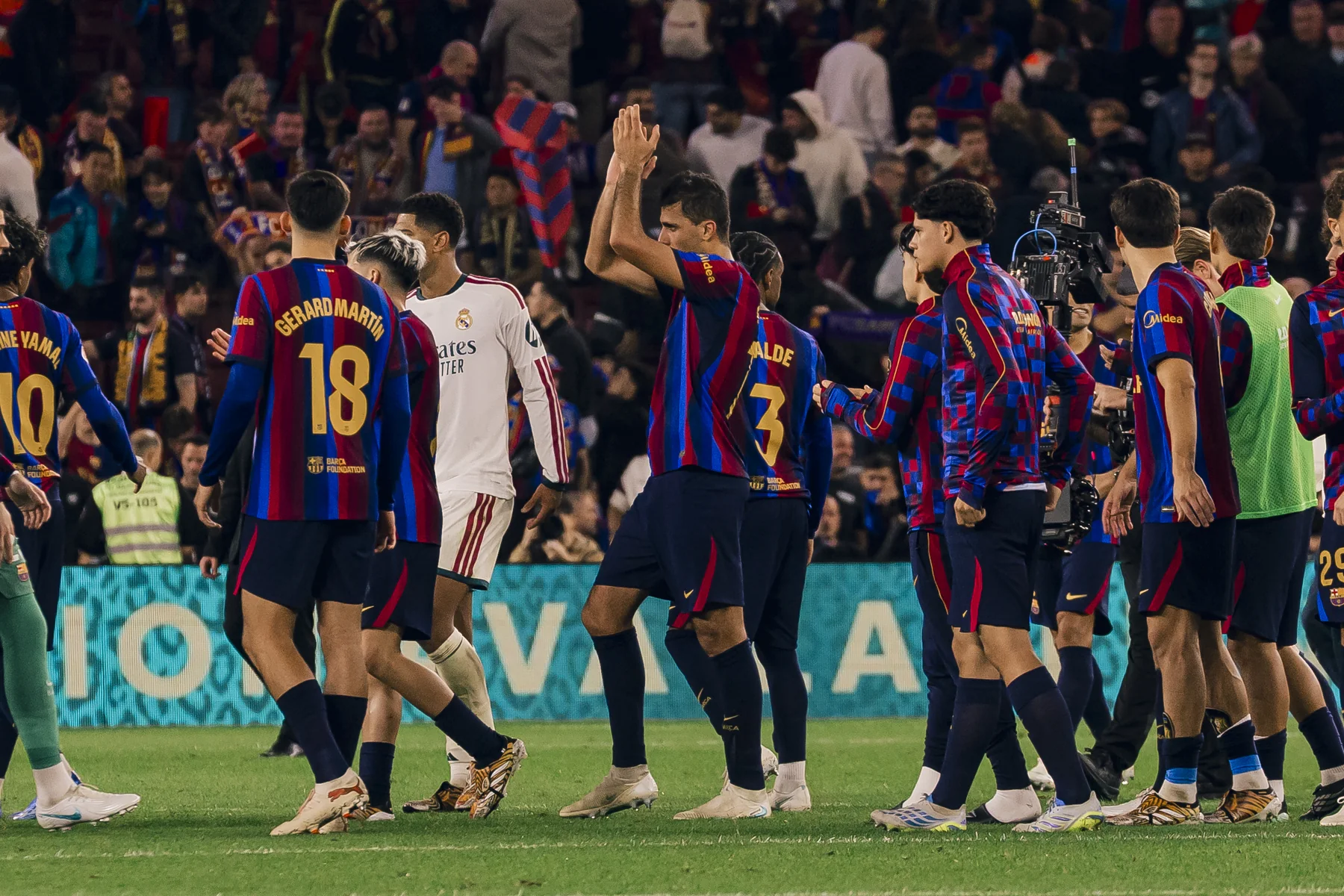
What the referees’ committee said about the two Clásico incidents
The explanation for the two disputed Barcelona–Real Madrid incidents is different: the referees’ committee considered Alejandro Balde’s contact with the ball non-punishable, while João Cancelo should have received a yellow card for his challenge on Yan Diomande. The second conclusion does not, by itself, mean the video assistant referee should have called the referee to the monitor. A missed booking and a reviewable direct-red offence are different questions.
Real Madrid won 2–1 at the Spotify Camp Nou on 25 October 2026. Two days later, the Spanish federation published programme eight of Tiempo de Revisión, listing the Clásico incidents in the 70th and 57th minutes. The programme is a retrospective explanation of selected incidents; it should not be read as a new match result or a new disciplinary decision.
According to BeSoccer’s account of the CTA review, Balde’s arm position was justified by the movement as he contested the ball with Kylian Mbappé. In the other incident, the committee judged Cancelo’s contact with Diomande reckless, rather than an action involving excessive force. Its assessment therefore acknowledged an on-field error: a caution was missing.
That distinction matters because a supporter can reasonably ask whether the referee judged a challenge correctly without treating every failure to show a card as a video-system failure. Equally, explaining the review boundary does not make the missed booking disappear. These are two separate responsibilities, and a useful discussion needs to keep both visible.
This guide follows the published committee account and the current rules as checked on 30 October. It does not claim that agreement with the CTA is compulsory, or that a different decision would certainly have produced a different winner. Use the confirmed La Liga results for what happened on the scoreboard; use the incident and review rules for the narrower question of why an official could, or could not, intervene.
Why the ball hitting Balde’s arm was not automatically a penalty
A replay showing contact answers one question: did the ball touch an arm? It does not settle whether a handball offence occurred. Under IFAB Law 12, deliberate handling and an unjustifiable enlargement of the body are relevant tests. The rule is not a requirement for defenders to keep both arms behind their backs through every physical contest.
Natural movement matters more than a freeze-frame
The committee’s explanation, as reported by Europa Press, describes Balde and Mbappé competing for the ball, with the defender’s arm position arising naturally from that action. Its reasoning was therefore about the movement and the context, rather than a denial that contact occurred.
A still image can be useful for finding the point of contact, but it removes the sequence that explains how a player got there. For a supporter comparing two handball appeals, the more useful question is whether the same movement produced the same kind of arm position. Simply putting two photographs side by side can make unlike incidents appear identical. It can also hide a deliberate additional movement in one incident that did not exist in the other.
A supporting arm is not a universal exemption
IFAB’s simplified handball guidance gives the example of a falling player whose supporting arm is between the body and the ground: contact there is not ordinarily a handball offence. That helps explain a common source of confusion, but it should not be used as a shortcut for every appeal involving a player close to the turf.
Consider two hypothetical blocks. In one, the arm takes the player’s weight during a fall. In the other, the player reaches sideways beyond the body to close an extra passing lane. Calling both arms “supporting” without examining their role skips the important part of the decision. The examples illustrate what a viewer should look for; they are not a claim that either is an exact reconstruction of Balde’s movement.
For this Clásico, the published CTA account rests on natural positioning during the contest. It is more accurate to preserve that explanation than to invent a different justification from an isolated photograph. Our Lo Celso disallowed-goal explainer concerns another incident with its own sequence. A familiar player, a familiar team, or contact with the same body part does not remove the need to examine each action on its own evidence.
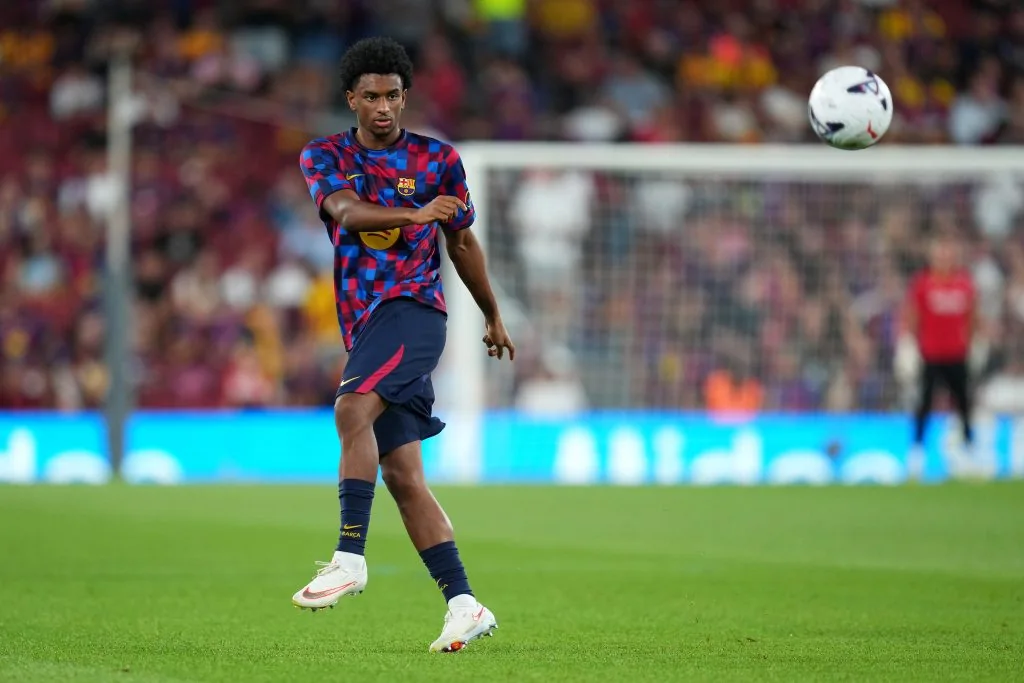
Why Cancelo’s challenge was judged a yellow-card offence
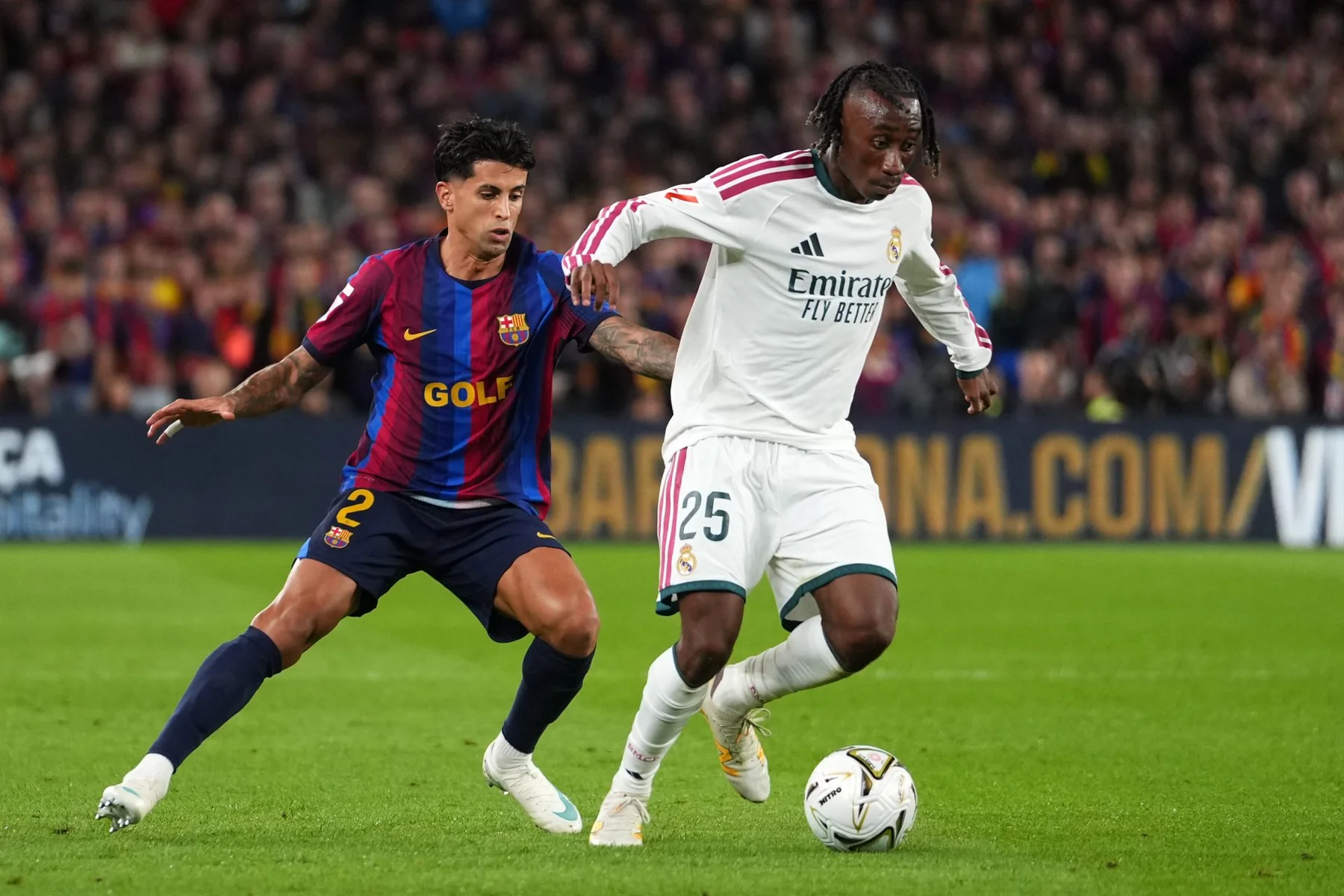
The CTA’s reported conclusion was not that Cancelo made a clean challenge. It was that his contact with Diomande warranted a caution and that the referee should have shown one. That is an important correction to explanations which treat the absence of a red card as proof that nothing punishable happened.
As reported by BeSoccer, the committee described partial contact with Diomande’s leg without excessive force or brutality. Supporters may disagree about the severity they see in the footage, but they should identify that as a disagreement with the assessment of the challenge. It is more precise than saying that the officials believed studs could never justify a dismissal.
Reckless contact and excessive force are different judgements
A reckless challenge belongs in the yellow-card category. A challenge that endangers an opponent’s safety or uses excessive force belongs in the serious-foul-play category and requires dismissal. UEFA’s instructional guide illustrates why the point of contact, speed, direction, force and risk need to be considered together. It is useful background, rather than an alternative ruling on this Spanish league match.
In practical terms, noticing studs is a reason to examine the challenge carefully. It is not the end of that examination. The same applies to noticing contact high on a leg: the next question is what happened through the contact, not merely which part of a boot appears in a photograph. Conversely, a player getting a touch on the ball would not automatically excuse a dangerous follow-through. Winning possession and making a safe challenge are different achievements.
Nor should a discussion depend entirely on whether a player is able to continue. The decision concerns the action and its danger, rather than a medical diagnosis made after the match. A supporter can discuss risk without guessing an injury, and an assessment of a particular challenge should not be borrowed from another match simply because the players occupy similar positions.
That is also why the Arda Güler–Peque red-card case is a comparison to examine, rather than a ready-made answer. For Cancelo, the published committee verdict was a missed yellow. Once that classification is understood, the next question is whether the video protocol permits intervention for precisely that sort of error. The fact that an error matters to a player or supporter does not automatically make it a reviewable category.
Why a missed yellow card does not automatically trigger VAR
The video official is not an extra referee with permission to correct every decision. Spain’s current CTA VAR manual describes a system intended for clear errors and serious missed incidents within defined, consequential categories. A supporter calling a missed booking obvious does not remove the need for it to fit one of those categories.
A check is different from a pitchside review
Potential penalty and red-card situations can be checked without the referee walking to the monitor. The absence of that walk is therefore not evidence, on its own, that nobody looked at the action. A formal review is a further step, rather than the visible part of every background check.
For Cancelo’s challenge, the relevant concern was whether the evidence showed a direct-red offence. The reported conclusion was that it did not. A monitor visit solely to add the missing ordinary caution would turn the process into a general booking review. That is the boundary which makes the apparently awkward combination possible: the on-field official missed a yellow, while a direct-red intervention was not justified under the committee’s assessment.
The 2026/27 second-yellow change has a precise limit
It is now outdated to say that second-yellow incidents can never be reviewed. The 2026/27 IFAB protocol permits correction of a clearly incorrect second caution that has produced a red card. Its own question-and-answer example also says that a potentially deserved second caution which the referee misses cannot be added through that provision.
Those situations point in opposite directions. One concerns undoing an erroneous dismissal; the other concerns creating a dismissal by adding a missed caution. They must not be merged into a claim that every challenge involving an already-booked player is now reviewable. These are hypothetical distinctions, not a claim about Cancelo’s previous disciplinary record in this match.
| Situation | Why the distinction matters |
|---|---|
| Missed ordinary booking | Not a general standalone review category. |
| Potential direct red | Can be examined against the clear-error or serious-missed-incident threshold. |
| Clearly incorrect second caution produces red | The current protocol allows correction. |
| Potential second caution is missed | The new exception does not permit VAR to add it. |
For viewers accustomed to older explanations, this is the most important update to keep in mind. The La Liga rules guide provides the wider season context. Here, the practical lesson is narrower: identify the exact error being alleged before deciding that the current protocol gives the video official power to fix it.
How to judge the next controversial replay without mixing up the rules
The most useful way to follow the next dispute is to write down four separate questions: what happened, how should that action be classified, what was decided on the pitch, and what could video assistance legally change? That order prevents a disappointing outcome from becoming the starting assumption for every part of the argument.
First, establish the sequence. Find the movement before contact and what happened immediately afterwards. Look for a replay which lets you follow the player’s whole action, then use the close view to locate the contact. UEFA’s published review process includes both technical detail and normal-speed context. Fans do not need to imitate a referee’s working procedure exactly to benefit from that distinction.
Second, name the alleged offence precisely. “Handball” needs a reason beyond contact. “Red card” needs a reason beyond the fact that the opponent was hurt or the crowd reacted. For a tackle, ask what makes the challenge reckless or dangerous. For handling, ask what made the arm movement deliberate or its position unjustifiable. If the evidence does not answer the question, keep that uncertainty in the discussion rather than filling it with the scoreline.
Third, establish what the referee actually did. A penalty awarded and a penalty appeal rejected are different starting decisions. A caution which was shown and a caution which was missed are also different, especially under the current second-yellow rule. This is why a short clip beginning with a replay can be misleading even when the footage itself is genuine: the viewer may never see the original decision.
Fourth, ask about the available correction. A claim that the referee could have made a better judgement is not identical to a claim that VAR had to intervene. The first is about the action; the second also needs a reviewable category and the required standard of evidence. Keeping those separate allows a much stronger criticism when an intervention really was available and justified.
Finally, resist rewriting the rest of the match as certainty. A hypothetical penalty is not automatically a converted goal, and a hypothetical dismissal does not tell us exactly how both coaches would respond. Those possibilities can explain why supporters cared so much about an incident. They cannot establish an alternative final score. Bring that distinction to the next game on the La Liga matchday schedule, and the conversation becomes more about football evidence than rival slogans.
What the Clásico review means for supporters
The review leaves supporters with a more specific account of the two incidents, rather than a reason to abandon questions about consistency. The stated handball judgement was that Balde’s position was natural for the action. The stated disciplinary judgement was that Cancelo deserved a booking. Neither conclusion requires a fan to believe that every decision made throughout the match was correct.
A good consistency challenge identifies the comparison and the relevant difference. If two tackles are said to deserve the same punishment, compare the contact, force and danger. If two arm contacts are said to deserve the same decision, compare the movement and position in context. If the complaint is about video intervention, compare the original decisions and the review categories as well. Without that last step, two similar fouls can appear to receive contradictory treatment when the difference actually concerns what the video official is allowed to correct.
There is also a difference between explaining an incident and measuring its influence. A missing caution may affect how a defender approaches later duels; a penalty appeal may change the emotional temperature of a game. Those are reasonable football considerations. They are not evidence that the final result was predetermined, or that a certain alternative score can be recovered from the footage.
Where to follow confirmed decisions and the next match
The federation’s VAR audio archive and its weekly review programme serve different purposes. A published explanation is worth reading for what it actually addresses, while an absence from a selected weekly programme should not be treated as a verdict on every other incident in the game. Look for a separate official announcement before calling something a disciplinary sanction or a suspension.
For the sporting consequences, the league table records the points and the matchday schedule shows the next fixtures. The useful lesson from these two Clásico debates is to follow the same order next time: establish the action, identify the offence, establish the original decision, then ask whether the review rules permit a correction. That gives supporters a concrete basis for agreeing with an explanation or challenging it.
Comments
Sign in with Google to comment. Keep the conversation useful and football-focused. New comments are reviewed before they appear.
Loading comments…