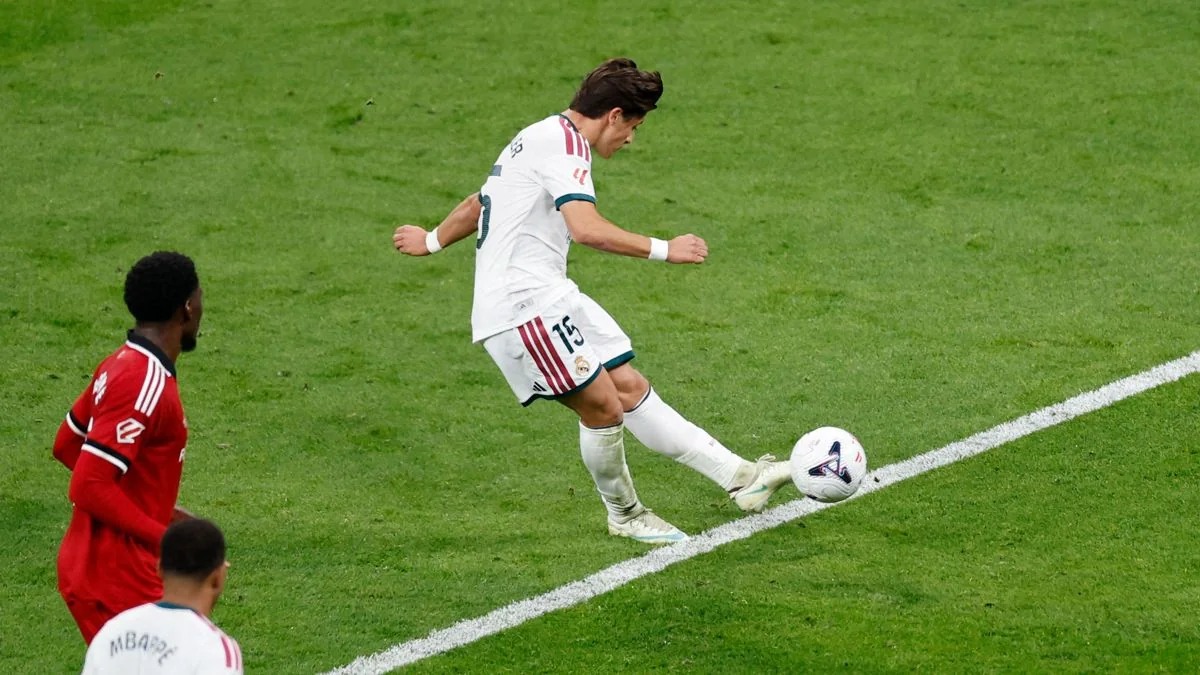
What happened between Arda Guler and Peque against Sevilla?
Arda Guler was not sent off for the disputed incident with Sevilla's Peque during Real Madrid's 4-1 win on 18 October 2026. The available reporting describes a VAR check that did not lead to a recommendation for a pitchside review. The latest explanation, reported on 19 October from CTA sources, concerns the lack of conclusive pictures of violent conduct. It should not be mistaken for proof that a deliberate blow to the face occurred, or proof that there was no contact.
The incident came with the score still 0-0, around the 22nd minute at the Bernabeu. Sevilla players appealed for Guler to be dismissed after Peque went down during their encounter. A confrontation followed. LaLiga's official match timeline records yellow cards for Dean Huijsen and Sevilla's Felix Correia in the 23rd minute, while Guler remained on the field without a card for the disputed action.
The chronology explains why the debate became so intense. Guler then scored the opener in the 30th minute. Kylian Mbappe added two goals, Yan Diomande scored Madrid's fourth and Manu Bueno scored for Sevilla. The completed results record the 4-1 outcome; the disciplinary controversy concerns an earlier moment when neither side had scored.
Those are different kinds of facts. The score, the goals and the recorded cards can be established from the match record. The exact location and nature of the alleged contact require a judgment about the incident itself. A player continuing to play tells us the decision that stood during the match; it does not supply the missing detail in a distant replay.
For a supporter trying to understand why no red card appeared, the central questions are therefore specific: what images were available, what could be established from them, and what the Laws require for the particular action being alleged? Treating every disagreement as evidence that VAR did nothing skips the most useful part of the explanation.
What the CTA explanation added on 19 October
The important development the following morning was an explanation about the evidence available to the video officials. Cadena SER reported information from CTA sources, relayed by journalist Hector Gonzalez, rather than a newly published disciplinary ruling. That attribution matters: it explains the reported basis for non-intervention without turning a radio report into a formal judgment on every disputed detail.
The VAR had the television camera feeds
According to that account, the VAR had access to the cameras used for the television production. COPE's report of Isaac Fouto's explanation similarly describes the available angles being checked without a sufficiently clear close view of the point and intensity of contact.
This answers one common assumption: a VAR room is not guaranteed to possess a perfect, separate close-up of every off-ball incident. Access to several feeds is useful only if one of them shows the relevant action adequately. It also does not mean that the single picture selected by the television director at a particular second is the only feed available to the video officials. The distinction is between the camera material supplied and the particular shots shown to viewers.
Unclear pictures are not a finding that nothing happened
The reported explanation was that the pictures did not clearly establish violent conduct to justify intervention. That is a narrower conclusion than saying an elbow definitely did not connect. It is also narrower than saying the officials saw an obvious head strike and chose to overlook it. Neither stronger claim follows simply from the absence of a monitor recommendation.
For viewers, the unresolved details are precisely the ones that affect the disciplinary test: where an arm made contact, whether the action was deliberate and what force or brutality it involved. Enlarging a distant clip may make the movement easier to locate, but a larger picture does not automatically resolve an obscured point of contact. Confidence in a claim should reflect what the angle actually establishes.
The camera explanation can therefore be discussed critically without inventing missing footage or declaring the incident conclusively settled. Fans may reasonably want better coverage of actions away from the ball. Whether the pictures were adequate, and whether a particular action deserved a red card, remain separate questions. The latest reporting mainly addresses the first.
Why a VAR check did not mean a pitchside review
The IFAB VAR protocol separates checking an incident from asking the referee to reconsider it. A potential direct-red-card incident is within the automatic checking process. A check can finish without a recommendation to use the pitchside monitor. That is why the absence of a walk to the screen does not establish that the video officials ignored Guler and Peque.
| Stage | What it means |
|---|---|
| Check | The VAR examines the relevant footage for a possible reviewable error or missed incident. |
| Recommendation | The VAR advises the referee when the checking process indicates grounds for a review. |
| Final decision | The referee decides, using the appropriate review procedure. |
The protocol permits checks to finish without a visible review. For subjective assessments, an on-field review is appropriate when the incident reaches that stage. But the existence of a dispute between players is not itself the evidence needed to recommend one. Sending the referee to a monitor is a means of reviewing a qualifying decision, rather than a compulsory response to every appeal.
In this case, the reported explanation concerns the step between checking and recommending. The concern was whether the available pictures established a sufficiently clear basis to revisit a possible sending-off. Describing that as a check without a monitor recommendation is more informative than saying simply that there was no review.
A possible red card is different from reviewing a yellow
An alleged act of violent conduct raises a potential direct-red-card question. That gives the incident a possible VAR route; it does not mean the system can intervene solely to award a missed ordinary first yellow card. The broader 2026/27 rules guide helps place that distinction in the season's framework.
The current protocol also allows correction of a clearly incorrect second caution that has produced a red card. That specific change does not create general video review of every missed caution. Conversely, a properly initiated review for a possible red card can end with a yellow if that is what the referee concludes the evidence supports. The reason for starting a review and the eventual disciplinary outcome are related, but they are not the same question.
When an arm strike becomes violent conduct
The relevant starting point is Law 12, rather than a rule that every movement of an elbow has the same consequence. The law distinguishes the type of action, whether it involves a challenge for the ball, the part of the opponent affected and the force used. Those distinctions explain why an unclear point of contact can matter so much.
The specific rule for a deliberate head or face strike
When a player is not challenging for the ball and deliberately strikes another person on the head or face with the hand or arm, Law 12 classifies it as violent conduct unless the force is negligible. The important conditions are deliberate striking, the head or face, the hand or arm, and the absence of a challenge for the ball. A claim about this incident must establish the relevant conditions rather than merely repeat the word elbow.
For that particular provision, excessive force is not required. But force is not irrelevant: the negligible-force exception is part of the rule. Nor does every accidental brush of an arm against a face automatically establish a deliberate strike. Removing those qualifications would turn a specific disciplinary test into a much broader rule than the one IFAB actually sets out.
Former referee Iturralde Gonzalez's analysis on Cadena SER highlighted the distinction while acknowledging that he could not identify the point or intensity of contact from the pictures. His conditional explanation helps describe the question; it does not independently establish that Guler struck Peque's face.
Violent conduct and serious foul play are different categories
Serious foul play concerns a dangerous tackle or challenge, including one that endangers an opponent's safety. Violent conduct also covers excessive force or brutality away from a challenge for the ball, including an attempt even without contact. These are distinct routes to a sending-off, rather than interchangeable descriptions of any unpleasant incident.
A blow to the body is therefore not automatically only a yellow card. Excessive force or brutality can still make it violent conduct. Likewise, an ordinary pushing offence and a reckless one need not receive identical disciplinary treatment. Location alone cannot answer every question about a chest contact; the nature and force of the action still matter.
Finally, the ball being in play is different from the two players challenging for it. An incident can occur during an attack while the ball is elsewhere. For this debate, explaining the applicable categories is possible without pretending that the disputed footage conclusively proves which factual description fits. The rule supplies the test; the evidence must establish the action to which it is applied.
What Sevilla's complaints can and cannot establish
Sevilla's objections were substantial, rather than a minor disagreement after the score was settled. AS's reporting of the players' reactions records Juan Iglesias's view that the incident looked like aggression and Kike Salas's frustration that Guler had not been sent off. Their concern was understandable in sporting terms: the alleged offence occurred before Madrid took the lead.
Salas also expressed trust in Peque's account. That is relevant to understanding the teammate's complaint, but it is different from an independent camera angle establishing every detail. A player's belief, another player's description and a clear replay are different sources of information. Repeating the same account through several headlines does not create additional visual evidence.
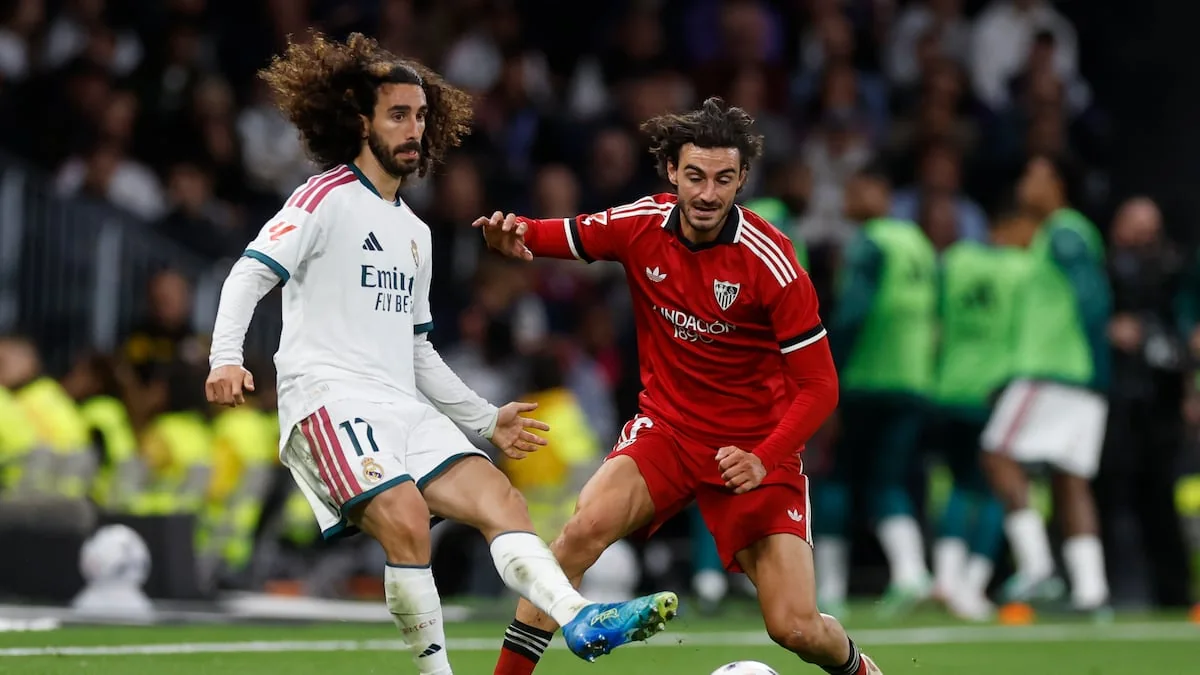
It would also be wrong to dismiss a complaint merely because it comes from the losing side. Players can identify an incident worth examining even when they disagree with the eventual judgment. The useful response is to assess the specific allegation against the evidence and the law, rather than decide its credibility solely from the shirt the speaker wears.
Peque going to ground is part of the sequence, but it cannot alone identify the point of contact, establish the degree of force or prove simulation. Equally, the fact that Guler stayed on does not establish that Peque invented his complaint. Neither player's intent should be supplied by guesswork to fill a gap in the pictures.
There is room to question whether the explanation offered to supporters was clear enough, especially when the visible outcome was simply that play continued. Claims that footage was deliberately hidden or that officials acted to protect a particular result require evidence of their own. Strong dissatisfaction with a decision does not, by itself, establish either claim.
What the incident means for the goal and El Clasico discussion
The timing creates an obvious football argument for Sevilla: the player whose dismissal they wanted subsequently scored the first goal. Had Madrid been reduced to ten while the score was 0-0, both teams would have faced a different contest. Space, pressing responsibilities and attacking choices can all change when a side loses a player. That explains the importance of the complaint without establishing what the alternative score would have been.
It is impossible to remove Guler from the match and assume everything else would then have happened in exactly the same way. Madrid might have changed shape or personnel; Sevilla might have altered their approach. Saying a red card could have materially changed the game is reasonable analysis. Saying it proves Sevilla would have won goes beyond what can be known.
The reverse argument is equally weak. Madrid's quality in scoring four does not settle the earlier disciplinary question. A good goal remains a good piece of football to analyse, while the decision about whether its scorer should still have been on the pitch requires its own evidence. Neither the final margin nor the quality of the finish can substitute for that assessment.
A hypothetical red card is not a confirmed future suspension
Madrid's next scheduled La Liga match is the visit to Barcelona on 25 October 2026. That proximity helps explain why the controversy immediately became part of the El Clasico conversation. Our next El Clasico guide covers the fixture details; the schedule provides the wider sequence of matches.
As of 19 October, Guler was not sent off for this incident. It is therefore inaccurate to describe a suspension supposedly resulting from that unissued red card as already confirmed. A claim about a later disciplinary action would need a real decision and its actual terms. An argument that he should have been dismissed cannot establish the length or effect of a punishment that has not been imposed.
This does not guarantee a starting place against Barcelona or predict every possible change before kickoff. It answers the narrower question raised by this match: the on-field outcome left Guler without a red card for the Peque incident. For fans following the debate, the defensible distinction is between that recorded outcome, the reported reason for no monitor recommendation, and the still-contested interpretation of the action itself.
Comments
Sign in with Google to comment. Keep the conversation useful and football-focused. New comments are reviewed before they appear.
Loading comments…