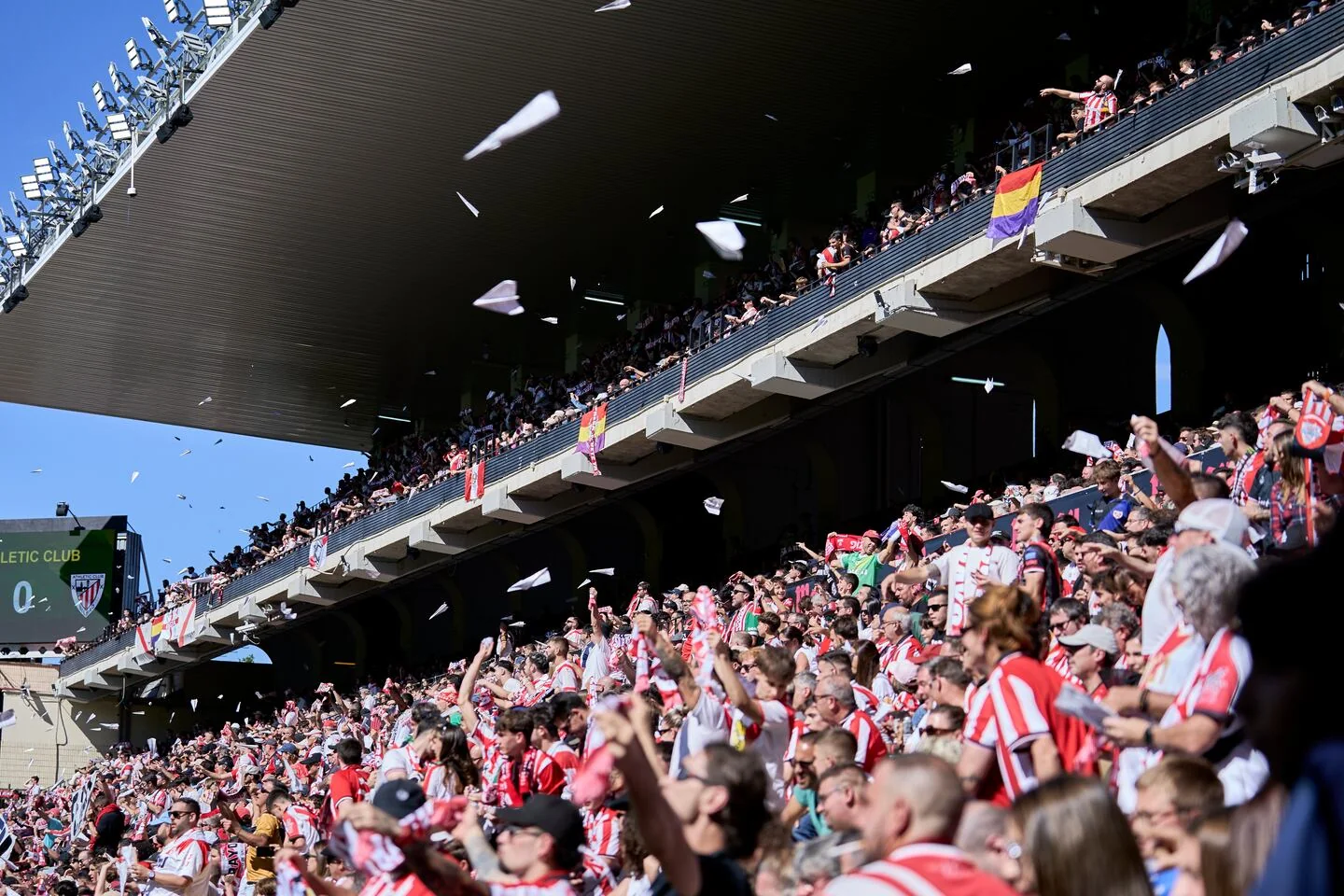
What Rayo supporters wanted the paper planes to say
Rayo Vallecano supporters threw paper planes during the Athletic Club match on 10 October 2026 to demand the departure of president Raúl Martín Presa. Their message concerned the running of the club and its relationship with supporters, with the condition and recent closure of Vallecas central to the dispute. The return to their home stadium was an opportunity to make that demand visible, rather than a reason for the organisers to stop protesting.
That distinction explains an otherwise confusing image: supporters disrupting the very homecoming they had wanted. Being allowed back into a ground answers whether a match can take place there. It does not, by itself, restore confidence in the people running the football club. The protesters were using the first occasion to challenge the second.
The leaflet and the planned thirteenth-minute protest
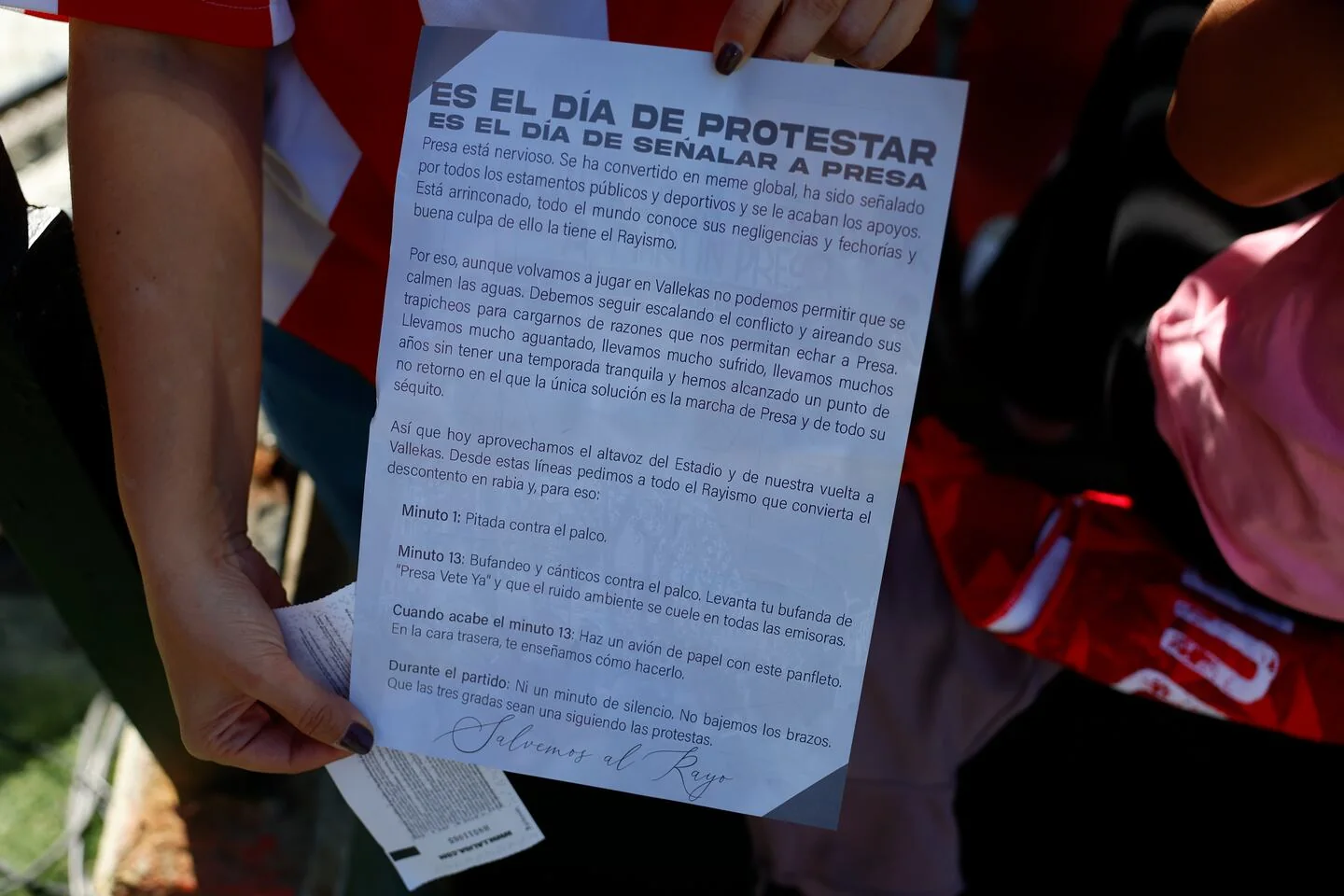
The leaflet reproduced by Mundo Deportivo explicitly rejected a truce simply because football had returned to Vallecas. It demanded a change at the top and gave supporters a shared sequence: whistle towards the directors' box in the first minute, raise scarves and chant in the thirteenth, then fold the sheet into a plane using the instructions on its reverse. It also called for continued noise throughout the match.
The documented explanation for the timing is therefore a coordinated instruction. The paper served two purposes: supporters could read the argument before kick-off and turn the same object into a visible part of the demonstration.
Europa Press reported that the first interruption came in the thirteenth minute, with the score 0–0 and Athletic preparing a corner. Small plastic balls accompanied the planes. The repeated disruption eventually prevented the match from continuing that afternoon.
The effectiveness of the image should be distinguished from agreement with the method. A simple sheet allowed many spectators to participate in a recognisable action, but it also entered the playing area. Understanding what protesters wanted does not require treating every spectator as an organiser, accepting every accusation printed on the sheet, or dismissing the interruption faced by players and other supporters.
Why returning to Vallecas did not settle the stadium dispute
The stadium argument had consequences beyond an unattractive concourse or an inconvenient seat. Rayo began the season playing home matches at Butarque in Leganés because their own ground could not be used. For supporters, that separated the fixture from its normal streets, meeting places and journey. For the team, a nominal home game took place in another club's surroundings.
The closure and the conditions for reopening
On 28 July, the regional government suspended the stadium concession as an interim measure following an audit. The concerns reported at the time included fire protection, electrical installations, emergency lighting and sanitary conditions. Those are specific safety issues, rather than simply a judgement that an old stadium looks worn.
The contemporaneous Europa Press account says the suspension was lifted on Monday 14 September after a second, favourable audit. Its article was updated the following day. Crucially, permission to use the stadium and the procedure concerning the concession were separate: the regional administration said the latter would continue despite the improvements.
Management disputed the handling of the affair. In its 2 September statement, Rayo said a technical visit supported its position that safety conditions were met, published supporting documents and called for an immediate return. That was the club's case; it should not be confused with the later administrative decision lifting the restriction.
A public stadium and the club's maintenance responsibilities
Vallecas belongs to the Comunidad de Madrid, the regional government. Owning Rayo does not mean owning this ground. The government's 2019 concession announcement assigned the club obligations for upkeep, cleaning and utilities, a maintenance plan and technical audits. It also provided for regional oversight and a technical commission that included supporters' representatives without voting rights.
This framework matters because public ownership does not remove the operator's duties. Equally, those general conditions do not establish who must pay every disputed item of work. Rayo's September statement argued that some obligations and missing documentation belonged to the administration. Specific responsibility needs evidence about the work and agreement involved, rather than a slogan from either side.
The homecoming therefore resolved an immediate sporting problem while leaving a deeper relationship unsettled. Fans could welcome football back and still demand reliable maintenance, clearer accountability and a voice in decisions affecting their ground. Treating those demands as identical to reopening would miss why the protest continued.
How Martin Presa became the focus of a long-running conflict
Martín Presa took control of Rayo in May 2011, buying the club from the Ruiz-Mateos family during a financial crisis. The report published at the time described an institution in pre-insolvency proceedings and reproduced the new owner's appeal for support from players, staff and fans. By October 2026, he had been in charge for roughly fifteen years.
That timescale changes how the demonstration should be read. The president was not a new appointee being judged after one unsuccessful afternoon. Nor was the protest sparked by Rayo falling behind against Athletic: its principal actions were scheduled before kick-off. The target was the authority responsible for decisions over a much longer period.
Ownership is different from winning supporters' trust
An earlier example helps explain the depth of the disagreement. Óscar Trejo relinquished the captaincy in autumn 2023. In his 2024 interview with Relevo, he described frustration at problems affecting people working across the club and the strain of repeatedly trying to help resolve them. He stressed the importance of staff outside the first-team spotlight, including the offices, foundation and youth structure. Giving up the armband was different from giving up playing for Rayo.
Trejo's account is his testimony about that experience, not a ruling on every later accusation. Its value here is to show that arguments about respect, administration and the people behind the team existed well before the paper planes. The visible first eleven depend on a much larger institution that supporters also recognise as their club.
A league position can describe competitive performance. It cannot measure whether supporters feel heard, whether an employee believes a complaint receives attention, or whether the next home match can reliably be played in the neighbourhood. Those are different standards of stewardship, and a fan can care about all of them at once.
Conversely, discontent does not transfer ownership or establish an automatic right to choose a replacement. The protest's demand and the mechanism that could achieve it are separate questions. That gap between formal control and social acceptance explains why a club can continue operating while the relationship between its president and sections of its support remains deeply damaged.
What the supporters' groups and players actually said
The grievances did not begin with a viral photograph. On its own website, Plataforma ADRV's July 2022 statement criticised the condition of the stadium and what it saw as neglect of the youth setup, foundation and women's team. This is evidence of what the group was saying four years earlier, rather than independent proof of each accusation.
After the Athletic interruption, a statement reported by AS blamed accumulated frustration over management, facilities, identity and treatment of workers and supporters. The protesters described their action as peaceful and legitimate. Those descriptions express their position; they do not replace the referee's separate responsibility for whether a football match can continue.
Several voices, rather than one unanimous fan position
Bukaneros, Plataforma ADRV and the Federación de Peñas all appear in the dispute, but their names should not be used as interchangeable descriptions of every Rayo spectator. In their 12 October response, the latter two organisations challenged the club's portrayal of the movement and argued that participation extended across the stands. Their claim to broad support is itself a statement by organisers, rather than a ballot of the crowd.
Óscar Valentín offered a different kind of intervention. In the message reported after the match, the captain called for supporters' frustration to be heard and understood, and for an approach bringing all parties together. Recognising discontent is different from endorsing every object thrown or announcing a collective dressing-room demand for a sale.
These distinctions matter for anyone trying to understand the club beyond a dramatic clip. A supporter might share the demand for better facilities while opposing an interruption. A player might sympathise with the crowd while wanting to finish the match. Neither position is logically inconsistent.
The practical challenge is therefore representation: who can speak for which people, and through what forum can their concerns produce a response? Treating one chant as the complete opinion of the entire club makes that task harder. The strongest account preserves the different voices while explaining the grievances they share.
How Rayo's management answered the protest
Rayo's official response condemned the disruption and portrayed it as a planned operation by an organised group intended to stop the match. It argued that players, officials and supporters who came to watch football had been deprived of their rights. That is management's characterisation of the protest, not a neutral description accepted by all the parties.
The club said it had warned the authorities, increased private security and repeatedly used announcements to ask for the throwing to stop. It described the work of volunteers and ball children clearing the pitch and said it would seek video footage to identify people responsible for throwing objects, with a view to applying its internal disciplinary rules.
Management also defended its wider record, pointing to financial recovery and sporting achievement under the current leadership. A club statement can establish that management makes this argument. It does not, on its own, provide an independently audited assessment of its finances or settle the supporters' complaints about everyday administration.
The disagreement consequently concerns what each side means by the good of Rayo. Management emphasises keeping the institution functioning, protecting the fixture and its record in professional football. Its critics argue that the institution also includes the way staff and supporters are treated and the conditions in which the wider club operates. Reporting only one of those standards would leave the other side's reasoning unexplained.
The regional government's response should also be read on its own terms. Europa Press reported that minister Mariano de Paco condemned the disruption and called for unity and respect. Condemning the interruption did not amount to endorsing every allegation in the club's statement, just as disagreeing with the president did not make every method of protest acceptable.
For supporters trying to judge the response, the useful questions are concrete: which complaints receive a specific answer, which assertions have supporting evidence, and what action can improve the next matchday? A forceful denunciation can explain why management opposes an interruption. It cannot substitute for answering a maintenance issue, and a compelling grievance cannot substitute for considering the effect of objects entering the pitch.
What the suspension changed and what it left unresolved
The protest made the conflict impossible to ignore during a televised league match. Its immediate result was an unfinished fixture, not a change of ownership. The decisions that followed concerned crowd disorder and completing the competition; neither decision was a mechanism for choosing Rayo's president.
The RFEF's 16 October resolution records an earlier, separate disciplinary decision on 14 October imposing a one-match partial stadium closure, a fine and a warning of possible total closure. The 16 October decision then ordered the Athletic match to continue without spectators, explaining that this was a competition measure intended to prevent another interruption, rather than a further disciplinary punishment.
A safety decision does not decide the ownership argument
The referee's report reproduced in that resolution is essential context. It records that none of the objects struck anyone. It also records repeated throwing, including plastic bottles in the final incident, and the National Police security coordinator's assessment that the conditions necessary to continue could not be guaranteed.
Both parts of the record matter. Omitting the absence of impacts would exaggerate what the document says happened. Treating that absence as proof that play had to continue would misunderstand a preventive safety decision. Officials do not need to wait for an injury before deciding that a repeatedly interrupted playing area cannot safely host the rest of a match.
The disagreement over the protest also survived the sanction. AS reported the supporters' response on 14 October: Plataforma ADRV expressed solidarity with the affected end and said protests would continue. Punishing an incident and persuading people that their underlying concerns have been addressed are different tasks.
For future match planning, consult the current fixture listings and the specific club notices rather than assuming a normal home game means the dispute has ended. A ground can be authorised, a competition order issued and confidence still absent. Progress on the wider argument would require visible answers about upkeep, administration and how supporters are heard, alongside conditions allowing the football to take place.
The paper plane captured that unresolved relationship unusually well: a familiar, inexpensive object carried a demand for change into the centre of a professional match. Its message explains the protest. The effect on the fixture explains why understanding that message and judging the action remain separate responsibilities.
Comments
Sign in with Google to comment. Keep the conversation useful and football-focused. New comments are reviewed before they appear.
Loading comments…