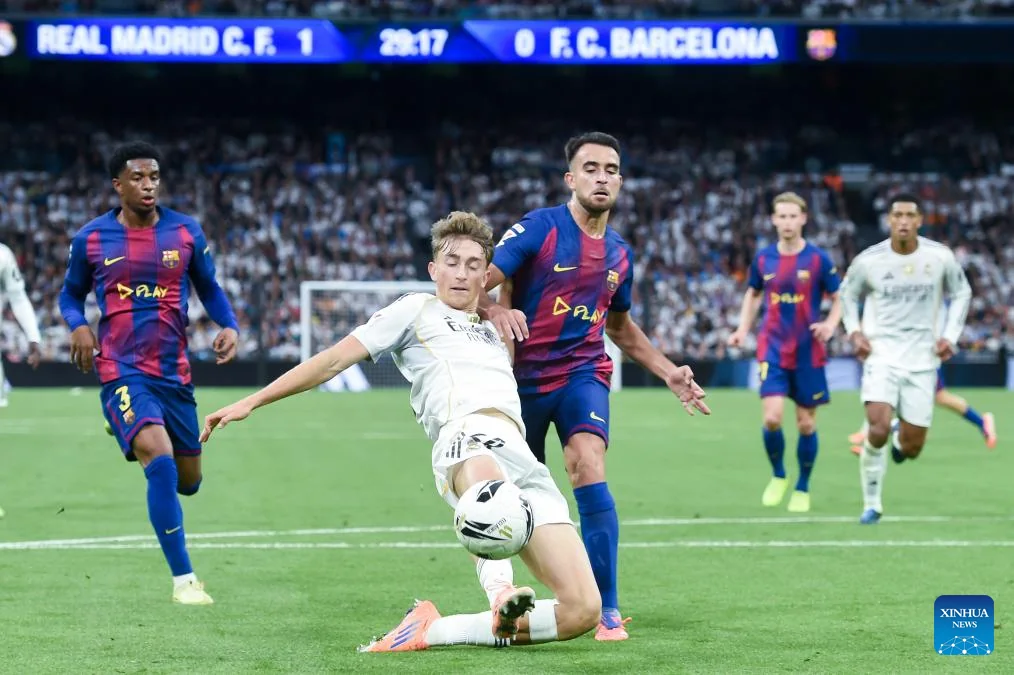
The current all-time score is Real Madrid 36 La Liga titles, Barcelona 29, using the completed 2025/26 season as the cutoff. Madrid lead by seven, while Barcelona lead the modern 2000/01–2025/26 window 13–9. This guide explains both truths, the Messi-era count and the dynasties behind the gap.
Real Madrid
36
Barcelona
29
All-time gap
7
The short answer: Real Madrid lead Barcelona 36–29
The clean answer, using the completed 2025/26 season as the cutoff, is Real Madrid 36 La Liga titles, Barcelona 29. Madrid therefore lead the all-time Spanish league championship count by seven. This comparison is narrower than the familiar argument about which club has “more trophies.” It counts only championships of Spain's top division—called the Primera División historically and marketed as La Liga today. Copa del Rey, Spanish Super Cup, Champions League and other honours do not enter the number.
The cutoff matters. Real Madrid reached 36 by winning the 2023/24 league, a title LALIGA said was clinched with four matches remaining. Barcelona moved from 28 to 29 by winning the 2025/26 championship. The RFEF recorded that the decisive moment came on 10 May 2026, when Barcelona beat Madrid 2–0 and became mathematically unreachable with three rounds left. A page still showing Barcelona on 27 or 28 is using an older endpoint; a page giving Madrid more than 36 is almost certainly mixing competitions.
Seven championships represent a substantial historical cushion, but not a verdict on every period of the rivalry. League titles measure repeatable excellence across an entire campaign: points taken against all kinds of opponents, injury management, away-game control and the ability to avoid costly slips. They do not tell us who won more individual Clásicos, played the most attractive football or collected the most European Cups. Fans should read the total as one very important measure of domestic consistency.
Every La Liga title by club and era
A raw total hides the shape of the rivalry. Barcelona were the first champions in 1928/29, while Real Madrid won their first championship in 1931/32 and retained it in 1932/33. The decisive historical separation came later. Madrid accumulated title after title in the middle decades of the twentieth century; Barcelona's most productive long run arrived from the 1990s onward.
The table groups completed seasons into readable blocks. A season belongs to the band in which it is listed, so 2019/20 sits in the 2010/11–2019/20 row. That convention prevents fuzzy decade wording from creating off-by-one disagreements.
| Completed-season band | Real Madrid | Barcelona | Balance |
|---|---|---|---|
| 1928/29–1949/50 | 2 | 4 | Barcelona +2 |
| 1950/51–1969/70 | 12 | 4 | Real Madrid +8 |
| 1970/71–1989/90 | 11 | 2 | Real Madrid +9 |
| 1990/91–1999/2000 | 2 | 6 | Barcelona +4 |
| 2000/01–2009/10 | 4 | 4 | Level |
| 2010/11–2019/20 | 3 | 6 | Barcelona +3 |
| 2020/21–2025/26 | 2 | 3 | Barcelona +1 |
| All time | 36 | 29 | Real Madrid +7 |
Two patterns stand out. First, Madrid's 23 championships across the 1950/51–1989/90 span created a platform that Barcelona have spent the modern era chasing. Second, Barcelona have outscored Madrid 15 titles to nine from 1990/91 through 2025/26. The gap has consequently narrowed without disappearing. This is why an older supporter and a younger supporter can remember very different domestic power balances and both be describing the same rivalry honestly.
Neither club's durability should be taken for granted. Madrid and Barcelona are also part of the tiny group that have remained continuously in Spain's top flight. Our guide to the La Liga clubs that have never been relegated gives that longer survival story. Staying up is not equivalent to contending, but uninterrupted participation creates more chances to build dynasties.
Who has won more La Liga titles since 2000?
Barcelona have won more championships in the modern period. From 2000/01 through 2025/26, Barcelona collected 13 titles and Real Madrid nine. The other four championships in those 26 completed seasons went to Valencia (2001/02 and 2003/04) and Atlético Madrid (2013/14 and 2020/21). The RFEF now describes Barcelona as the most successful First Division club of the twenty-first century on this measure.
That result does not conflict with Madrid's 36–29 all-time lead. It simply changes the window. Madrid entered 2000/01 with a much larger historical advantage; Barcelona have won the modern slice by four but still trail overall by seven. It is like a side winning the second half without overturning the full-time score. Both statements—Madrid lead all time, Barcelona lead since 2000—are simultaneously true.
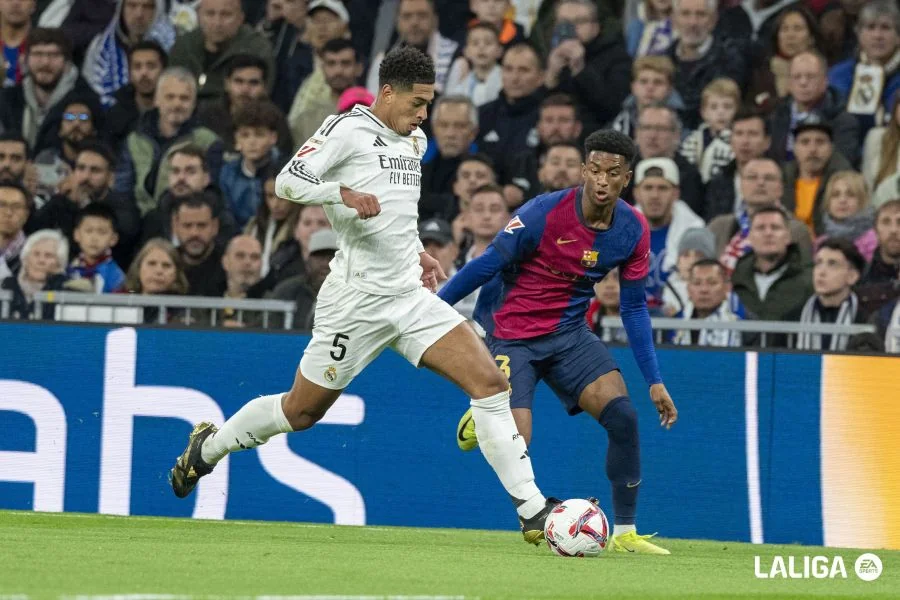
Madrid won in 2000/01, 2002/03, 2006/07, 2007/08, 2011/12, 2016/17, 2019/20, 2021/22 and 2023/24. Barcelona won in 2004/05, 2005/06, 2008/09, 2009/10, 2010/11, 2012/13, 2014/15, 2015/16, 2017/18, 2018/19, 2022/23, 2024/25 and 2025/26. Barcelona's advantage came through clusters: back-to-back titles under several coaching cycles, plus six championships in the 2010/11–2019/20 band.
“Since 2000” needs a convention because football seasons cross calendar years. This article starts with the first full season beginning in 2000 and ends with the latest completed campaign. Starting at 1999/2000 would add Deportivo La Coruña, not Madrid or Barcelona, so the head-to-head conclusion remains unchanged. For current form, use the La Liga results page rather than projecting history onto the next race.
How many La Liga titles did Barcelona win with Messi?
Barcelona won 10 La Liga titles with Lionel Messi in the first-team squad. The championship seasons were 2004/05, 2005/06, 2008/09, 2009/10, 2010/11, 2012/13, 2014/15, 2015/16, 2017/18 and 2018/19. Barcelona's official honours record gives that exact list. When the club sealed the tenth in 2018/19, Messi moved ahead of Andrés Iniesta's nine league winner's medals.
“With Messi” is best treated as a player-honours question. Messi made his senior competitive debut in October 2004 and left in 2021, but not every season in that span ended with a league title. The first championship on his list came in his debut campaign, when his role was much smaller than during the Guardiola and later title teams. Counting medals attached to winning seasons produces a clear, non-subjective answer.
Those ten championships amount to more than one third of Barcelona's all-time 29. They also account for ten of the club's 13 titles in the broader modern window. That does not mean Messi delivered them alone. League success required different coaches, defensive structures and supporting cores: Ronaldinho and Samuel Eto'o early; Xavi, Andrés Iniesta and Sergio Busquets around the peak possession sides; then later groups that adapted as veterans departed. Messi was the constant elite attacker across several versions of Barcelona.
A knockout star can decide two or three nights, but a decade-long league run demands repeated production against low blocks, pressing teams, hostile away grounds and title rivals. Messi's scoring, creation and availability helped Barcelona turn tactical evolution into points year after year. Our Messi vs Ronaldo La Liga statistics comparison goes deeper into individual numbers. Barcelona have since added championships in 2022/23, 2024/25 and 2025/26, so the club's league history neither began nor ended with him.
The dynasties that built Real Madrid's seven-title lead
Real Madrid's advantage was built through two domestic sequences that Barcelona have never quite matched in length. The first began in 1960/61. Madrid won five consecutive championships through 1964/65, the club's first five-in-a-row, then added three more from 1966/67 through 1968/69. Atlético Madrid's 1965/66 win was the only interruption in a stretch of eight Madrid titles in nine seasons. That is the single most important block behind today's historical lead.
The second great run belonged to the Quinta del Buitre generation. Madrid had gone six seasons without the title before winning in 1985/86, then took every championship through 1989/90. LALIGA identifies Emilio Butragueño, Míchel and Manuel Sanchís among the homegrown core. This streak also helped establish Cibeles as the club's modern celebration setting: repeated winning turns a spontaneous gathering into ritual.
Barcelona's answer changed the direction of the chase. Johan Cruyff's Dream Team won four consecutive leagues from 1990/91 through 1993/94. More important than one famous score, that cycle supplied a durable football identity: positional occupation, technical midfield control and the expectation that Barcelona could dictate a season rather than merely upset Madrid. It did not erase the old deficit, but it opened the club's most productive long era.
The later Barcelona teams compressed success across different coaches. By 2018/19, Barcelona had won eight of 11 championships. Pep Guardiola's side provided the tactical reference, but the run survived managerial changes because key players understood how to control league matches. Madrid responded with individual champions—most spectacularly the 100-point 2011/12 side—without the same density of domestic titles during that period.
For supporters, dynasties reveal why squad construction matters beyond the strongest starting XI. A champion must refresh full-backs, midfield legs and scoring support before decline becomes obvious. Academy continuity can preserve principles; recruitment can cover a missing profile; coaching clarity can prevent points leaking in ordinary fixtures after emotional European nights. Explore current competitors in our La Liga teams index, but judge a possible dynasty only after it survives change. One brilliant season is a champion; several connected champions become an era.
What the title count means—and what it does not
League championships reward breadth. In a normal 20-club season, every side plays 38 matches, home and away against 19 opponents. The champion must solve far more than Barcelona versus Madrid. It must protect a one-goal lead in Getafe, create chances against a deep block, recover after European travel and keep taking points when its best football is unavailable. That is why the count is such a strong record of domestic repeatability.
Different champions can reach that outcome differently. LALIGA's review of Madrid's 2019/20 crown highlighted 87 points and a defence that conceded 23 goals. Atlético's 2013/14 winner earned 90 points and secured the championship with a final-day draw at Barcelona. Barcelona's 2024/25 victory came by four points, with both league Clásicos won. Defensive control, attacking volume and direct six-point swings can all matter.
Each Clásico offers three points, but also denies three to the closest historical rival and can change confidence across the run-in. Winning both meetings can create a six-point head-to-head swing. Yet repeated drops against mid-table or relegation-threatened opponents can surrender it. A fan following the live race should therefore check today's scheduled matches, not circle only the Clásico dates.
What does 36–29 not prove? It does not settle the all-trophies debate because the clubs have different totals in the Copa del Rey, Champions League and other competitions. It does not identify the best single team. It does not measure aesthetics, global support or academy quality. And it does not guarantee the next result. Honours are accumulated evidence, not a predictive model.
There is also a useful distinction between a championship total and a championship rate. Madrid and Barcelona have both participated throughout the competition's history, so their all-time totals are comparable in a way that would be unfair to a club with fewer top-flight seasons. Even then, formats have changed: early leagues had fewer clubs and fewer matchdays, while the modern campaign demands 38 games. A 1930s champion and a 2020s champion faced different calendars, sports science and tactical environments. Each title remains one official championship, but comparing the quality of the teams requires more evidence than counting medals.
Runners-up finishes deserve context as well. Finishing second with a huge points total can indicate an outstanding team that happened to share an era with another great side; it still adds zero to the honours column. Barcelona's 90 points behind Madrid in 1996/97, Madrid's 96 behind Barcelona in 2009/10 and the one-point 2015/16 finish all show how thin the line can be. Trophy counts are intentionally unforgiving: they record who completed the season first, not how close the pursuit felt.
Barcelona vs Real Madrid La Liga titles FAQ
Who has more La Liga titles?
Real Madrid. After 2025/26, Madrid have 36 Spanish top-flight championships and Barcelona 29, a margin of seven.
How many La Liga titles have Barcelona won?
Barcelona have won 29. Their first came in 1928/29; their 29th was secured after a 2–0 win over Madrid on 10 May 2026.
How many La Liga titles have Real Madrid won?
Real Madrid have a record 36. Their first arrived in 1931/32, and their latest remains the 2023/24 championship.
Did Barcelona win more leagues with Messi than Madrid in the same period?
Messi collected ten Barcelona league winner's medals from 2004/05 to 2018/19. A strict club comparison needs defined endpoints, so the safest answer to the player question is ten.
Does winning El Clásico count as a title?
No. A league Clásico is one fixture worth three points. It can be decisive—Barcelona clinched the 2025/26 crown in one—but it carries no separate league championship.
Is the all-trophies comparison also 36–29?
No. LALIGA's current comparison lists Barcelona with 32 Copa del Rey wins to Madrid's 20, while Madrid lead European Cup/Champions League wins 15–5. This page deliberately isolates league championships.
Can Barcelona catch Real Madrid soon?
The gap is seven, so Barcelona need seven more titles than Madrid merely to draw level. Predicting a date would require guessing many seasons. Follow the live table and top scorers race for present evidence instead.
Comments
Sign in with Google to comment. Keep the conversation useful and football-focused. New comments are reviewed before they appear.
Loading comments…