Which Spanish teams played in Europe in 2025/26?
Eight Spanish clubs played in the men's UEFA competitions in 2025/26: Barcelona, Real Madrid, Atlético Madrid, Athletic Club and Villarreal in the Champions League; Real Betis and Celta in the Europa League; and Rayo Vallecano in the Conference League. This is a review of those completed European campaigns, checked on November 12, 2026.
| Competition | Spanish clubs |
|---|---|
| Champions League | Barcelona, Real Madrid, Atlético Madrid, Athletic Club, Villarreal |
| Europa League | Real Betis, Celta |
| Conference League | Rayo Vallecano |
The season label is essential. These clubs earned their entry before the European campaign began in 2025 and continued playing into 2026. The final La Liga table in May 2026 allocated places for 2026/27. It did not retrospectively replace Athletic with Betis in the 2025/26 Champions League or put another club into Rayo's Conference League campaign.
UEFA's historical records also need to be read by competition. A quarter-final in the Champions League and a quarter-final in the Europa League share a round name, but belong to different tournaments and opponent pools. Likewise, “played in Europe” can describe a long knockout run or a campaign that ended at the league phase. The roster answers who represented Spain; the individual journeys explain what they achieved.
This account follows the senior men's teams. It does not combine their matches with the UEFA Youth League or Women's Champions League, even where the same club name appears. Mixing those records can produce a convincing-looking score list that is attached to the wrong competition.
For the domestic side of the same year, our La Liga 2025/26 season review covers the final table and awards. Here, the focus stays on European opponents, decisive ties and the difference between winning a match and progressing over two legs.
Champions League: Atlético outlasted Barcelona and Real Madrid
Atlético Madrid went furthest of Spain's five Champions League entrants, reaching the semi-finals. Barcelona and Real Madrid both exited in the quarter-finals. Those labels conceal three very different endings: a narrow failure to score in London, a victorious second leg that could not repair the first, and a contest in Munich that changed during its closing minutes.
Atlético Madrid: a semi-final decided by one goal
Atlético's knockout run was hardly a succession of quiet defensive wins. They eliminated Tottenham 7–5 on aggregate in the round of 16, then overcame Barcelona 3–2 across the quarter-final. The reward was a semi-final against Arsenal, with the first leg in Madrid finishing 1–1 on April 29.
The return in London on May 5 ended Arsenal 1–0 Atlético, 2–1 on aggregate. Bukayo Saka finished the rebound from Leandro Trossard's saved shot just before halftime. Atlético then had to change the tie with a goal of their own, but Arsenal restricted the clear openings as the second half wore on. UEFA's semi-final report records the decisive sequence.
For Atlético supporters, the frustration was the small final gap after surviving much wilder ties. Against Barcelona they could protect an advantage already earned away from home. Against Arsenal, once Saka scored, protecting the existing score was no longer useful. A semi-final appearance showed their ability to navigate the knockout bracket; the last step still required a breakthrough they could not produce. Our Atlético Champions League history places that run alongside the club's earlier campaigns.
Barcelona: a comeback that still fell short
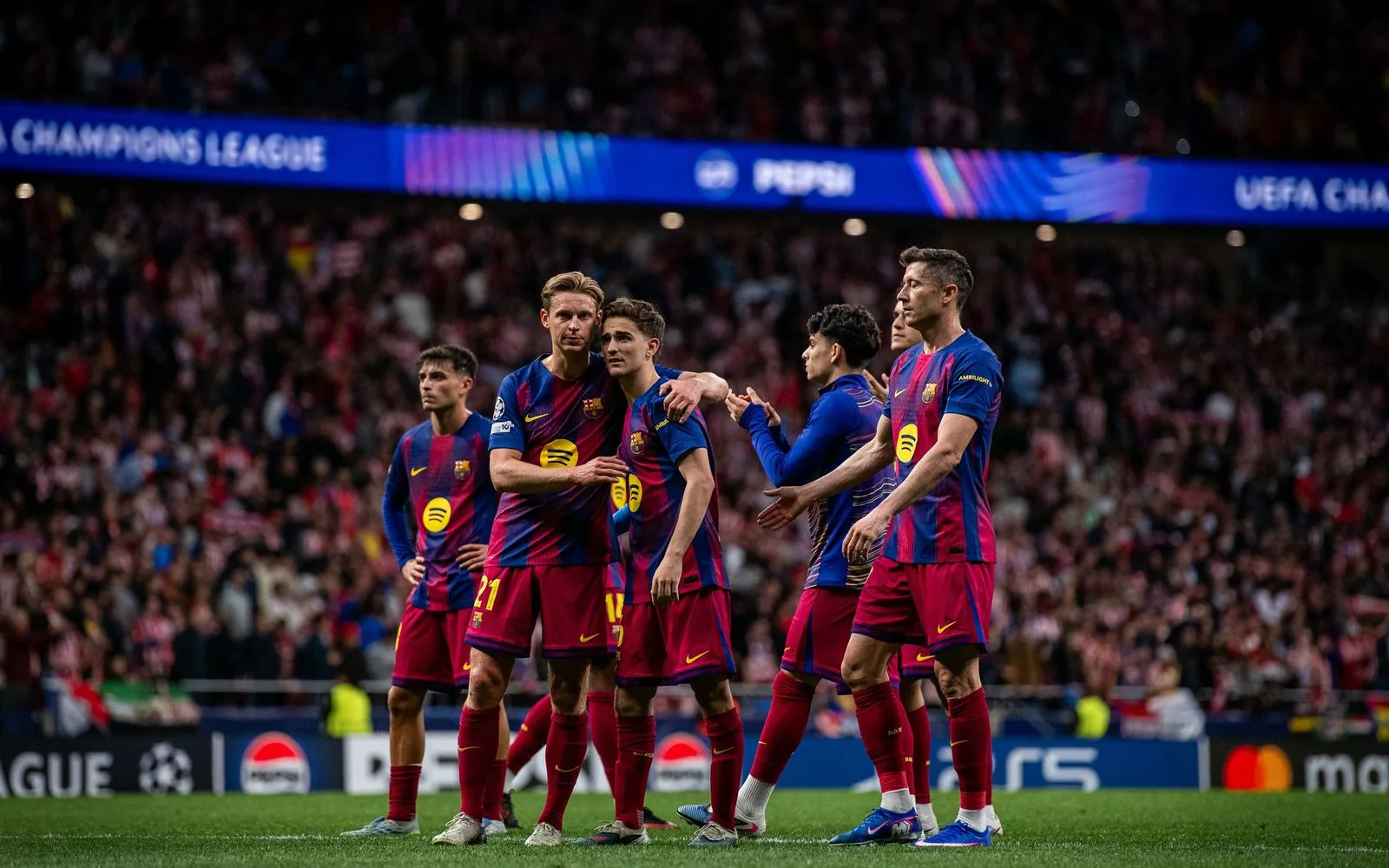
Barcelona had overwhelmed Newcastle 8–3 on aggregate in the round of 16, including a 7–2 home victory. Their quarter-final presented a different problem: a 2–0 home defeat to Atlético on April 8 left them chasing the tie before the return even began.
Lamine Yamal scored after four minutes in Madrid on April 14, and Ferran Torres made it 2–0 on the night in the 24th minute. The aggregate deficit had disappeared. Seven minutes later, however, Ademola Lookman converted Marcos Llorente's cross and Atlético regained the overall lead. Barcelona won the match 2–1 but lost the tie 3–2.
The distinction matters more than an isolated “Barcelona win” headline. Their attacking response was real, but it had to compensate for the previous week's damage. Lookman's goal changed what the remaining hour demanded: another Barcelona goal was required simply to restore equality across the tie. Eric García's late dismissal made that task harder. Winning an away leg can be an admirable response and still leave a campaign over.
Real Madrid: Manchester City beaten, Bayern too strong
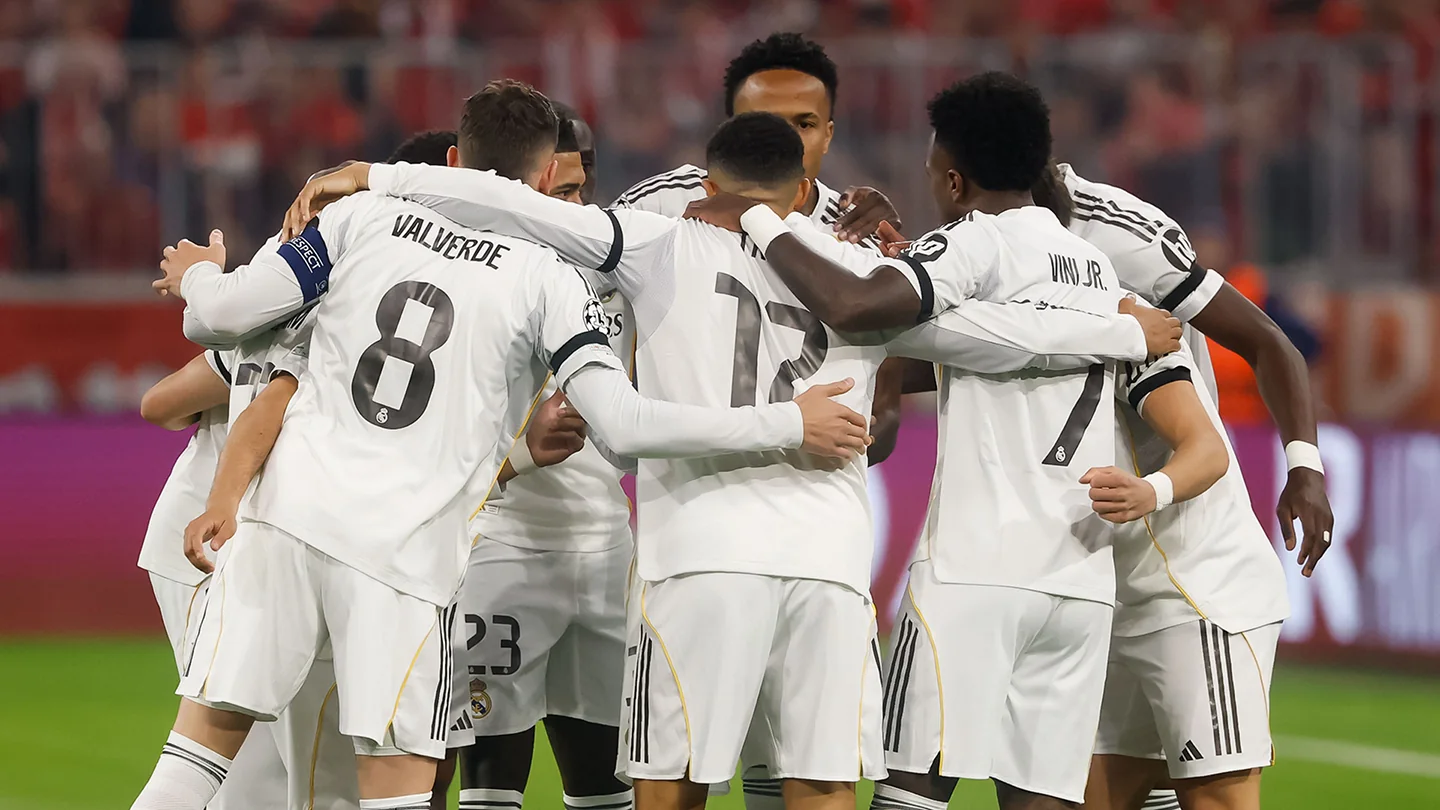
Real Madrid eliminated Manchester City 5–1 on aggregate before facing Bayern. A 2–1 home defeat in the quarter-final first leg meant another comeback was needed in Munich on April 15. Arda Güler scored twice and Kylian Mbappé added another as Madrid led 3–2 at halftime. Across both matches, however, the score was level at 4–4.
The ending was decisive. Eduardo Camavinga was sent off in the 86th minute, Luis Díaz scored in the 89th, and Michael Olise added Bayern's fourth in stoppage time. Madrid lost the return 4–3 and the tie 6–4, as documented in UEFA's quarter-final account.
The six conceded across the tie explain why an impressive three-goal away performance did not secure progress. Madrid repeatedly repaired the aggregate score, but could not keep it level through the finish. Their earlier domination of City did not carry a goal advantage into the next round: every new tie reset the problem.
Athletic Club and Villarreal stopped at the league phase
Athletic Club and Villarreal both ended their European seasons in January, before the knockout rounds. Yet putting them in the same exit-stage category should not erase the difference between their campaigns. Athletic still had something to chase on the final night; Villarreal's final fixture closed a competition in which they never found a win.
Athletic Club's last-night opportunity
Athletic finished with two wins and two draws, worth eight points. The victories over Qarabağ and Atalanta, and the draws with Slavia Praha and Paris Saint-Germain, gave supporters genuine reasons to value parts of the campaign. The 3–2 away win at Atalanta on the penultimate matchday kept the last fixture meaningful.
Against Sporting CP at San Mamés on January 28, Oihan Sancet and Gorka Guruzeta twice put Athletic in front. Sporting twice answered, with Francisco Trincão making it 2–2 after the interval. Athletic still needed victory, so a level scoreboard was not a position they could simply defend until the whistle.
Sporting then counterattacked after an Athletic corner and Alisson Santos scored in stoppage time. The final score was Athletic Club 2–3 Sporting CP. The club's match account captures the particularly painful shape of that exit: twice ahead, pushing for the necessary winner, then beaten at the other end.
The last goal makes an obvious dramatic ending, but it should not become a false explanation that a draw would have preserved the season. The need to win was already shaping Athletic's decisions at 2–2. Their late risk was a response to the qualification situation, and the final defeat was the consequence of that unsuccessful chase.
Villarreal's eight-match struggle
Villarreal's record was starker: no wins, one draw and seven defeats. The 2–2 draw with Juventus was their only point. Unlike Athletic, they were already out of contention before the final visit to Bayer Leverkusen on January 28.
That match finished Leverkusen 3–0 Villarreal, with Malik Tillman scoring twice before halftime and Alejandro Grimaldo adding the third after the break. Villarreal rotated their lineup and gave academy players European experience, details recorded in their official final-match report. Those minutes were a practical benefit of a difficult evening, rather than a substitute for the results missing earlier in the campaign.
Eight fixtures provide more room to recover than one bad night, but recovery still requires converting performances into points. Villarreal never built that platform. Their European history gave supporters memories of deeper runs; it could not supply a win in this edition. Reading the actual eight-match record keeps that distinction clear.
Europa League: Betis and Celta reached the quarter-finals
Real Betis and Celta both reached the last eight of the Europa League, and both went out on April 16, 2026. Neither was a finalist. Their exits also differed sharply: Betis surrendered a promising position in their home return, while Celta could not reverse a heavy first-leg loss.
Real Betis: a comeback followed by a home collapse
Betis had already demonstrated their capacity to overturn a first-leg defeat. After losing 1–0 away to Panathinaikos in the round of 16, they won the return 4–0 and advanced 4–1 on aggregate. That was a complete response to a manageable deficit, with the home crowd able to watch the tie move decisively in their favor.
The quarter-final against Braga initially offered a similarly encouraging path. A 1–1 draw in Portugal on April 8 left the return open. Antony and Abde Ezzalzouli then put Betis 2–0 up at home, making their overall advantage two goals. Progress was within reach, but it had not been secured.
Braga scored before halftime, then equalized early in the second half through Vítor Carvalho. Ricardo Horta's penalty put the visitors ahead, and Jean-Baptiste Gorby's later strike extended the damage. The return finished Betis 2–4 Braga, with Braga through 5–3 on aggregate. UEFA's match report shows how rapidly the promising opening turned.
The contrast between those two home knockout games is the heart of Betis's European story. Against Panathinaikos, each additional goal increased control. Against Braga, conceding before the interval reduced the cushion, and two goals soon after the restart transformed the task again. The same supporters who had seen a convincing comeback one round earlier watched a lead disappear in the next.
Calling the campaign a quarter-final appearance is accurate, but incomplete without that position of strength. Betis did not spend the whole tie trying to bridge a superior opponent's established lead. They built an advantage and then lost it. That is why the exit felt more abrupt than the final round alone suggests.
Celta: Lyon overcome before Freiburg's six-goal tie
Celta's route included two important knockout successes. They beat PAOK 3–1 on aggregate in the playoffs, then eliminated Lyon by the same aggregate score in the round of 16. A 1–1 draw in Vigo was followed by a 2–0 away win in France on March 19. Winning that return gave their supporters a concrete high point to remember, rather than merely a place in a draw.
Freiburg changed the scale of the challenge. Celta lost the first quarter-final leg 3–0 in Germany on April 9, leaving a much larger deficit than Betis had faced against Panathinaikos. The return in Vigo never became the hoped-for recovery: Igor Matanović opened the scoring and Yuito Suzuki scored twice for Freiburg.
Williot Swedberg supplied a late consolation, but the match finished Celta 1–3 Freiburg, 1–6 on aggregate. The UEFA account of the return describes an opponent that did not let Celta re-enter the contest.
That margin should be acknowledged without erasing the PAOK and Lyon ties. A successful round does not guarantee the next matchup will be equally manageable. Celta's last eight appearance contained both credible knockout progress and a clear final defeat; a useful review leaves room for both judgments.
Rayo Vallecano reached the Conference League final
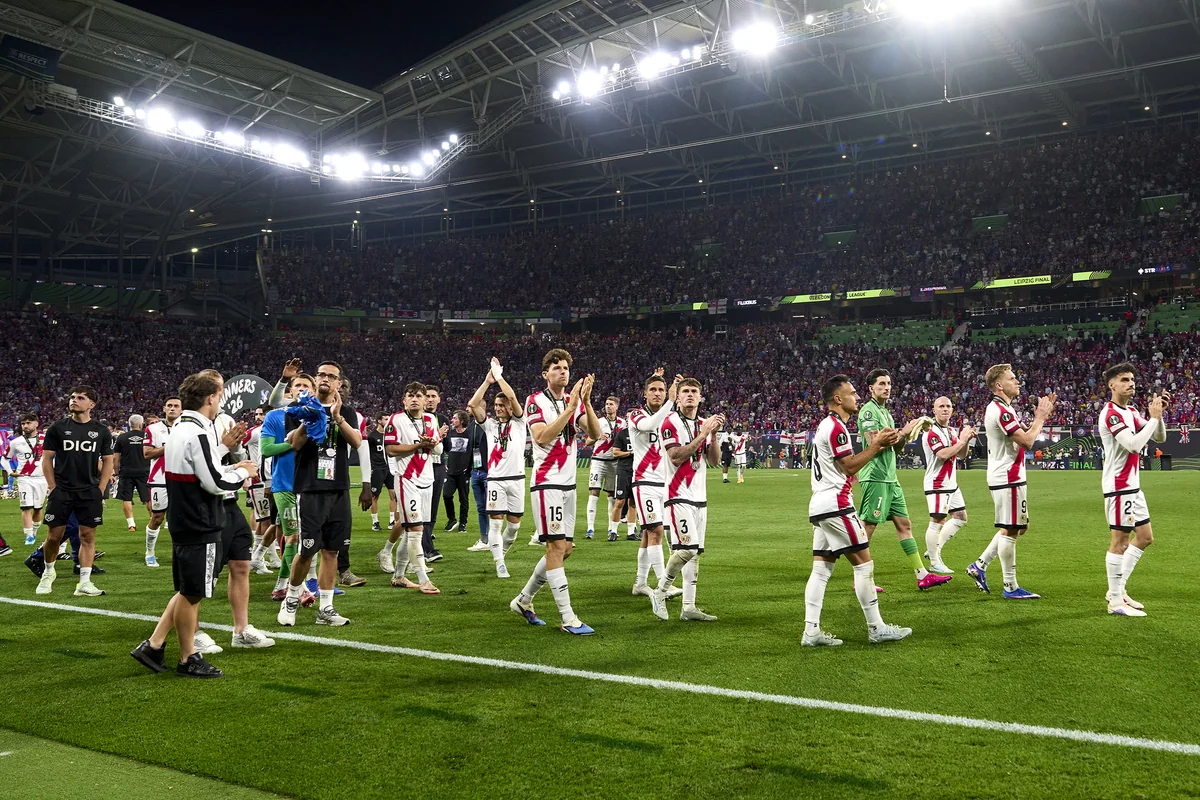
Rayo Vallecano were Spain's only finalists in the three men's UEFA competitions in 2025/26. They reached the Conference League final in Leipzig on May 27, where Crystal Palace won 1–0. Rayo finished as runners-up, not champions.
That final result should sit alongside the scale of the journey. Rayo recorded four wins and a draw in their six league-phase matches, collecting thirteen points. Their campaign then continued through three two-legged knockout rounds before the single-match final. Reaching Leipzig was therefore the outcome of repeated progress, rather than one isolated upset.
The final itself was settled by Jean-Philippe Mateta's close-range finish in the 51st minute. Adam Wharton's shot was saved by Augusto Batalla, and Mateta reacted to the rebound. Rayo had created first-half opportunities through Alemão and Unai López, but had not converted them into a lead. Their later attempts to equalize also fell short.
UEFA's final report and Rayo's own account agree on the essential outcome: a narrow defeat after a competitive final. For supporters, pride in reaching that occasion does not require changing who lifted the trophy. The achievement and the disappointment can both be stated plainly.
How Rayo survived the knockout rounds
The round of 16 supplied an early lesson in aggregate football. Rayo won 3–1 away to Samsunspor, then lost the home return 1–0. The second result did not undo the first: Rayo advanced 3–2 overall. A supporter checking only the latest score would have missed the more important outcome.
The quarter-final against AEK Athens followed a similar pattern in the opposite order of venues. Rayo won the home first leg 3–0, but lost 3–1 in Athens. Their own goal in the return mattered because it helped preserve a 4–3 aggregate victory. A comfortable first-leg score had become a narrow qualification margin by the end of the second match.
The semi-final was more controlled on the scoreboard. Rayo beat Strasbourg 1–0 in Madrid on April 30 and by the same score in France on May 7, advancing 2–0 on aggregate. Alemão scored in both legs. The return-leg report describes Rayo pressing Strasbourg's buildup rather than simply retreating to protect their existing advantage.
Those rounds show why the run cannot be reduced to a vague label such as “lucky finalist.” Rayo had to establish leads, survive responses and then perform while already ahead. Their supporters experienced different versions of the knockout problem, with the overall score repeatedly deciding what was required from the next ninety minutes.
Leipzig offered no return fixture in which to repair a missed chance or a conceded rebound. Once Palace led, Rayo had to find their equalizer within that evening. That change from two legs to one is a useful way to understand the ending: the qualities that took them through a long route earned their place in the final, but did not guarantee its decisive moment.
What the 2025/26 European season meant for La Liga
Spain finished the campaign without a men's trophy in these three UEFA competitions, but that is only one measure of the season. Atlético reached a Champions League semi-final, four other Spanish clubs reached quarter-finals, and Rayo reached the Conference League final. The exit stages provide a useful reference without pretending every tournament presented the same task.
| Club | Competition | Final outcome |
|---|---|---|
| Atlético Madrid | Champions League | Semi-final; Arsenal won 2–1 on aggregate |
| Barcelona | Champions League | Quarter-final; Atlético won 3–2 on aggregate |
| Real Madrid | Champions League | Quarter-final; Bayern won 6–4 on aggregate |
| Athletic Club | Champions League | Eliminated at the league phase |
| Villarreal | Champions League | Eliminated at the league phase |
| Real Betis | Europa League | Quarter-final; Braga won 5–3 on aggregate |
| Celta | Europa League | Quarter-final; Freiburg won 6–1 on aggregate |
| Rayo Vallecano | Conference League | Runner-up; Crystal Palace won the final 1–0 |
The collective result also had a concrete reward. Spain finished second in UEFA's single-season association coefficient for 2025/26, with an average of 22.093. That earned an additional Champions League place for 2026/27, taken by fifth-placed Real Betis. UEFA's final European Performance Spot confirmation identifies both the season that generated the points and the following season that received the extra entry.
Rayo's win in Strasbourg on May 7 helped make that extra Spanish place mathematically secure, as the contemporaneous AS report explained. It gave domestic rivals a reason to care about a Conference League result: a club's European progress could contribute to an opportunity for another Spanish team.
This does not turn Rayo's final defeat into a victory, or Betis's quarter-final exit into a successful trophy campaign. It shows why silverware and collective performance answer different questions. The first identifies a champion; the second combines results from the association's participating clubs. Spain could fall short in the finals while still earning the next season's extra place.
For fans comparing years, keep three lines separate: the clubs that entered, the rounds they reached, and the places allocated afterward. Our Champions League qualification guide explains the entry rules in full. The current La Liga table follows today's domestic race; it is not an archived table of these European results.
The lasting picture of 2025/26 is therefore varied: a narrow semi-final, an all-Spanish quarter-final, two very different Europa League exits and Rayo's first UEFA final. Remembering those specific journeys gives a fuller account than judging all eight clubs by the last trophy presentation alone.
Comments
Sign in with Google to comment. Keep the conversation useful and football-focused. New comments are reviewed before they appear.
Loading comments…