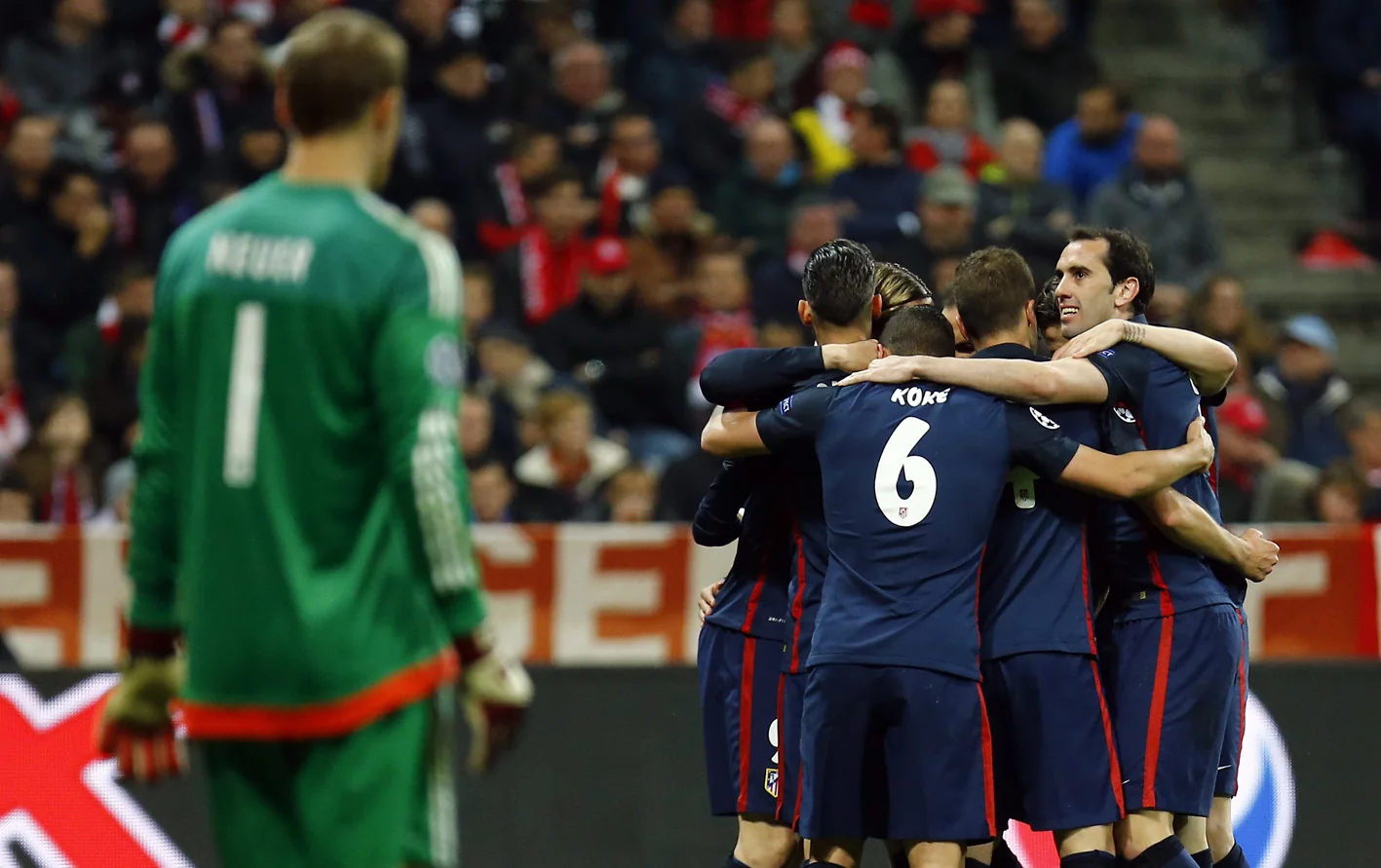
Atlético have reached three finals without winning the trophy
Atlético Madrid have never won the European Cup or UEFA Champions League. Their three final appearances came in 1974, 2014 and 2016, with Bayern Munich winning the first and Real Madrid winning the next two. That remains the record as of 14 October 2026. The last appearance was the Milan final in May 2016, as summarised in Bolavip’s final-history guide.
| Season | Venue and opponent | How the title was decided |
|---|---|---|
| 1973/74 | Brussels; Bayern Munich | 1–1 after extra time; Atlético lost the replay 0–4 |
| 2013/14 | Lisbon; Real Madrid | Atlético lost 1–4 after extra time |
| 2015/16 | Milan; Real Madrid | 1–1 after extra time; Atlético lost the shootout 3–5 |
Those are three final editions, even though the 1974 contest required two matches. The table’s season labels describe the campaign; the familiar years describe when its final took place. Equally, the 2016 shootout score does not replace the 1–1 match score. Keeping these distinctions makes a historical result list much easier to understand.
European Cup history and other European honours
The European Cup is the predecessor of today’s Champions League, so Atlético’s 1974 appearance belongs in the same competition history as Lisbon and Milan. A list confined to the Champions League name would show two finals; a complete European Cup/Champions League history shows three. Neither definition produces a winning season for Atlético.
Their trophy cabinet nevertheless contains major European honours. The club’s official honours catalogue lists the 1962 Cup Winners’ Cup, Europa League triumphs in 2010, 2012 and 2018, and UEFA Super Cups in those same three modern years. These competitions have their own identities and qualification routes. Winning one is a real achievement, but it does not constitute winning the Champions League.
For supporters, the missing trophy is therefore a specific gap rather than an absence of European success. The useful historical question is how Atlético repeatedly became capable of reaching its final, and why each decisive match took a different turn. A replay, an extra-time defeat and a penalty shootout tell three football stories rather than one interchangeable tale of bad luck.
1974: a late equaliser and the only final replay
Atlético’s first final was played at Brussels’ Heysel Stadium on 15 May 1974. After a goalless 90 minutes against Bayern Munich, Luis Aragonés put Atlético ahead with a free-kick in extra time. Georg Schwarzenbeck’s late equaliser made it 1–1 and prevented the trophy from being awarded that evening. The Bayern honours archive records both that match and the replay on 17 May.
The memorable last moments followed a demanding route to Brussels. UEFA’s season review describes Atlético overcoming Galatasaray, Dinamo București and Crvena Zvezda before facing Celtic. Three Atlético players were sent off in a 0–0 away semi-final; the return at the Vicente Calderón ended 2–0 to the Spanish side.
That semi-final illustrates why the campaign should be remembered beyond one long-range shot in Brussels. Atlético had survived away pressure and made home advantage count. It also shows the disciplinary cost of protecting a result: a successful defensive outcome can coexist with dismissals that complicate the next match. The route to a final and the final itself are connected stories.
Why Bayern and Atlético played again
The 1974 final was not designed as a two-legged tie. The replay was required because the first match remained level after extra time under the final’s rules then in force. It remains the competition’s only final replay. Modern viewers accustomed to a penalty shootout should therefore resist reading the first 1–1 as merely the opening leg of a planned aggregate contest.
Bayern won the replay 4–0, with Uli Hoeneß and Gerd Müller scoring twice each. The wider margin belongs to the second match; it does not describe the balance of the first. One game brought Atlético close to winning, while another settled the title convincingly in Bayern’s favour. Both results are necessary to explain what happened.
A useful way to watch the surviving footage is to separate the decisive actions: Aragonés making a set piece count, Schwarzenbeck rescuing a contest that seemed almost over, then Bayern’s finishing in the replay. The sequence explains Atlético’s sense of a missed opportunity without requiring a claim that later generations inherited the same fate. Forty years would pass before the club returned to the final, with different players, a different coach and a different competition structure.
2014: Simeone takes Atlético back to the final
Diego Simeone’s Atlético arrived in Lisbon as Spanish champions. On 17 May 2014, Diego Godín’s equalising header at Barcelona helped secure the league title at the Camp Nou, a result recalled in the club’s anniversary account. Seven days later, Atlético faced Real Madrid in the European final. These were separate opportunities to win separate trophies, even though the same team and centre-back were central to both.
The achievement was more than a surprise appearance in a one-off match. Atlético had reached the final unbeaten. Their campaign combined reliable defending with goals from several positions, rather than requiring Diego Costa to settle every contest. Reaching the last night in Lisbon demonstrated that the league challenge and European challenge could be sustained together.
The route to Lisbon and the late turning point
The knockout route went through AC Milan, Barcelona and Chelsea, as documented in UEFA’s road-to-the-final review. At Stamford Bridge, Atlético recovered from Fernando Torres’ opener to win 3–1, with Adrián López, Costa and Arda Turan scoring. The club’s contemporary semi-final report captures a side able to advance after falling behind away from home.
That Chelsea match is a useful corrective to the idea that Simeone’s team could only protect a lead. They had to respond to a changed score and find attacking solutions. The campaign’s defensive discipline was a platform for competing, not a guarantee that every tie would be won by sitting through pressure.
In the final on 24 May, Godín headed Atlético ahead in the 36th minute. Costa’s early injury substitution had already disrupted the attack. Sergio Ramos equalised from a corner in added time, and the match continued into extra time. Gareth Bale, Marcelo and Cristiano Ronaldo then scored to make it 4–1, the sequence established by UEFA’s final report.
For anyone revisiting the match, its changing phases matter more than the eventual three-goal margin. Atlético led deep into normal-time stoppage time; Madrid’s second goal came much later in extra time. Watching the corners at both ends also reveals a shared weapon: aerial timing brought Atlético their lead and Madrid their escape. Lisbon was a title lost after an extremely close contest, rather than a final controlled comfortably by the eventual winners from the beginning.
2016: a second Madrid derby final ends on penalties
Returning to the final two seasons after Lisbon confirmed Atlético’s ability to challenge repeatedly. The 2015/16 campaign asked different questions along the way: they survived a goalless tie, overturned a first-leg deficit, and advanced after losing a semi-final return. The results reward a closer look at the rules and match situations.
Eliminating Barcelona and Bayern
First came PSV Eindhoven. Two 0–0 matches led to an 8–7 shootout victory, Juanfran converting the decisive kick, as recorded in UEFA’s round-of-16 report. Atlético then lost 2–1 at Barcelona but won 2–0 at home, Antoine Griezmann scoring both goals to produce a 3–2 aggregate victory.
Against Bayern, Saúl Ñíguez’s goal supplied a 1–0 home lead. The return ended 2–1 to Bayern, but Atlético progressed on away goals with the aggregate level at 2–2. The club’s Munich report describes Griezmann finishing after Fernando Torres’ pass and Jan Oblak saving Thomas Müller’s penalty. Atlético did not win that second leg: they achieved the result required to win the tie.
Those examples show three routes through knockout football. A shootout rewarded accurate execution against PSV; the Barcelona return rewarded a clean sheet and two goals; one away goal altered Bayern’s task. Calling all three simply defensive victories misses the different attacking contributions and the importance of understanding the score across both legs.
The Milan equaliser and the shootout
At San Siro on 28 May 2016, Sergio Ramos scored first for Madrid. Griezmann hit the crossbar with a penalty early in the second half, but half-time substitute Yannick Carrasco equalised in the 79th minute from Juanfran’s cross. The UEFA final report follows Atlético’s recovery and the eventual shootout defeat.
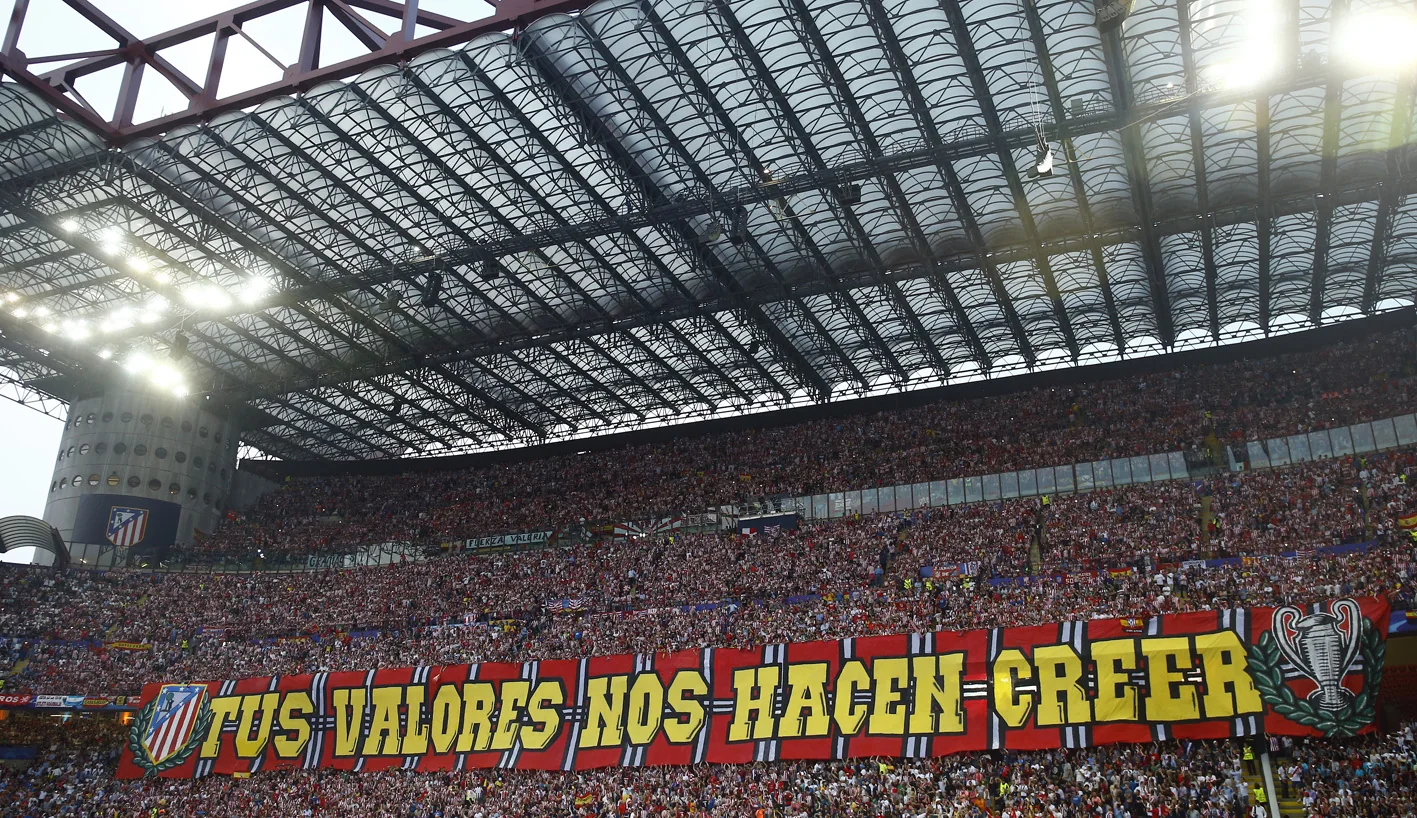
Extra time brought no further goals. Griezmann converted in the shootout, but Juanfran’s fourth Atlético attempt struck the post; Cristiano Ronaldo’s fifth Madrid kick secured a 5–3 shootout win. Juanfran had supplied both the PSV winner and the final’s equalising cross. Remembering those contributions prevents a single missed penalty from becoming an unfair summary of his campaign.
Carrasco’s role offers another useful viewing point. His running and width gave Atlético a way to move the contest towards Madrid’s goal after falling behind. Milan was therefore a comeback that reached a shootout, whereas Lisbon had been a lead lost before extra time. The same rival won, but the two finals unfolded differently.
The campaigns after Milan and the return to the semi-finals
Atlético’s Champions League story did not end in 2016. They reached another semi-final in 2016/17, then experienced campaigns ranging from group-stage elimination to quarter-final runs. The following selection of completed seasons follows UEFA’s club history archive; it shows the furthest stage reached rather than treating every memorable victory as a final appearance.
| Season | Champions League finish |
|---|---|
| 2016/17 | Semi-finals |
| 2017/18 | Group stage |
| 2019/20 | Quarter-finals |
| 2021/22 | Quarter-finals |
| 2022/23 | Group stage |
| 2023/24 | Quarter-finals |
| 2024/25 | Round of 16 |
| 2025/26 | Semi-finals |
The 2019/20 run provides a striking example of the difference. Marcos Llorente scored twice in extra time as Atlético won 3–2 at Liverpool and advanced 4–2 on aggregate, in UEFA’s Anfield report. Yet they subsequently lost the single-match quarter-final 2–1 to Leipzig in Lisbon. A celebrated last-16 comeback did not produce a semi-final place.
In 2025/26, Atlético did return to the last four for the first time in nine seasons. The club’s Arsenal preview records their elimination of Club Brugge, Tottenham and Barcelona along the way. A 1–1 home draw followed by a 1–0 away defeat ended the semi-final 2–1 on aggregate to Arsenal. Bukayo Saka scored the decisive second-leg goal, as confirmed in UEFA’s 5 May 2026 report.
A new format changes how campaigns are compared
Since 2024/25, a 36-club league phase has replaced the old group stage. Each team meets eight different opponents, four at home and four away. The top eight advance directly to the round of 16; places ninth to 24th enter knockout play-offs. Lower finishers leave European competition rather than dropping into the Europa League, under UEFA’s format explanation.
The away-goals rule that helped Atlético against Bayern in 2016 was also removed from 2021/22. Comparing campaigns therefore requires more than raw match totals: starting phases, possible play-offs and tie-break rules differ. The ongoing 2026/27 season has no final finishing stage yet. For supporters following Atlético across both competitions, the La Liga schedule supplies the domestic fixtures around their European commitments.
Player records and what to watch in Atlético’s European history
Koke’s longevity helps explain how Atlético turned occasional European Cup appearances into sustained modern participation. In November 2024, against Sparta Prague, he became the first Atlético player to reach 100 Champions League appearances for the club. The official milestone report also distinguishes Antoine Griezmann’s career appearances across Atlético, Real Sociedad and Barcelona. A player’s career total and his Atlético total answer different questions.
In the UEFA club archive checked on 14 October 2026, Koke heads Atlético’s appearance list and Griezmann heads its goalscorer list. Jan Oblak is also prominent among the appearance leaders. These records reflect different jobs: midfield continuity, finishing and goalkeeping all contribute to progression. A goals table alone cannot capture the saves that kept a tie alive or the work required to create an opening.
The older history deserves a place beside those modern names. Atlético reached the semi-finals in their first European Cup campaign, 1958/59. Their tie with Real Madrid ended level across two legs before Madrid won a replay in Zaragoza, as explained in UEFA’s historical derby background. The European rivalry therefore began long before the Lisbon and Milan finals.
Between the earliest campaign and the modern final appearances, there were other notable runs. UEFA’s archive records a semi-final in 1970/71 and a quarter-final in 1996/97. These stages help place the long gap between the 1974 and 2014 finals in perspective: Atlético did have significant European Cup campaigns during that interval, even without reaching its last match again. The distinction matters when describing Simeone’s achievement. He took the club back to the final and made repeated participation part of its modern identity; he did not create its entire history in the competition. Earlier generations had already established a record against major continental opponents.
When revisiting the major campaigns, watch how the requirement changes with the score. In 1974, a free-kick almost settled a level final. In Lisbon, the leading team had to defend another corner. In Munich in 2016, a counterattacking goal changed the opponent’s qualification problem. In Milan, a substitute and a right-sided combination restored equality. Atlético’s history contains several ways to get close to a trophy, not one tactic repeated unchanged.
It is also worth watching the passages between the famous goals: goalkeeper decisions, the first pass after a regain, support for the forwards and the response to a substitution. Those details make the celebrated result understandable as football. They explain how a side can resist pressure successfully for long periods and still need a precise attacking action to progress.
The most accurate record combines achievement and limitation. Three finals established Atlético as serious contenders in different eras; later quarter-finals and the 2026 semi-final show a continuing presence among strong European opponents. The first European Cup or Champions League title remains unclaimed. Understanding the routes, the rules and the decisive moments gives that missing trophy its proper context.
Comments
Sign in with Google to comment. Keep the conversation useful and football-focused. New comments are reviewed before they appear.
Loading comments…