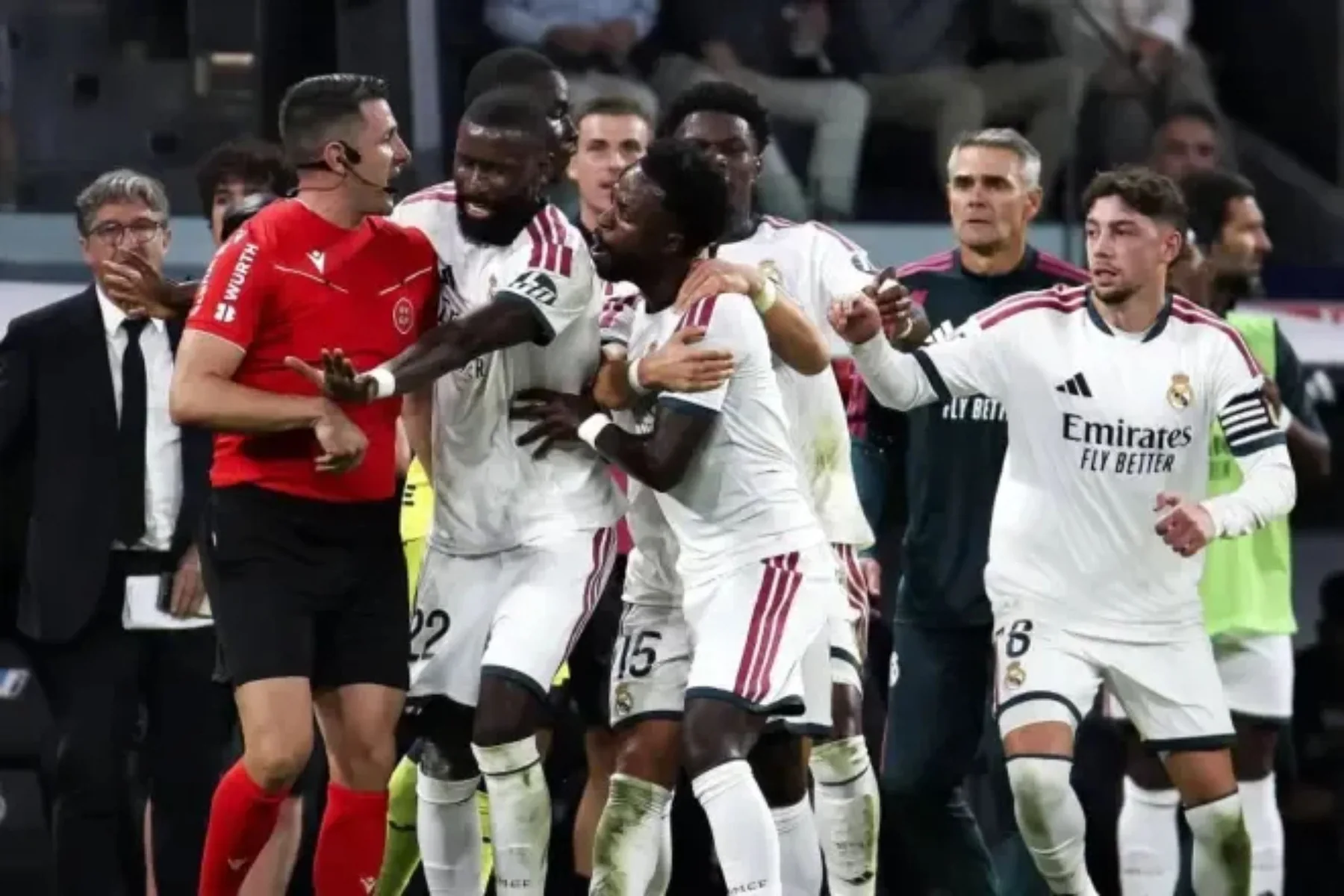
What is the latest on Vinicius's four-match ban?
Vinicius Junior's four-match La Liga suspension was upheld by the RFEF Appeals Committee on 16 October 2026. Under that ruling, the Barcelona game on 25 October remains part of the ban. The 16 October appeal decision remains the latest confirmed ruling as of 19 October. A reported further challenge does not itself change his availability; that would require an effective decision altering or suspending the punishment.
Cover photograph: an archival image of Vinicius with Real Madrid teammates.
The suspension consists of two separate two-match penalties. One concerns the incident with Villarreal's Nathan Saliba; the other concerns Vinicius's reaction toward the referee after being sent off. That structure is the key to understanding the total. It was not simply a four-game punishment automatically attached to every straight red card.
The official Appeals Committee decision confirms the disciplinary resolution issued on 14 October. The match incident occurred against Villarreal on 10 October. Keeping those dates distinct avoids confusing the referee's action during the match, the initial sanction and the subsequent appeal into a single event.
Independent reporting on the appeal described Madrid's intention to go to the Tribunal Administrativo del Deporte, usually shortened to TAD. The federation appeal had failed; that did not mean every possible further remedy had been exhausted. Equally, the prospect of another challenge did not itself put the player back into the team.
For supporters planning around El Clasico, the practical distinction is between the ruling currently in force and a possible future change. The existing sanction determines availability until a competent body changes its effect. A headline about an appeal being prepared, lodged or rejected can describe different stages, so the date and the decision-maker matter as much as the word “appeal.”
Our next El Clasico guide covers the fixture itself. The Vinicius role and career guide provides the player background. Here, the focus is the disciplinary decision: why the two offences were treated separately, what Madrid argued and what would have to change for the winger to become available.
Why the suspension is two matches plus two
The simplest way to read the punishment is to separate what happened before and after the red card. Vinicius's physical action against an opponent generated one disciplinary finding. His subsequent behaviour toward the match official generated another. The resulting four matches are the sum of those findings, with a two-match minimum applied to each.
| Conduct | RFEF provision applied | Suspension |
|---|---|---|
| Hair pull away from a legitimate challenge for the ball | Article 130.2 | Two matches |
| Protests toward the referee after dismissal | Article 127 | Two matches |
The hair pull was treated as conduct away from a challenge
The report recorded the ball as being in play, while not being contested between the two players. Those are compatible descriptions. An attack can be developing elsewhere on the pitch while an incident between opponents has no legitimate connection to winning the ball. “Away from a challenge” does not necessarily mean the referee had already stopped play.
That distinction matters because the sanction depends on the particular category applied. MARCA's report on the initial decision describes the two separate punishments, while the official ruling identifies their precise provisions. A general expectation that a red card means one missed game cannot override the category used for the actual conduct.
The protests were a separate disciplinary offence
The second finding concerned what happened after the dismissal, with play stopped. It was not an additional finding that the same hair pull happened twice. The disciplinary question was whether the later conduct toward the referee independently met the requirements of another offence. The committee concluded that it did.
This explains why an immediate reaction can still have separate consequences. Being angry about a decision describes the setting of the behaviour; it does not automatically make that behaviour part of the original foul. A player can disagree with the red card and also create a further disciplinary problem through the manner of that disagreement.
For fans debating whether four matches feels severe, the useful starting point is therefore the two individual classifications. A change to either could affect the total, but reducing the total requires more than comparing it with an unrelated sending-off. The 2026/27 rules guide offers broader context; this case turns on the RFEF disciplinary provisions applied to two particular actions.
Why no injury was needed for the hair-pulling sanction
One of Madrid's arguments concerned the absence of an injury or medical treatment. That is an understandable question for a supporter watching the opponent continue playing: if no damage was recorded, why did the physical incident still carry a suspension? The answer turns on the distinction between creating a risk and actually causing an injury.
Article 130 covers violent conduct involving risk without harmful or injurious consequences. In this case, the Appeals Committee considered the particular movement of the opponent's head and neck while the players were running. It found risk in those circumstances. That is the committee's assessment of the incident, rather than a claim that Saliba sustained a diagnosed neck injury.
The distinction is explored in IUSPORT's account of the appeal reasoning. Importantly, the reasoning did not reduce the test to the word “violent.” Risk still had to be examined. The conclusion was that the lack of an injury did not, by itself, defeat that finding.
For a fan comparing similar-looking incidents, this means the outcome is only one part of the picture. An opponent getting up quickly does not necessarily tell us how the contact occurred. Equally, it would be wrong to infer an injury simply because an action was punished. The relevant questions include the movement, the setting and the specific provision applied, rather than an assumption that every contact with hair must receive the same penalty.
Madrid also sought a different disciplinary classification that could have reduced the first component to one match. That made the choice of article central to the appeal. Once the committee maintained Article 130.2, two matches were already the minimum within that category. Asking for leniency within a category and successfully challenging the category itself are different routes to a smaller number.
This is useful context when a headline describes the four-match total as unusually harsh. Such a description is an opinion about the outcome; it does not explain the rules that produced it. To assess the decision, first separate the physical sanction from the dissent sanction, then ask whether the facts support each classification. That is a more precise discussion than treating an uninjured opponent as automatic proof that the first sanction had to disappear.
What the appeal said about the referee's report
The appeal involved both the facts recorded by the referee and the provisions used to punish them. Those are related questions, but they are not identical. A club can argue that the recorded incident did not happen as described, or accept the contact while arguing that a different disciplinary category should apply.
An alternative reading of video was not enough
Madrid argued that the contact with Saliba's hair and headband was accidental during a tussle. The committee did not accept that the video established the clear factual error needed to displace the referee's account. The report's special evidential status was therefore important to the outcome.
The standard does not make a referee's report impossible to challenge. It sets a demanding threshold for overturning its factual description. Showing that a viewer could offer another interpretation is different from demonstrating that the recorded version is clearly wrong. That explains why the existence of video alone does not guarantee a successful appeal.
For supporters, this is a useful distinction between discussing an incident and reviewing a disciplinary decision. Fans can disagree over a replay without either interpretation meeting the test required to reverse the report. The committee's rejection means Madrid did not satisfy that test in this case; it should not be stretched into a claim that all video challenges are futile.
Dissent can be established without quoting an insult
The other central question was the absence of a precise recorded phrase. Madrid argued that shouting or appearing upset did not necessarily establish punishable protest. The committee assessed the described behaviour as a whole, including the player's movement toward the referee and the intervention of teammates.
Reporting on the appeal decision explains that the dissent finding survived. Article 127 was applied to protest; it did not require proof of a particular insult. The absence of a transcript is therefore different from the absence of observable behaviour. It would be inaccurate to invent abusive words to make the sanction sound more understandable.
Madrid also sought a warning in place of the suspension. The committee rejected that alternative, including the proposed retrospective substitution of an on-field caution. This leaves a practical lesson for reading disciplinary news: identify the behaviour found proved and the exact offence, rather than assuming that every sanction concerning a referee must be an insult case. Dissent, insulting language and physical conduct toward an official are distinct questions and should be described with care.
Which matches does Vinicius miss, including El Clasico?
The four league fixtures covered by the upheld punishment are Sevilla, Barcelona, Racing Santander and Valencia. As of 19 October, the Sevilla match has already taken place: Madrid won 4-1 at the Bernabeu on 18 October. It should therefore no longer appear as an upcoming absence. The remaining scheduled league games in this sequence are all away from home.
| Date in 2026 | La Liga fixture | Position in the suspension sequence |
|---|---|---|
| 18 October | Real Madrid vs Sevilla | First game; already played |
| 25 October | Barcelona vs Real Madrid | Second game; El Clasico |
| 1 November | Racing Santander vs Real Madrid | Third game |
| 7 November | Valencia vs Real Madrid | Fourth game |
The consequence for El Clasico is direct: Vinicius is suspended for the Barcelona game under the ruling currently in force. For the date and venue context, see the next El Clasico guide. A later reduction or suspension of the punishment could change the calculation, but a report that Madrid intends to seek one does not remove the existing restriction.
The next league opportunity after this run is the home match against Celta on the 21-22 November weekend, following the international break. LaLiga currently lists 22 November without a confirmed kickoff time. Treat that as the next possible league return under the present sequence, rather than a promise that he will start or a reason to book around an unconfirmed time. Check the fixture schedule for subsequent timing updates.
La Liga availability and European fixtures are separate
The four games are league games, rather than simply Madrid's next four matches on any calendar. The Champions League fixtures against Leipzig on 21 October and AEK on 4 November sit between those domestic dates. This La Liga punishment does not itself make Vinicius unavailable for those European fixtures, and playing in Europe does not count down the four league matches.
That distinction gives Madrid a different selection problem in each competition. They must plan the league left-wing role without him while retaining the possibility of using him in Europe. It does not establish any particular starting lineup, replacement or number of minutes. Eligibility answers whether the suspension prevents selection; the coach still decides who plays. Supporters should keep those questions separate when reading predictions about how Madrid will manage the gap.
Could a further appeal still change his availability?
A further challenge could matter, but the result of that challenge matters more than the announcement of it. Mundo Deportivo reported Madrid's intention to go to the TAD, Spain's Administrative Sports Tribunal, after the federation's appeal rejection. That reporting describes a potential next step; it is not a ruling restoring the player's eligibility. The 16 October decision remains the latest confirmed ruling as of 19 October.
There are two different outcomes to watch. A successful challenge to the substance of the punishment could remove or reduce a component of the suspension. An interim decision could instead suspend its enforcement while the dispute continues. The latter would concern what happens pending a decision; it would not necessarily mean that the original incident had been cleared or that Madrid had won every argument.
The RFEF code's Article 8 makes the immediate practical point clear: disciplinary sanctions are enforceable without appeals automatically stopping them, while the relevant bodies retain powers to grant interim measures. A request for a stay and the grant of a stay are separate events. Until an effective decision changes the position, the upheld suspension is the basis for assessing league availability.
Even a reduced total needs to be read against the match sequence. El Clasico is the second league game in that sequence. A headline saying that one component has been reduced would not, on its own, tell you whether the Barcelona game becomes available. The number of games still to serve and the effect of any interim order would need to be considered together. An announcement should specify the actual change before fans recalculate the fixture list.
For supporters following the story before 25 October, the useful update would therefore be a dated decision identifying whether the sanction remains enforceable, has changed in length or has been suspended temporarily. A club's disagreement, an intention to appeal or a predicted outcome cannot perform that function. Madrid can continue contesting the punishment while still having to plan without the player in La Liga. Under the current ruling, that is the position for El Clasico; the possibility of a further remedy should be kept conditional.
Comments
Sign in with Google to comment. Keep the conversation useful and football-focused. New comments are reviewed before they appear.
Loading comments…