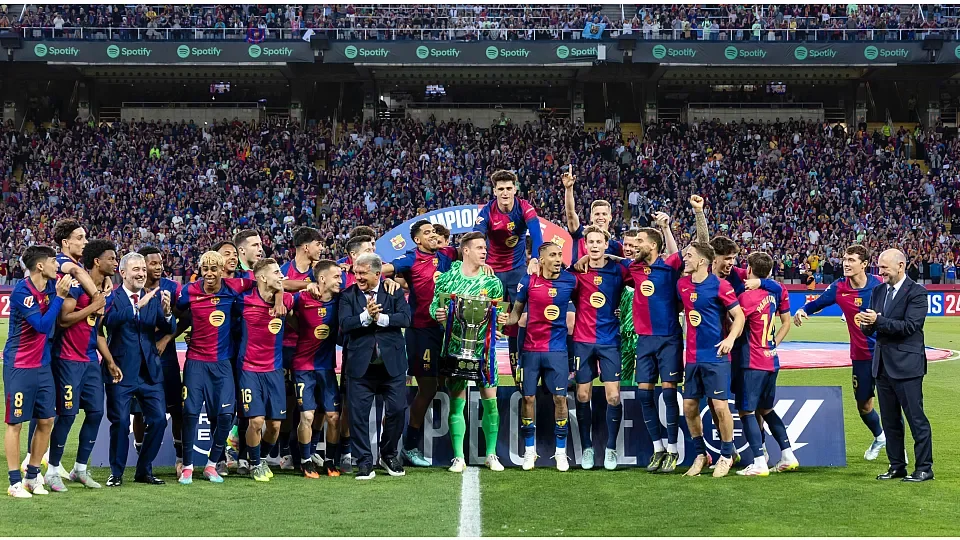
Barcelona won La Liga 2024/25 with 88 points, four ahead of Real Madrid, after scoring a league-best 102 goals. Kylian Mbappé won the Pichichi with 31. Athletic Club and Villarreal completed the top five, while Leganés, Las Palmas and Real Valladolid were relegated.
Champion
Barcelona, 88 points
Top scorer
Kylian Mbappé, 31
Survival line
Sevilla, 41 points
La Liga 2024/25 final table
Barcelona won the 2024/25 La Liga title with 88 points, four ahead of Real Madrid. Hansi Flick's champions produced the division's most explosive attack: 102 goals, 24 more than Madrid, and a league-best +63 goal difference. The final table records every club's 38-match campaign.
| Pos | Team | P | W | D | L | GF | GA | GD | Pts | Outcome |
|---|---|---|---|---|---|---|---|---|---|---|
| 1 | Barcelona | 38 | 28 | 4 | 6 | 102 | 39 | +63 | 88 | Champions, UCL |
| 2 | Real Madrid | 38 | 26 | 6 | 6 | 78 | 38 | +40 | 84 | UCL |
| 3 | Atlético Madrid | 38 | 22 | 10 | 6 | 68 | 30 | +38 | 76 | UCL |
| 4 | Athletic Club | 38 | 19 | 13 | 6 | 54 | 29 | +25 | 70 | UCL |
| 5 | Villarreal | 38 | 20 | 10 | 8 | 71 | 51 | +20 | 70 | UCL |
| 6 | Real Betis | 38 | 16 | 12 | 10 | 57 | 50 | +7 | 60 | UEL |
| 7 | Celta Vigo | 38 | 16 | 7 | 15 | 59 | 57 | +2 | 55 | UEL |
| 8 | Rayo Vallecano | 38 | 13 | 13 | 12 | 41 | 45 | −4 | 52 | UECL |
| 9 | Osasuna | 38 | 12 | 16 | 10 | 48 | 52 | −4 | 52 | — |
| 10 | Mallorca | 38 | 13 | 9 | 16 | 35 | 44 | −9 | 48 | — |
| 11 | Real Sociedad | 38 | 13 | 7 | 18 | 35 | 46 | −11 | 46 | — |
| 12 | Valencia | 38 | 11 | 13 | 14 | 44 | 54 | −10 | 46 | — |
| 13 | Getafe | 38 | 11 | 9 | 18 | 34 | 39 | −5 | 42 | — |
| 14 | Espanyol | 38 | 11 | 9 | 18 | 40 | 51 | −11 | 42 | — |
| 15 | Alavés | 38 | 10 | 12 | 16 | 38 | 48 | −10 | 42 | — |
| 16 | Girona | 38 | 11 | 8 | 19 | 44 | 60 | −16 | 41 | — |
| 17 | Sevilla | 38 | 10 | 11 | 17 | 42 | 55 | −13 | 41 | — |
| 18 | Leganés | 38 | 9 | 13 | 16 | 39 | 56 | −17 | 40 | Relegated |
| 19 | Las Palmas | 38 | 8 | 8 | 22 | 40 | 61 | −21 | 32 | Relegated |
| 20 | Real Valladolid | 38 | 4 | 4 | 30 | 26 | 90 | −64 | 16 | Relegated |
The outcome column reflects places earned through league position for the next UEFA season. Spain had five Champions League places, which mattered enormously to fifth-placed Villarreal. Athletic finished above Villarreal despite their equal 70 points, while Rayo finished above Osasuna on 52. League ordering uses the competition's tiebreak rules rather than goal difference alone, so the official position is the result to preserve.
The bottom was unusually compressed immediately above Leganés. Sevilla survived in seventeenth on 41, just one point ahead of the relegated side; Girona also had 41. Getafe, Espanyol and Alavés all had 42. One result could move several clubs, and goal difference cannot tell that story by itself.
This is a completed-season snapshot, not the current competition. Use the live La Liga table for today's standings. Here the lasting headline is Barcelona's combination of volume and margin: 28 wins and 102 goals turned a turbulent winter into a four-point championship.
How Barcelona won the 2024/25 La Liga title
Barcelona's championship was not a smooth procession. It had three distinct acts: a startling opening, a real winter crisis and a recovery strong enough to settle the title before the final weekend.
Hansi Flick's side won 11 of their first 12 league games. The signature result was the 4-0 Clásico victory at the Bernabéu on 26 October, when Barcelona's high defensive line repeatedly caught Madrid offside before the visitors attacked the space with greater precision. The score created an early psychological advantage, but it did not end the race.
The winter changed the mood. Barcelona lost three consecutive home league games and fell to third. Their aggressive shape could look exposed when pressure on the ball weakened, while missed chances made close matches unstable. That slump matters because the eventual champion did not simply protect an autumn lead. It had to repair its rhythm and overtake rivals.
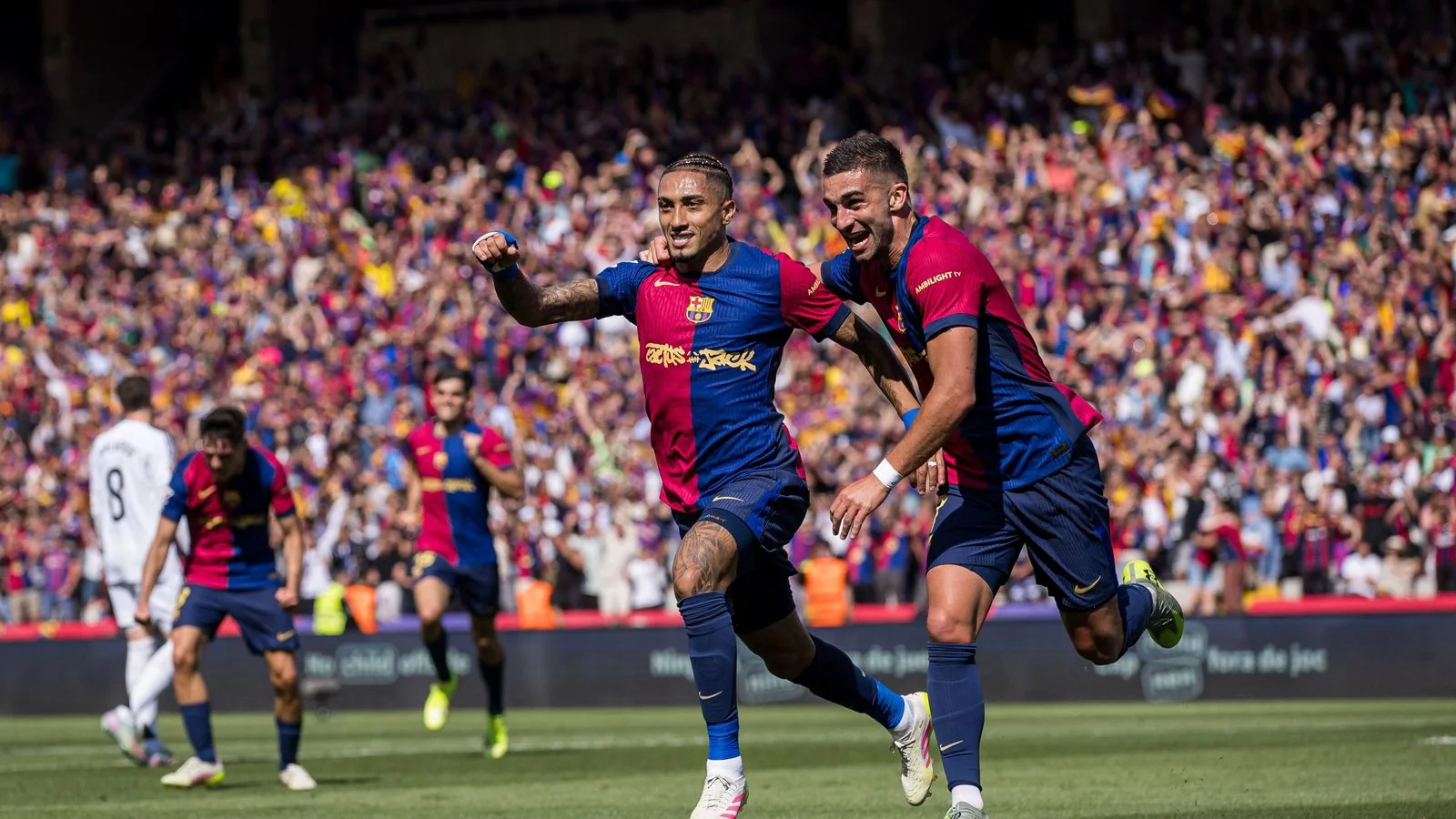
The response began after the calendar turned. Barcelona reached the title-clinching derby in May without a La Liga defeat in 2025. The crucial league rematch with Madrid condensed the season into 90 minutes. Mbappé put Madrid 2-0 ahead inside 14 minutes; Eric García, Lamine Yamal and two Raphinha goals turned it into a 4-2 Barcelona lead before halftime. Barcelona held on 4-3 and moved seven points clear with three games remaining.
Four days later, the title was won at Espanyol. The derby stayed scoreless through halftime, but Lamine Yamal curled in the breakthrough and Fermín López added a late second. The 2-0 result left Barcelona seven points ahead with only six available, securing the club's 28th league championship with two rounds to spare.
The two Clásicos supplied a six-point sweep rather than a split. Reverse either result and the four-point final margin looks completely different. Yet head-to-head dominance was not the whole title: it became decisive because Barcelona's extended 2025 run removed the cheaper dropped points that had damaged their winter.
Flick's first league season therefore showed two championship qualities. The attacking ceiling could overwhelm Madrid, but the deeper achievement was tactical and emotional recovery after falling to third. Barcelona did not need perfection; they needed to make the unstable phase temporary. See how the crown changed the rivalry totals in our Barcelona vs Real Madrid title comparison.
The tactical and attacking numbers behind Barcelona's 88 points
The 102-goal total was not simply the product of elite finishing. Barcelona changed the conditions around each attack. Flick wanted possession, but he also wanted the team to accelerate once a line opened and to win the ball back before opponents could leave their defensive shape.
The structure often resembled a 4-2-3-1 or 4-3-3. Pedri connected the first pass to the attacking line, while a second midfielder protected the centre. Lamine Yamal held or attacked the right side, Raphinha moved aggressively beyond the ball from the left or inside channels, and Robert Lewandowski occupied centre-backs. Advancing full-backs added width or pressing support. The point was not a rigid formation; it was giving the ball carrier several forward relationships.
Barcelona's counter-press made attacks arrive in waves. When a pass broke down, nearby midfielders and forwards closed central exits before sprinting at the ball. Winning it there meant facing a defence that had begun to expand, a better scoring situation than restarting from the goalkeeper. UEFA-qualified tactical analysis measured the second-lowest PPDA in La Liga after 22 matches, evidence of an intense press in that sample, while early-season Opta analysis showed opponents sustaining fewer long passing sequences.
The high defensive line supported that pressure. Pau Cubarsí, Iñigo Martínez, Jules Koundé and the left-back stepped toward midfield, shrinking the playing area and catching runners offside. It demanded coordination: pressure on the passer and the defenders' forward step had to happen together. If the ball carrier escaped with time, one accurate pass could expose a large space behind.
That trade-off explains both the entertainment and the occasional chaos. Barcelona conceded 39—hardly a historically tiny champion's number—but scored 102, 24 more than Real Madrid. Their +63 difference was 23 better than the runner-up's. The club also recorded 45 of its 88 points away from home, showing that the aggressive idea travelled rather than depending entirely on Montjuïc momentum.
Flick's most important decision was not removing risk. It was accepting controlled risk because the attack and counter-press produced more repeatable advantages. Winter defeats showed the system could fail when spacing and finishing deteriorated; the 2025 recovery showed the same principles could work again after distances and confidence improved.
For fans revisiting the campaign on our La Liga results archive, look beyond the scorer. Ask where Barcelona recovered possession, whether the opponent's passer faced pressure and how quickly Raphinha or Yamal attacked the next line. Those details turn “102 goals” from a number into a football explanation.
Real Madrid, Atlético and the race for Europe
Real Madrid's 84 points would win some championships, but here they were four short. Carlo Ancelotti's side matched Barcelona's six defeats and conceded one fewer goal, yet scored 24 fewer. More important than the aggregate was the direct contest: losing both Clásicos removed points from Madrid and gave them to the eventual champion. Mbappé's extraordinary first-season scoring could not solve every issue in chance creation, defensive availability and collective balance.
Atlético Madrid finished third on 76. Their 30 goals conceded were the league's best defensive record, two better than Athletic and eight better than Madrid. The gap to first therefore came at the other end and in draws: Atlético scored 68 and drew ten, compared with Barcelona's 102 goals and four draws. Diego Simeone's team could control many matches, but the champion converted more stalemates into wins.
The unusual feature was the value of fifth place. England and Spain ended the UEFA association performance ranking in the top two, earning an extra Champions League league-phase place for 2025/26. UEFA awarded Spain's European Performance Spot to fifth-placed Villarreal. It was a reward created by the country's collective European results, not a permanent rule that every fifth-placed La Liga club receives Champions League football.
Athletic Club took fourth on 70 through the division's second-best defence, returning to the Champions League after 11 years. Ernesto Valverde's compact pressure, wing threat and San Mamés consistency made qualification feel like a complete-season achievement rather than a late opportunity.
Villarreal also reached 70, but through a more open route: 71 scored and 51 conceded. Marcelino's 4-4-2 gave forwards freedom to connect, and Ayoze Pérez supplied 19 league goals. A six-win finish, including a 3-2 victory at newly crowned Barcelona, made fifth secure.
Betis finished sixth with 60 and entered the Europa League. Celta's 2-1 comeback at Getafe preserved seventh and the other Europa League place. Rayo's final-day 0-0 draw with Mallorca, combined with Osasuna's 1-1 draw against Alavés, preserved eighth and a Conference League place. That was Rayo's first European qualification in 25 years and only the second European season in club history.
The table therefore contains several different successes: Athletic's defensive return to the elite, Villarreal exploiting an exceptional fifth Champions League berth, Celta returning through academy-influenced attacking football and Rayo turning narrow margins into a historic reward. Explore the present versions of those clubs through our La Liga teams index; the 2024/25 places remain achievements, not forecasts.
The relegation battle and what separated safety from the bottom three
The survival line fell between Sevilla and Leganés: 41 points stayed up; 40 went down. That makes the battle look like a one-weekend coin flip, but the final positions came from three very different relegation seasons.
| Pos | Team | Points | Goal difference | Meaning |
|---|---|---|---|---|
| 14 | Espanyol | 42 | −11 | Safe |
| 15 | Alavés | 42 | −10 | Safe |
| 16 | Girona | 41 | −16 | Safe |
| 17 | Sevilla | 41 | −13 | Safe |
| 18 | Leganés | 40 | −17 | Relegated |
| 19 | Las Palmas | 32 | −21 | Relegated |
| 20 | Valladolid | 16 | −64 | Relegated |
Valladolid's problem was structural. Four wins and 90 goals conceded produced only 16 points, leaving the promoted club detached long before Matchday 38. A −64 difference was 43 goals worse than Las Palmas. Individual late results could no longer repair a season in which almost every opponent found a route to chances.
Las Palmas were more competitive but lost momentum after New Year and did not record their first league win of 2025 until mid-April. Thirty-two points left an eight-point gap to Leganés. Their possession could look composed, yet too many matches lacked enough penalty-area control at both ends. Returning to the second tier after two top-flight seasons showed how quickly an encouraging first year can lose its margin.
Leganés carried hope to the last day. They did their job at Butarque, beating Valladolid 3-0 through first-half goals from Javi Hernández, Yan Diomande and Juan Cruz. The win lifted them to 40 but did not alter the survival outcome. Finishing one point short makes every earlier draw and narrow defeat painful in retrospect: nine wins were not enough, and 13 draws did not create the extra victory required.
The teams just above them offer an equally sharp lesson. Girona fell from a historic third-place 2023/24 season to sixteenth with 41 points amid a more demanding schedule and significant squad change. Sevilla's seventeenth place and 41 points marked a severe decline for a club accustomed to European competition. Survival was relief, not validation of either campaign.
Fans often use 40 points as a safety slogan, but 2024/25 shows why it is only a heuristic. Forty was insufficient; 41 survived. The target depends on how the entire bottom group distributes points. Tracking the results by matchday reveals the true pressure: clubs are racing each other, not an abstract number.
La Liga 2024/25 top scorers and individual standouts
Kylian Mbappé won the 2024/25 Pichichi with 31 goals in 34 league appearances. That total also earned the European Golden Shoe: 62 coefficient points. He became the third Real Madrid player to win that European prize after Hugo Sánchez and Cristiano Ronaldo.
| Rank | Player | Club | Goals | Apps |
|---|---|---|---|---|
| 1 | Kylian Mbappé | Real Madrid | 31 | 34 |
| 2 | Robert Lewandowski | Barcelona | 27 | 34 |
| 3 | Ante Budimir | Osasuna | 21 | 38 |
| 4 | Alexander Sørloth | Atlético | 20 | 35 |
| 5 | Ayoze Pérez | Villarreal | 19 | 30 |
| 6 | Raphinha | Barcelona | 18 | 36 |
| 7 | Julián Álvarez | Atlético | 17 | 37 |
| 8 | Oihan Sancet | Athletic | 15 | 29 |
| 9 | Kike García | Alavés | 13 | 35 |
| 10 | Javi Puado | Espanyol | 12 | 35 |
Mbappé's pursuit accelerated late. His hat-trick in the 4-3 Clásico defeat illustrated the paradox of Madrid's season: the league's most productive scorer could dominate his individual duel while the opponent won the match and title. Finishing four clear of Lewandowski made the Pichichi decisive even though Barcelona owned the collective prize.
Lewandowski's 27 goals gave the champion an elite penalty-box reference. His movements pinned centre-backs and created room for the wider forwards, while Raphinha's 18 goals and ten listed assists showed how Barcelona spread production. Lamine Yamal scored nine but supplied 14 assists; judging his season only through goals would miss his chance creation and role in the decisive derby.
Budimir's 21 for Osasuna were a different achievement. He did not play inside a 100-goal attack, so his aerial positioning, penalty-area timing and reliability carried greater team share. Sørloth scored 20 despite starting fewer matches than the top three and ended with four against Girona on the last day. Ayoze's 19 powered Villarreal into fifth and earned the Zarra Trophy as the leading Spanish scorer.
The lower half of the top ten also maps onto club goals. Julián Álvarez adapted with 17 for third-placed Atlético. Sancet's 15 from attacking midfield drove Athletic's top-four return. Kike García and Puado supplied survival-critical goals for Alavés and Espanyol.
Scorer totals answer who finished chances, not who was the season's single “best” player. Minutes, penalties, assists, defensive work and tactical responsibility change that debate. Use our La Liga top scorers hub for current races; this table is the completed 2024/25 record.
La Liga 2024/25 season review FAQ
Who won La Liga in 2024/25?
Barcelona won under Hansi Flick. It was the club's 28th Spanish top-flight championship and completed a domestic treble alongside the Copa del Rey and Spanish Super Cup.
What was the final points gap?
Barcelona finished on 88 and Real Madrid on 84, a four-point gap. Atlético were third on 76. The champion won 28 of 38 matches and scored 102 goals.
When did Barcelona clinch the title?
Barcelona clinched it on Matchday 36 with a 2-0 away win against Espanyol on 15 May 2025. Lamine Yamal and Fermín López scored, leaving a seven-point lead with only six points available.
Who was the top scorer?
Kylian Mbappé scored 31 league goals in 34 appearances for Real Madrid. He finished four ahead of Robert Lewandowski and won both the Pichichi and European Golden Shoe.
Which teams qualified for the Champions League?
Barcelona, Real Madrid, Atlético Madrid, Athletic Club and Villarreal entered through their league finish. The fifth berth was a European Performance Spot earned because Spain finished in UEFA's top two association coefficients for 2024/25; it was not a permanent fifth-place guarantee.
Who qualified for the other UEFA competitions?
Real Betis and Celta Vigo earned Europa League places. Eighth-placed Rayo Vallecano earned the Conference League place, returning to Europe after 25 years.
Which teams were relegated?
Leganés, Las Palmas and Real Valladolid finished in the bottom three. Leganés had 40 points—only one below Sevilla and Girona—but Las Palmas ended on 32 and Valladolid on 16.
Is this the current La Liga table?
No. This is a final historical record. Use today's La Liga schedule and the current table for live decisions. The La Liga archive contains more completed-season guides.
The enduring lesson: the table rewards recovery as much as momentum. Barcelona's winter crisis made the race real; their sustained response, two Clásico wins and league-best attack made the recovery a championship.
Comments
Sign in with Google to comment. Keep the conversation useful and football-focused. New comments are reviewed before they appear.
Loading comments…