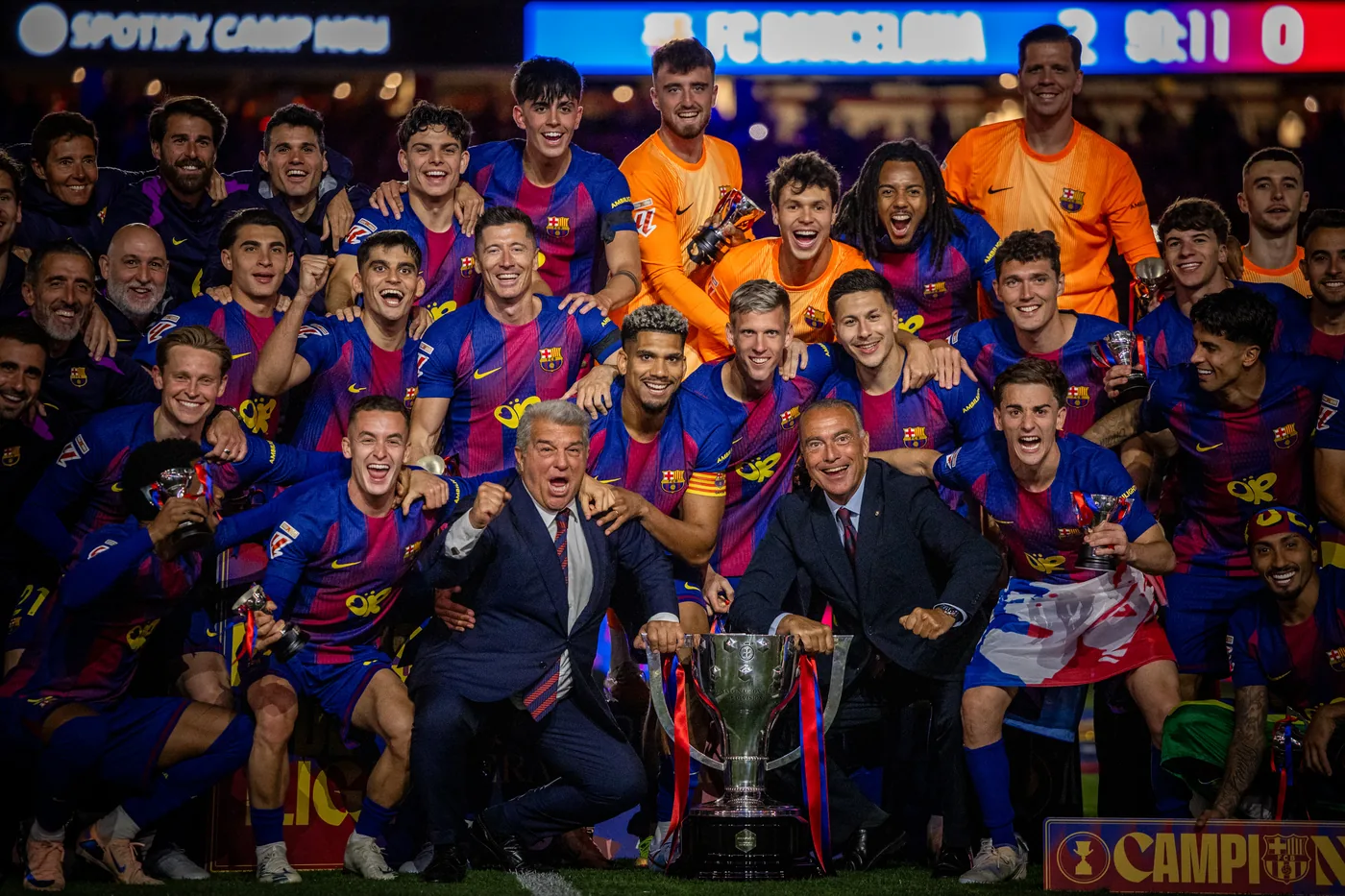
The Short Answer: La Liga Means "The League"
La Liga literally means "the league" in English. La is the feminine singular form of the Spanish definite article, equivalent to English "the," and liga is a feminine noun meaning "league." Put together, the two words form a normal Spanish noun phrase as well as the familiar name used for Spanish professional football.
la
The feminine singular definite article: the.
liga
A feminine noun: league, including a sports competition.
The Real Academia Española gives a precise sporting sense for liga: a competition in which the registered teams play against all the others. That describes the basic idea of league play, where results accumulate into a table. It also explains why the phrase feels ordinary to a Spanish speaker. In isolation, una liga can mean "a league," while la liga can mean "the league" already understood from context.
Capitalisation adds the football shortcut. English-language fans usually write La Liga when they mean Spain's men's top division, much as they use the Premier League as a proper competition name. The official organisation now styles its brand as LALIGA, but ordinary editorial writing still commonly uses La Liga for the top flight.
The literal translation alone is therefore correct but incomplete. In a football conversation, "La Liga" normally points to the Spanish competition whose clubs appear in the La Liga table. In an unrelated Spanish sentence, the same two words could refer to a different league that the speakers already know.
How to Pronounce La Liga in Spanish
A practical English guide is lah LEE-gah. Say four short syllables—la, then LEE-gah—and put the main stress on LEE. Do not pronounce liga like the English words "lie-ga" or "lie-ger." The Spanish i is a clean vowel close to the sound in "machine."
Say it in two beats
la LEE-gah
Broad IPA: /la ˈliɡa/ · Common connected-speech realisation: [la ˈliɣa]
The two phonetic forms are not a contradiction. Spanish treats the consonant as the phoneme /g/. RAE phonetics notes that this sound is often a full closure after a pause or nasal but becomes a softer approximant between vowels. Because the g in the connected phrase la liga follows the final a of la, a native speaker may make it gentler than the hard English g in "go." Using an ordinary hard g is still an understandable starting point for an English speaker.
Keep both a vowels simple and open. Avoid turning the final -ga into an English "guh" with a reduced, indistinct vowel. Spanish vowels generally remain clearer from beginning to end, so the final syllable should sound like gah, not guh.
Native-speaker recordings from Spain confirm the stress pattern, although individual voices naturally differ in speed and exact consonant strength. Accent variation does not change the identity of the phrase. A careful lah LEE-gah will be recognised across Spanish-speaking regions.
Pronunciation also stays the same when a commercial label follows: LALIGA EA SPORTS begins with the same Spanish phrase. Once you can say it, use our where-to-watch guide to find the competition's legal broadcaster in your location.
What La Liga Refers to in Spanish Football
In everyday English football, La Liga usually means Spain's men's first division. Yet official material also uses LALIGA for the organisation that covers both professional men's divisions. The intended meaning comes from context, and three common uses are worth separating.
| Context | What the term normally means | Example |
|---|---|---|
| Fan or media shorthand | The Spanish men's top flight | "He scored 20 goals in La Liga." |
| Competition brand | LALIGA EA SPORTS, the first division | A standings, fixture or broadcast graphic. |
| Institution or group | The professional-league association and its 42 clubs | A financial, legal or audiovisual-rights document. |
LALIGA's institutional explainer says the association consists of the 20 clubs and sports public limited companies in LALIGA EA SPORTS plus the 22 in LALIGA HYPERMOTION. Its financial reporting is even more explicit: the top division is LALIGA EA SPORTS, the second is LALIGA HYPERMOTION, and the unqualified all-caps LALIGA grouping means the sum of both—42 professional clubs.
That wider institutional meaning matters in sentences about financial controls, central broadcasting rights, technology or league administration. Saying "LALIGA introduced a policy" may refer to the organisation. Saying "Barcelona won La Liga" refers to the first-division championship. The capital letters alone provide a branding clue, but the verb and subject matter usually make the meaning clear.
The formal federation title supplies another layer. RFEF labels the top competition Campeonato Nacional de Liga de Primera División, meaning the National First Division League Championship. LALIGA says it organises the professional national competitions in coordination with RFEF while retaining its own legal personality and autonomy for internal operation. The brand, competition and organising institutions are related, not interchangeable legal labels.
A quick context decoder
| Phrase | What it points to |
|---|---|
| a La Liga club | One participating team in Spain's first division. |
| a La Liga match | One fixture whose result contributes to the league season. |
| the La Liga table | The ordered standings built from every club's results. |
| the La Liga champion | The club that wins that season's league competition. |
| LALIGA announced | Usually the organising association speaking institutionally. |
This decoder matters because search questions sometimes treat the words as the wrong kind of thing. La Liga is not a country: the country is Spain. It is not the Spanish national team, which represents Spain in international football. It is not a single club such as Barcelona or Real Madrid; those clubs compete within it. It is also not the name of one annual final.
The official 2026/27 club page lists 20 first-division participants, while the live standings place them in order using points, games played, wins, draws, losses, goals for, goals against and goal difference. Those columns reveal the sporting meaning more clearly than branding does. Each match adds evidence to a season-long table, and the table identifies the champion.
RAE's definition reinforces that structure by describing a sports league as a competition in which the registered teams play the others. LALIGA's honours page then records the championships accumulated by clubs. So "winning La Liga" means winning a league season, while "winning a La Liga match" means earning one result inside that larger campaign. A club can win a match without winning the title, and there is no contradiction.
Finally, distinguish a competition season from the organisation's continuous existence. The 2026/27 La Liga season has a defined set of fixtures and a champion; LALIGA as an institution operates across seasons. This is why a sentence about a season can take a year label, while a statement about governance may not.
For a supporter, the simple rule is enough: schedules, results, titles and the 20 La Liga teams normally concern the top flight. A document discussing 42 clubs or two divisions is using LALIGA as the broader professional-football organisation.
La Liga, Primera División and LALIGA EA SPORTS
Three labels often appear beside the same fixtures. La Liga is the familiar international shorthand. Primera División means "First Division" and is the durable formal category. LALIGA EA SPORTS is the current commercial competition name used in league branding and broadcasts.
La Liga
Best understood as the traditional fan and editorial name for Spain's men's top league.
Primera División
The first tier; RFEF uses the fuller title Campeonato Nacional de Liga de Primera División.
LALIGA EA SPORTS
The title-sponsored brand for that first division in the current naming cycle.
LALIGA announced the EA SPORTS partnership in 2023 as a five-season strategic agreement. Its announcement said the first division would take the LALIGA EA SPORTS name, while the second division would become LALIGA HYPERMOTION. Current 2026/27 league communications still use the EA SPORTS title for the top flight.
The sponsor words do not change the Spanish translation. EA SPORTS is not hidden inside the meaning of la liga; it identifies the title partner. This is similar to a stadium or cup adopting a commercial name while retaining a formal sporting identity. Because partnerships have defined terms, a historical article should use the label that applied in that season rather than retroactively renaming every championship.
For normal English prose, "La Liga" remains clear. Use "LALIGA EA SPORTS" when reproducing the current official brand, and "Primera División" when the formal tier distinction matters. All three can lead to the same day's games on the La Liga schedule; the difference is register and purpose, not a different set of top-flight fixtures.
Where LALIGA HYPERMOTION Fits
LALIGA HYPERMOTION is Spain's professional men's second division. It sits directly below LALIGA EA SPORTS in the league system. Fans may search for "La Liga 2," "Spanish Segunda" or "Segunda División," but the current official commercial brand is LALIGA HYPERMOTION.
Tier 1 · 20 clubs
LALIGA EA SPORTS
Primera División, usually called La Liga in English.
Tier 2 · 22 clubs
LALIGA HYPERMOTION
Segunda División, the professional second tier.
The distinction resolves an apparent numbers problem. If a page says La Liga has 20 teams, it is almost certainly describing the top division. If an official institutional or financial document says LALIGA includes 42 clubs, it is combining the 20 first-division clubs and 22 second-division clubs. LALIGA's 2026 Fantasy announcement used exactly that combined total when it added HYPERMOTION's 22 clubs.
Hypermotion is not a Spanish word that changes the translation of liga. LALIGA's original naming announcement connected it with EA SPORTS FC's motion-capture technology. Like EA SPORTS in the first-tier title, it is a commercial identity applied to a familiar sporting level. RFEF still has a distinct page for Segunda División, literally "Second Division."
The two divisions are related within professional Spanish football but should not be merged in statistics. A player can score in HYPERMOTION without that goal counting as a top-flight La Liga goal. Likewise, a club's season in the second tier is not part of its first-division record. When comparing rosters or histories, check the season and division in our La Liga teams guide.
For clear English, use "La Liga" for the top flight unless the context says otherwise, "LALIGA HYPERMOTION" for the current second-tier brand, and "Spanish professional football" when intentionally discussing both.
How to Use "La Liga" Correctly in English
Use La Liga in ordinary English when referring to Spain's men's top division, and use LALIGA when reproducing the organisation's current corporate brand. The difference is editorial register, not pronunciation. LALIGA's 2023 identity announcement explicitly changed the former LaLiga styling to one word in all capitals, and its current pressroom follows that form.
Natural and clear
- Real Madrid play in La Liga.
- She checked the La Liga table.
- LALIGA published its financial report.
- The formal tier is Primera División.
Better avoided
- Real Madrid play in the La Liga.
- La Liga means the Spanish league final.
- EA SPORTS is part of the Spanish translation.
- Every Spanish-language "la liga" means Spain's top flight.
The first incorrect example duplicates the definite article: la already means "the." English does add an article when another noun controls the phrase, as in "the La Liga title" or "the La Liga table." Here, La Liga behaves like a modifier of title or table; the English article belongs to the full noun phrase.
Capitalise the competition name in prose. RAE orthography applies capitals to the words forming official sports-competition names, while LALIGA's own wordmark uses its all-caps corporate treatment. Lowercase la liga is appropriate when the words are merely ordinary Spanish for a contextually known league rather than the Spanish top-flight name.
Time matters. Use the commercial label that belonged to the season being discussed, or use the stable terms La Liga and Primera División. Calling a championship from decades ago "LALIGA EA SPORTS" projects a modern sponsor name backwards. Conversely, a current brand asset should not be redrawn as "LaLiga" simply because that was the official styling before the 2023 rebrand.
Geography matters too. Spanish-speaking countries have many leagues, and local writing can naturally say la liga about them. Add "Spain," "Spanish top flight" or a formal competition name when the audience could misunderstand. For more plain-English explainers that separate current branding from football structure, browse our La Liga guides.
Comments
Sign in with Google to comment. Keep the conversation useful and football-focused. New comments are reviewed before they appear.
Loading comments…