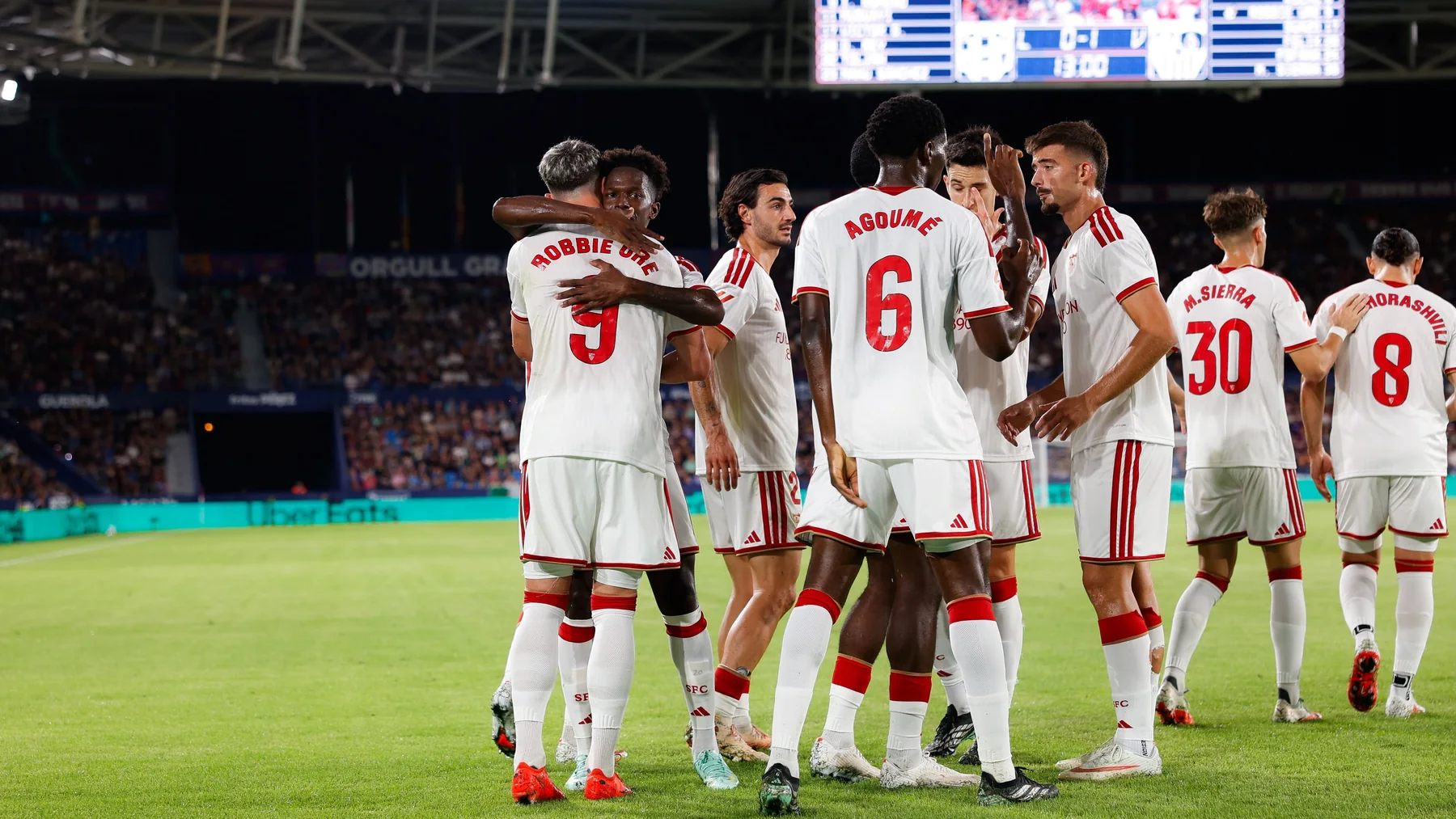
Sevilla’s current players and shirt numbers
Sevilla’s 2026/27 squad combines a rebuilt senior team with academy players who are already competing for minutes. The tables below identify their shirt numbers as checked on 14 October 2026. They follow the club’s broad positional groups, with Fábio Cardoso and Nico Guillén added from the league profile and official number announcement respectively. This is a player guide, rather than a claim that all 27 names occupy senior registration places.
The club’s first-team page and number announcement are useful together. The announcement’s introductory sentence contains a Suazo number error; its complete list and the current player cards agree that the captain wears 17, while Arouna Sangante wears 12. For the wider competition, see our La Liga teams guide.
Goalkeepers
| Number | Player |
|---|---|
| 1 | Odysseas Vlachodimos |
| 13 | Fran González |
| 33 | Rafa Romero |
The club lists these three goalkeepers on its current first-team page. A travelling squad can differ: Loren went to Levante as the third goalkeeper on 12 October instead of Rafa. That distinction matters when using a season roster to identify the substitutes at a particular game.
Defenders
| Number | Player |
|---|---|
| 2 | Juan Iglesias |
| 3 | Julio Díaz |
| 4 | Kike Salas |
| 5 | Andrés Castrín |
| 12 | Arouna Sangante |
| 15 | Fábio Cardoso |
| 17 | Gabriel Suazo |
| 22 | José Ángel Carmona |
| 23 | Marcão |
Cardoso’s La Liga profile confirms number 15. His inclusion in Sevilla’s latest Levante selection also explains why a guide limited to the displayed club cards would miss a relevant defender. The unit offers experienced centre-backs, academy graduates and natural options on both flanks.
Midfielders
| Number | Player |
|---|---|
| 6 | Lucien Agoumé |
| 8 | Giorgi Kochorashvili |
| 11 | Rubén Vargas |
| 14 | Manu Bueno |
| 18 | Jon Guridi |
| 24 | Youssouf Fofana |
| 27 | Nico Guillén |
Vargas appears in the club’s midfield category, although his attacking contribution belongs in any discussion of the wide positions. Nico’s academy number is another reason to distinguish a broad season list from the players selected for one match; he was absent from the October Levante call-up.
Attackers
| Number | Player |
|---|---|
| 7 | Alfon González |
| 9 | Robbie Ure |
| 10 | Peque Fernández |
| 16 | Isaac Romero |
| 19 | Lucas Stassin |
| 20 | Félix Correia |
| 21 | Chidera Ejuke |
| 30 | Miguel Sierra |
Peque sits in the club’s attacking group, reflecting a squad in which a player can connect midfield to the forwards without fitting a single fixed position. The attacking numbers cover centre-forwards, wide creators and a young academy option, rather than eight interchangeable strikers.
Suazo and the captaincy under Luis García Plaza
Gabriel Suazo is Sevilla’s first captain for 2026/27. The club confirmed the complete leadership group on 11 October, giving a clear answer to a question that older squad pages can obscure. Kike Salas is second captain and Lucien Agoumé third. Luis García Plaza selected those three, while Marcão keeps fourth position from the previous season. The players elected José Ángel Carmona and Odysseas Vlachodimos as fifth and sixth captains.
That distribution gives the leadership group a presence at goalkeeper, across the defence and in central midfield. It also brings academy products Kike and Carmona together with players who arrived from elsewhere. The practical value, in our view, is that leadership can stay visible even when one established player is absent or substituted. The captaincy announcement identifies responsibilities; it does not guarantee a starting place for every member.
García Plaza became head coach in March 2026, with the appointment running to 30 June 2027. His career includes promotions with Levante, Mallorca and Deportivo Alavés, as well as experience establishing teams in the top flight. Those are relevant credentials for a squad with substantial turnover: coordinating new arrivals and turning individual strengths into repeatable league performances are central demands of this season.
The coaching staff and the new squad
The current club staff page lists Pedro Rostoll and Javi Martínez as assistant coaches, Arturo González as goalkeeper coach, and Félix Vicente and Rubén Martínez in fitness roles. Christian Moya, Juan Antonio Guzmán and Adrián García form the listed analyst group. This gives supporters a fuller picture of the people responsible for preparation than the head coach’s name alone.
Before the October trip to Levante, García Plaza described an intense, direct side that creates chances and is improving with the ball. His pre-match assessment also placed importance on managing the game. Our reading is that Sevilla’s attacking ambition has to be supported by sensible distances between the lines. If the forwards press but midfield cannot cover behind them, intensity alone will not provide control. That is a useful way to assess this group without reducing every match to one formation label.
Odysseas Vlachodimos and the goalkeeper options
Odysseas Vlachodimos provides an experienced reference point in a changing squad. Sevilla’s July loan announcement confirmed another season from Newcastle United after he had played 33 league matches and one Copa del Rey match in 2025/26. His return therefore preserves a goalkeeper who already knows the club and the competition, rather than beginning another unfamiliar partnership behind the defence.
His earlier career includes five seasons at Benfica and Portuguese league titles in 2018/19 and 2022/23. That background helps explain the experience behind the current number 1, but his Sevilla role should be judged through present performances rather than reputation alone. Our tactical reading is that a defence containing several new players benefits from clear decisions behind it: when to claim a cross, when to stay on the line and where to offer an outlet under pressure.
Fran González represents a different part of the plan. The goalkeeper joined permanently from Real Madrid in August, with Sevilla announcing a contract until June 2031. At the time of the transfer he was 21, stood 1.99 metres tall and had just completed a season of 28 appearances for Castilla. Madrid’s announcement also confirmed that he had spent four years in its academy and made his first-team debut in 2025.
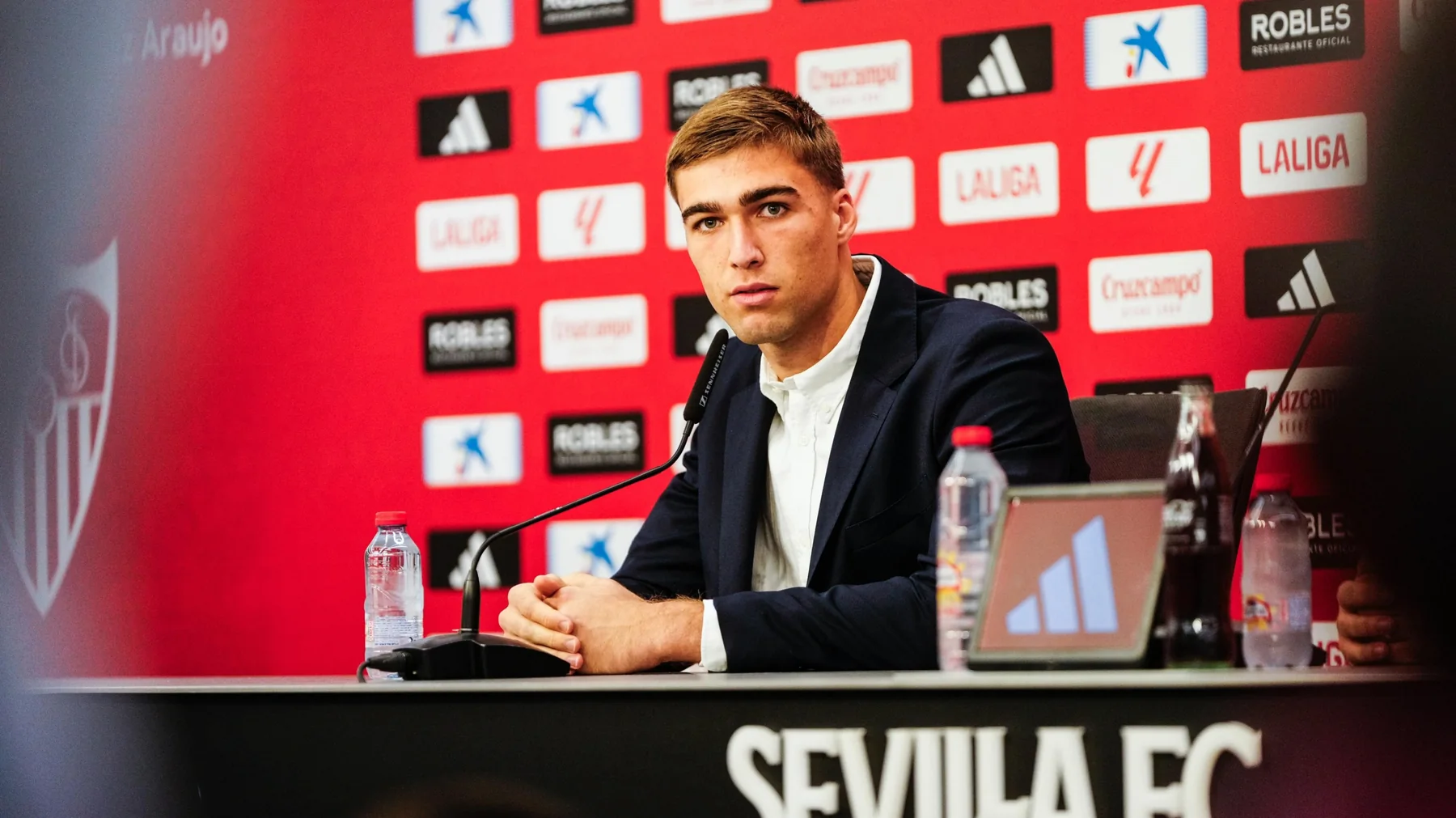
At his Sevilla presentation, Fran highlighted his involvement in possession and dealing with high balls, while describing Odysseas as someone he could learn from. Those are his own stated strengths, not a guarantee of an immediate change in the goalkeeping hierarchy. They do, however, identify the areas supporters can watch when he gets opportunities.
Rafa Romero’s presence on the club page adds the academy connection. The October Levante selection used Loren as its third goalkeeper instead, illustrating that development and match preparation can involve a wider group than the main display. Taken together, the options give Sevilla an established keeper, a young permanent signing and additional academy coverage.
Building the defence around experience and academy players
Sevilla can build defensive combinations from players who know the club and recruits with experience elsewhere. That mix is visible in the centre and on the flanks. The football question is how reliably those combinations work together when Sevilla attacks, loses possession or has to defend its penalty area for sustained periods.
The central defenders
Kike Salas offers a strong academy connection. His first-team debut came in the 3-2 win at Espanyol on 10 September 2022, followed by a Tenerife loan and a growing role after returning. The club’s account of his development traces that progression through several seasons. Together with Andrés Castrín, who now wears a senior first-team number, he gives the central defence a route from Sevilla Atlético to regular first-team responsibility.
Arouna Sangante adds a different background. He arrived from Le Havre as a free agent in June, signing until 2031. The signing announcement identifies him as a centre-back who can also play on the right, with 74 Ligue 1 matches and experience captaining Le Havre before the move. Marcão and Fábio Cardoso widen the available central-defensive group rather than leaving the coach with only one pair.
Our assessment is that depth matters particularly when defending set pieces or adjusting to opponents who attack the channels beside the centre-backs. The names offer alternatives, but the quality of the unit depends on communication and collective positioning. Different selections should be assessed through those actions, rather than treating any one pairing as automatically superior.
Full-backs on both sides
Juan Iglesias and José Ángel Carmona provide right-sided options, while Suazo and Julio Díaz cover the left. Julio’s July transfer from Atlético Madrid brought a player contracted until 2031 who had already won the 2024 European Under-19 title with Spain and gained senior league experience the following season.
Iglesias has already supplied a decisive attacking contribution. His 81st-minute header settled the 1-0 win over Valencia on 11 September. Valencia’s own match report confirms that he met a free kick at the back post; it also lists Kike and Castrín together in the starting defence. That is a concrete example of the unit contributing beyond protecting its own goal.
When a full-back advances, midfield must cover the space behind him and the opposite side must judge its positioning. This is our tactical interpretation, not a prescribed team instruction. It gives supporters a useful detail to follow alongside the completed match results: whether Sevilla can gain width and attacking numbers without opening an easy route back toward its own penalty area.
Agoumé, Fofana and the midfield combinations
Lucien Agoumé and Youssouf Fofana are important names when reading Sevilla’s central midfield. Agoumé’s permanent transfer from Inter dates to 2024; Fofana arrived from AC Milan on loan in September 2026. Milan confirmed the loan runs to 30 June 2027, while Sevilla specified that it contains no purchase option. They belong to different stages of the squad’s construction, even when they appear together on the pitch.
New arrivals and different roles
Fofana has already demonstrated a contribution beyond the defensive-midfield label in his transfer announcement. Against Barcelona on 19 September, he moved into the scoring position to finish Félix Correia’s cross from the left. The club’s match report records Sevilla taking the lead before Raphinha’s three goals produced a 1-3 defeat. The attacking run was productive, even though the result also exposed the difficulty of sustaining control against a strong opponent.
Giorgi Kochorashvili joined from Sporting in August on a contract until 2030. His earlier experience at Levante and Castellón gives him familiarity with Spanish football before this return. Jon Guridi arrived from Alavés on a two-season deal and already knows García Plaza from their time together in Vitoria. The Guridi announcement makes that working relationship a concrete part of his background, rather than an assumed connection.
Manu Bueno and Nico Guillén add academy options to the midfield group. Our assessment is that the coach’s decisions involve combinations as much as individual talent: someone must offer a passing angle, someone must protect the defence, and forward movement must leave enough cover if possession is lost. A goal from a central midfielder is most useful when the team can also manage the transition immediately afterward.
Peque, Vargas and the link to attack
Peque Fernández brings a finishing background as well as creativity. Sevilla described him as a playmaker capable of working on the left or as a striker when he arrived from Racing Santander in 2024. His preceding season yielded 18 goals in 40 second-tier league games. That historical record helps explain the attacking expectations around number 10; it is not his current La Liga tally.
Rubén Vargas joined from Augsburg in January 2025. His return to the October Levante squad widened the available creative group, although García Plaza’s pre-match remarks still described a gradual return to full fitness. That was the situation for that particular game. In football terms, our reading is that Vargas and Peque can help connect central possession to the penalty area through different starting positions. Their contribution should include chances created and useful combinations, alongside goals, rather than being judged only by the positional category used on a roster page.
Isaac Romero, Robbie Ure and Sevilla’s attacking choices
Sevilla’s attacking group includes new recruits and academy players with meaningful first-team contributions. The options can be understood through their work around the penalty area, their ability to combine and the pressure they apply when opponents have the ball. Those details help explain how the forwards fit together beyond a list of goalscorers.
Centre-forwards and wide players
Robbie Ure arrived from Sirius with an impressive scoring run: the Swedish club’s transfer announcement recorded 15 goals in 15 Allsvenskan games during 2026. In his first Sevilla interview, he also emphasised linking play and holding the ball for teammates, rather than presenting himself solely as a penalty-area finisher. The Swedish tally belongs to his pre-transfer record; his Sevilla contribution is a separate story.
The October Levante game supplied an example of both sides of that profile. Ure started the opening-goal move by winning possession near the opposition area. He then helped create Félix Correia’s goal with a headed lay-off after Miguel Sierra’s cross. Pressing, finishing and assisting all featured in one game. Our reading is that this variety makes the relationship between the central striker and wide players particularly worth following.
Lucas Stassin came from Saint-Étienne on a loan with a purchase option, confirmed by the French club. Félix’s loan from Lille contains no purchase option. That distinction explains the transfer arrangements without implying that either player has already joined permanently. Chidera Ejuke and Alfon González add further wide choices, alongside a group that can place several different players around its centre-forward.
Miguel Sierra and the academy connection
Miguel Sierra’s early-season impact has been tangible. After scoring his first senior league goal against Atlético Madrid, he supplied the winner in the 1-0 victory at Deportivo on 16 September. The club’s following-day profile also credited him with ten ball recoveries and twelve duels won at Riazor. Those match-specific figures support a broader picture than the winning finish alone: an attacker contributing to the team’s work without the ball.
Isaac Romero carries another visible academy connection through number 16. Sevilla’s number announcement places him in the tradition associated with Antonio Puerta and later academy players, including Jesús Navas and Juanlu Sánchez. Isaac’s path through the reserve setup led to his senior league debut against Alavés in January 2024.
For supporters, Sierra and Isaac make the academy presence easy to identify in attacking positions. Their value is already expressed through actual goals and match contributions. The next developmental challenge, in our view, is repeating those contributions while the coach rotates or changes the surrounding players, allowing promising individual performances to become dependable options across a long campaign.
What the 2026/27 season asks of this squad
Sevilla reached 14 points after eight league matches, with two wins and two draws across its first four away fixtures. The club’s 13 October review also counted 13 goals from eleven different scorers, including two each for Isaac Romero and Miguel Sierra. That season total includes Oso, who had already moved to Strasbourg in August; it describes everyone who scored for Sevilla during the campaign, rather than eleven goalscorers still in the current squad.
Shared scoring is an encouraging feature of this group. A full-back’s set-piece goal, a midfielder arriving to finish and an academy forward supplying a winner all offer different routes to points. In our assessment, spreading that responsibility makes the attack less dependent on one player having an outstanding afternoon. The league table remains the measure of whether those contributions are translating into results over time.
The 3-3 draw at Levante also identified an immediate challenge. Sevilla led 2-0, then regained the lead through Isaac in added time, yet still conceded another equaliser. Levante’s report confirms both the late recovery and Isaac’s dismissal for two yellow cards. The match showed the difference between producing enough attacking moments to win and completing the job collectively.
Our priorities for assessing the squad are therefore concrete: the way midfield supports the defence after substitutions, the protection of the penalty area late in games, and discipline when a match becomes emotionally charged. These are football judgments drawn from that result, not a claim that one game defines every player. They give this season’s new arrivals and academy graduates shared objectives alongside their individual development. Follow the current match schedule to see the next opportunities for those combinations to work on the pitch.
Comments
Sign in with Google to comment. Keep the conversation useful and football-focused. New comments are reviewed before they appear.
Loading comments…