What decided the 2024 Ballon d’Or result?
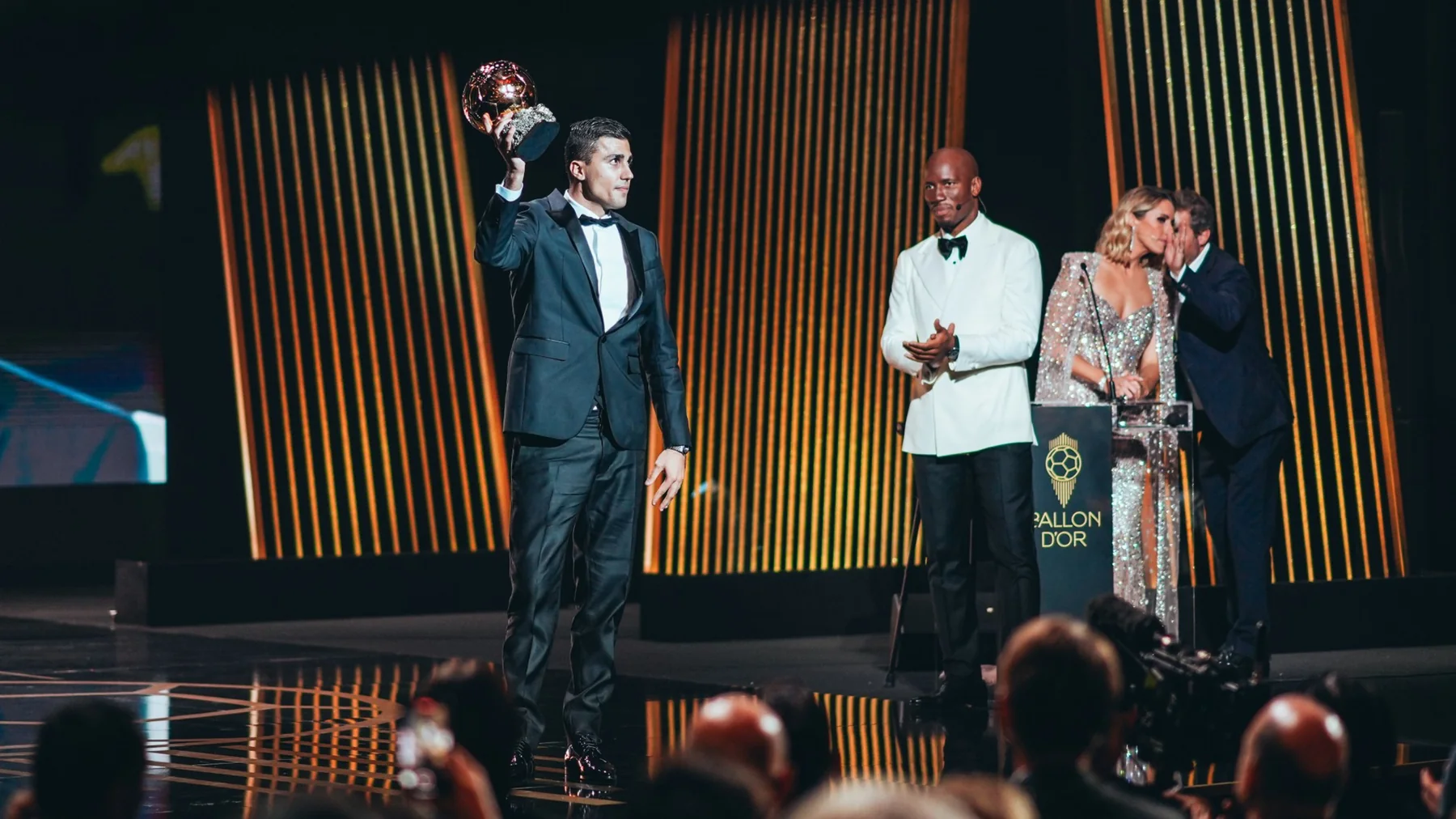
Rodri won the 2024 men’s Ballon d’Or ahead of Vinícius Júnior by 41 points: 1,170 to 1,129. The trophy was presented in Paris on 28 October 2024; the detailed points became public afterwards. These are two separate pieces of the story: the ceremony established the winner, while the November breakdown showed how close the ranked-ballot contest had been. GOAL’s published voting table records both totals.
For a football comparison, the useful question is what each candidate offered during the assessed season. Rodri represented Manchester City and Spain in that evaluation; Vinícius represented Real Madrid and Brazil. Their later achievements cannot strengthen or weaken an already completed vote. This article keeps the historical contest separate from today’s fixtures, form and transfer stories.
The judging period and the three criteria
The 2024 edition evaluated the season from 1 August 2023 to 31 July 2024, including the summer international tournaments. It was not a calendar-year award running through December. The historical edition record identifies that window. Consequently, a spring Champions League performance and a July international performance could both matter in the same decision.
UEFA’s 2024 voting explanation lists individual performance and decisive impact, team performance and achievements, then class and fair play. Journalists representing eligible countries in the FIFA ranking’s top 100 selected ten names from a thirty-player shortlist. No published formula assigned a goal, league title or international trophy a fixed numerical value. The criteria guided a football judgment; the points recorded each journalist’s ranking.
Why a 41-point margin is not 41 votes
Each ballot awarded 15 points for first place, then 12, 10, 8, 7, 5, 4, 3, 2 and 1 down to tenth. The highest total won; first-place selections were a tiebreak if totals matched. A journalist could therefore contribute points to both leading candidates, rather than cast a single exclusive vote for one of them.
Imagine a ballot placing Rodri first and Vinícius second. It contributes a three-point advantage to Rodri. Reversing those two positions changes that ballot’s contribution to a three-point advantage for Vinícius, a six-point swing in their relative totals. That is a hypothetical illustration of the rules, not a claim about any actual journalist. It explains why subtracting 1,129 from 1,170 cannot tell us how many people preferred one player. The result was close in points, but the underlying rankings require their own analysis.
Comparing their club-season statistics fairly
A holding midfielder and a forward do not start from the same scoring expectation. Rodri’s normal work involved offering a central passing outlet and protecting City behind the attack. Vinícius was asked to threaten defenders, enter scoring positions and turn possession into opportunities near goal. Those responsibilities make attacking output relevant to both players, but with different significance.
| Measure | Rodri | Vinícius Júnior |
|---|---|---|
| Domestic top-flight goals | 8, Premier League | 15, La Liga |
| Domestic league outcome | Champion with Manchester City | Champion with Real Madrid |
| Champions League outcome | Quarter-final exit | Champion |
| Principal positional responsibility | Holding midfield and circulation | Attacking penetration and finishing |
City’s annual report records Rodri’s eight league goals and nine league assists. Madrid’s May scoring review already records Vinícius’s fifteen league goals. Both numbers belong to domestic league campaigns; neither includes an international tournament or the other player’s European output.
What goals and assists can tell us
Rodri was productive even against an attacking measure: City’s completed-season review lists nine goals in fifty club appearances, alongside 4,935 successful passes and 92.33% passing accuracy. Vinícius’s European record supplied a different kind of evidence. UEFA’s season award profile lists six goals and five assists in ten Champions League appearances, covering 901 minutes.
The five assists here are specifically UEFA’s count. Madrid’s own Champions League award announcement lists four. Such differences are a reason to identify the competition’s published figure, rather than quietly add numbers from several statistical conventions into an apparently exact club-and-country total. A one-assist difference should not become the decisive argument in a contest about a full season’s impact.
Goals tell us who finished moves. Assists identify a credited final contribution. Neither consistently captures the pass that escapes a press, the run that drags a defender away, or the positioning that stops a counterattack before it becomes a chance. Rodri could improve an attack while remaining behind the ball; Vinícius could improve it by drawing a second marker and leaving a teammate free. These are different routes to an advantage, not excuses to ignore output.
The stronger comparison asks whether each player excelled in the tasks his team needed. High completion is valuable when it sustains pressure and progresses possession; riskier attacking actions are valuable when they break an organised defence. For present-day scoring races, the La Liga top-scorers page answers a separate question. It cannot retrospectively rank the full contribution of two players in the 2024 award.
Consider the cost of losing possession in each area. A forward attempting to beat the last covering defender may accept a failed action because success creates an immediate scoring chance. A holding midfielder turning into traffic in front of his centre-backs can expose his team to a direct counterattack. Identical completion rates would not mean identical decision quality. Conversely, a safe midfielder who never advances the ball can limit his team despite attractive accuracy figures. The location, available options and consequence of each decision belong in the comparison.
Rodri’s case: control for Manchester City and Spain
Rodri’s strongest argument began with the quality of City’s possession, rather than a claim that midfielders deserve a separate award standard. A reliable central outlet changes what teammates can attempt. Defenders can pass forward into pressure, attacking midfielders can stay higher, and wide players can receive the ball after the opponent has been moved across the pitch. The holding player’s decisions connect those actions.
Watch the sequence around a reception, not just the completed pass. Has he checked the space behind him? Can he turn, or does a quick return pass preserve the advantage? After releasing the ball, does his next position give the receiver another option while keeping the team protected? This is how control becomes useful football. A player who repeatedly solves those problems can influence many attacks without being credited with their last pass.
City’s season review notes that the team lost all three league games Rodri missed through suspension. That supports his importance, but it does not establish that his absence alone caused every defeat. Opponents, other missing players and the replacement midfield also matter. A strong case for him need not turn a correlation into an absolute claim that City could never win without him.
He also supplied a visible decisive action on the final league day. Against West Ham on 19 May, City’s two-goal lead had been cut to one before Rodri scored in the 59th minute. The official match report records a 3–1 victory that secured the title. His finish restored breathing space; his contribution was not confined to maintaining possession while teammates did every important thing.
Why EURO 2024 strengthened his claim
Spain added a second setting in which to assess the same qualities. Rodri played 521 minutes, scored once and registered 92.84% passing accuracy at EURO 2024. He started six of Spain’s seven matches, partnered Fabián Ruiz in central midfield and scored in the 4–1 round-of-16 victory over Georgia. UEFA’s technical observers named him Player of the Tournament.
That recognition matters because it was an individual assessment within a successful team, not merely an international trophy appearing beside his name. It reinforced the argument that his influence survived a change of coach, teammates and competition. It also broadened his case beyond the Premier League: an award judging the whole season could reasonably give substantial attention to a strong summer tournament.
There is a necessary qualification. Rodri was forced off at half-time in Spain’s 2–1 final victory against England. He did not personally control the entire winning final, and the team’s ability to finish the job shows the strength around him. The sound argument is that his tournament contributed to Spain’s success and earned specialist recognition. It is stronger than pretending one midfielder single-handedly delivered a national title.
Vinícius Júnior’s case: decisive attacking impact
Vinícius’s strongest claim was his capacity to decide elite matches through attacking actions that are difficult to replace. A defence can prepare to close the left side, provide cover behind its full-back and still be vulnerable to his acceleration or a run through the centre. The threat changes the opponent’s shape before the eventual shot or assist appears.
His value was particularly clear when Madrid could not assume long spells of dominance. A dangerous outlet gives a team a way out of pressure. It forces defenders to consider the space behind them, even while their own side attacks. Rodri’s control made possession more secure; Vinícius’s penetration could make a smaller share of possession more damaging. A preference for one form of influence should still recognise the other.
The Champions League knockout evidence
The first leg against Bayern on 30 April supplies a concrete example. Vinícius opened the scoring after Toni Kroos’s through ball, then converted a late penalty as Madrid recovered to draw 2–2 in Munich. Both UEFA’s report and Bayern’s account identify those two goals. The first combined movement and timing with a fine pass; the second required execution under pressure.
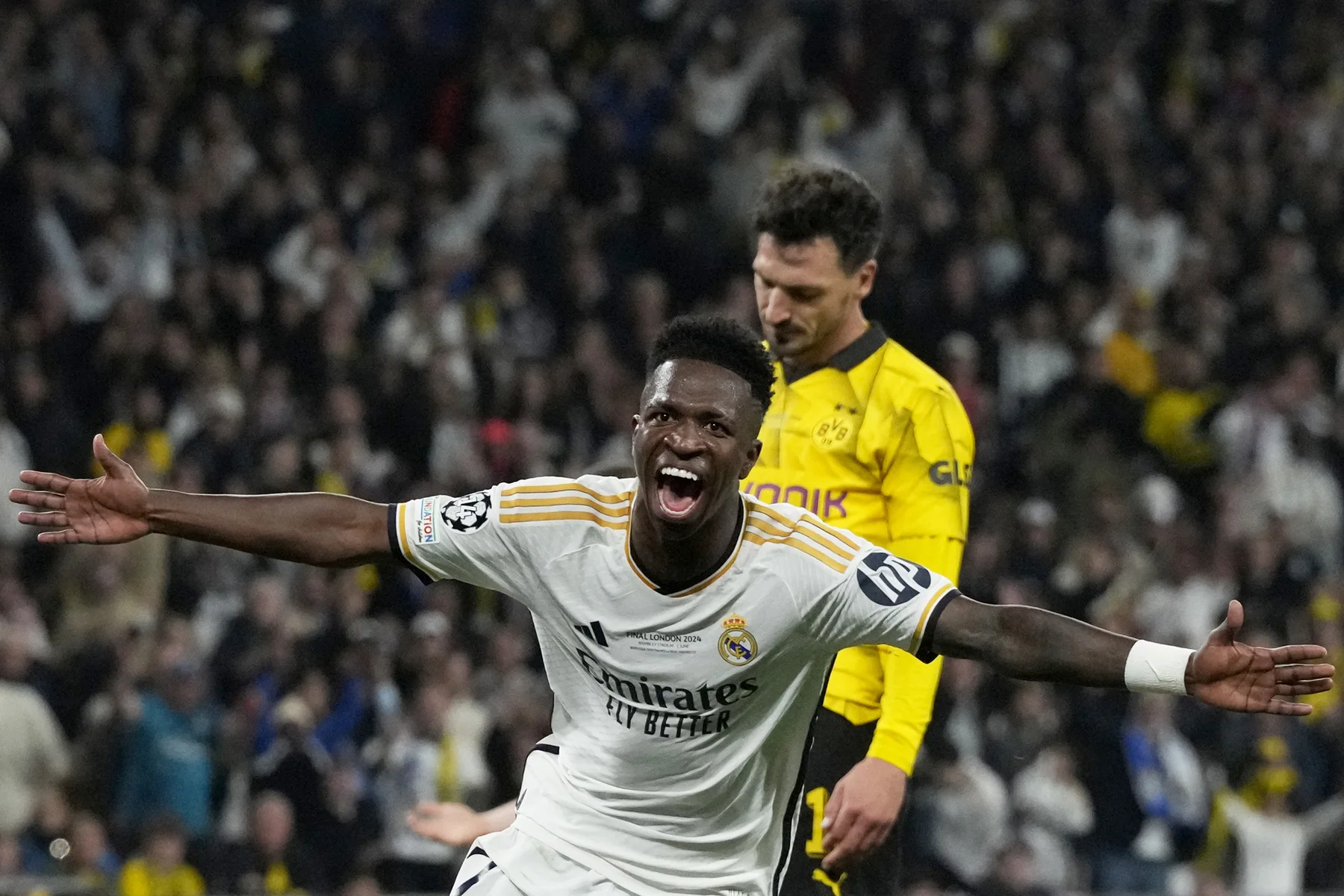
At Wembley on 1 June, he scored Madrid’s second goal in the 2–0 final victory over Dortmund. The final report also makes the collective effort clear: Dani Carvajal supplied the breakthrough, while Thibaut Courtois made important saves. Vinícius’s season award therefore supports a major individual contribution without making every round of Madrid’s run his personal achievement.
Club excellence and Brazil’s different summer
Brazil’s Copa América did not give him a parallel international triumph. Nevertheless, describing his entire summer as empty would ignore his two goals in the 4–1 win over Paraguay. The tournament’s official account records the brace and his attacking influence in that group match.
Brazil subsequently exited against Uruguay on penalties after a goalless quarter-final. Vinícius missed that match through suspension after two group-stage bookings, as AS’s team-news report confirms. He was unavailable to change the result; he was not an on-field participant in the elimination. The official match recap records Brazil’s departure.
That difference gave Rodri a stronger summer component, but it does not erase Vinícius’s club case. National teams have different combinations, coaches and routes through a tournament. The fair judgment considers what each player actually contributed and where he was available, rather than treating a team’s final placement as an automatic individual score.
How to judge the comparison without reducing it to one number
The most persuasive preference for Rodri values sustained midfield influence across two successful teams, with EURO 2024 adding a major individual distinction. The most persuasive preference for Vinícius values attacking impact in the toughest club knockout matches, with a Champions League season award reinforcing that judgment. Both arguments have concrete football behind them. Neither needs to dismiss the other player’s season as ordinary.
Be careful with the popular vote-splitting explanation. Jude Bellingham finished third on 917 points and Dani Carvajal fourth on 550, according to the published rankings. Their strong positions show Madrid had several highly rated candidates. They do not establish that those points would otherwise have gone to Vinícius. One journalist could rank several Madrid players, and a different shortlist would require a fresh judgment about every place on that ballot.
It is reasonable to ask whether outstanding teammates affected voters’ interpretation of an individual’s contribution. It is a different claim to add teammates’ points together or redistribute them automatically. The award selected a player, not a club, and a hypothetical alternative vote cannot be recovered from the final totals alone.
The organisation also matters when describing responsibility for the result. UEFA’s partnership announcement says Groupe Amaury retained the brand and oversight of the independent voting system. Co-organising the ceremony does not mean a Champions League technical panel selected the Ballon d’Or winner. Those are separate judgments made through separate processes.
There was a useful illustration later in 2024: Vinícius won The Best FIFA Men’s Player award. FIFA’s announcement explains its equal weighting of fans, national-team captains, national-team coaches and media representatives. That was a separate award with a different electorate. It did not overturn Rodri’s Ballon d’Or or prove that one set of football opinions was mathematically correct.
For your own assessment, choose the principle before choosing the winner. If the decisive criterion is season-long control plus international performance, explain how Rodri fulfilled it. If it is the capacity to alter elite club ties, explain how Vinícius fulfilled it. Then acknowledge the strongest evidence for the runner-up in your personal ranking. That produces a more revealing football discussion than changing the standard every time a rival’s best moment is mentioned.
Rodri is the official 2024 winner; Vinícius had a substantial, defensible claim. The forty-one-point gap describes the jury’s final result. The lasting interest lies in what the comparison reveals about football value: making a team function consistently and supplying the action that breaks a match open can both be decisive, even when they look very different on a highlights reel.
Comments
Sign in with Google to comment. Keep the conversation useful and football-focused. New comments are reviewed before they appear.
Loading comments…