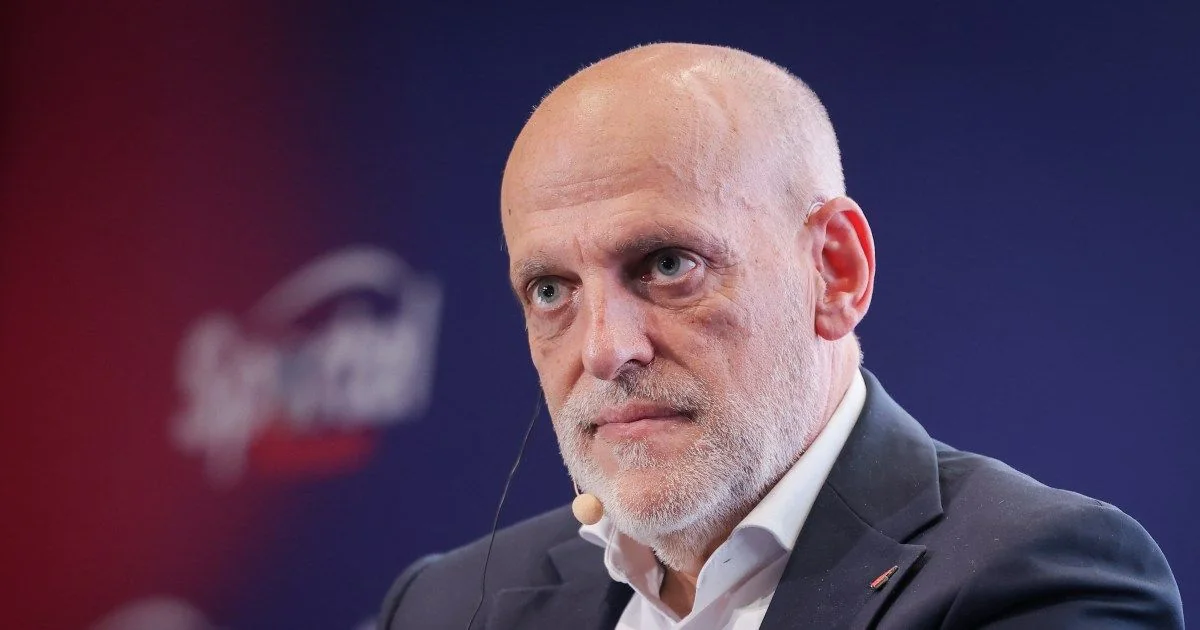
Real Madrid called for different La Liga leadership after president Javier Tebas criticised a refereeing-conspiracy narrative following the September 2026 Madrid derby. The club accused him of failing to act with institutional neutrality; Tebas answered that independence means applying the same principles to every member club, including Madrid. Neither the club statement nor his reply removed him from office. This guide traces the exchange from the original Spanish texts, separates it from the referees' review of the match, and explains how league leadership is actually chosen.
Updated September 30, 2026. Statements and governance rules are dated; consult official announcements for later developments.
How the derby dispute reached La Liga's president
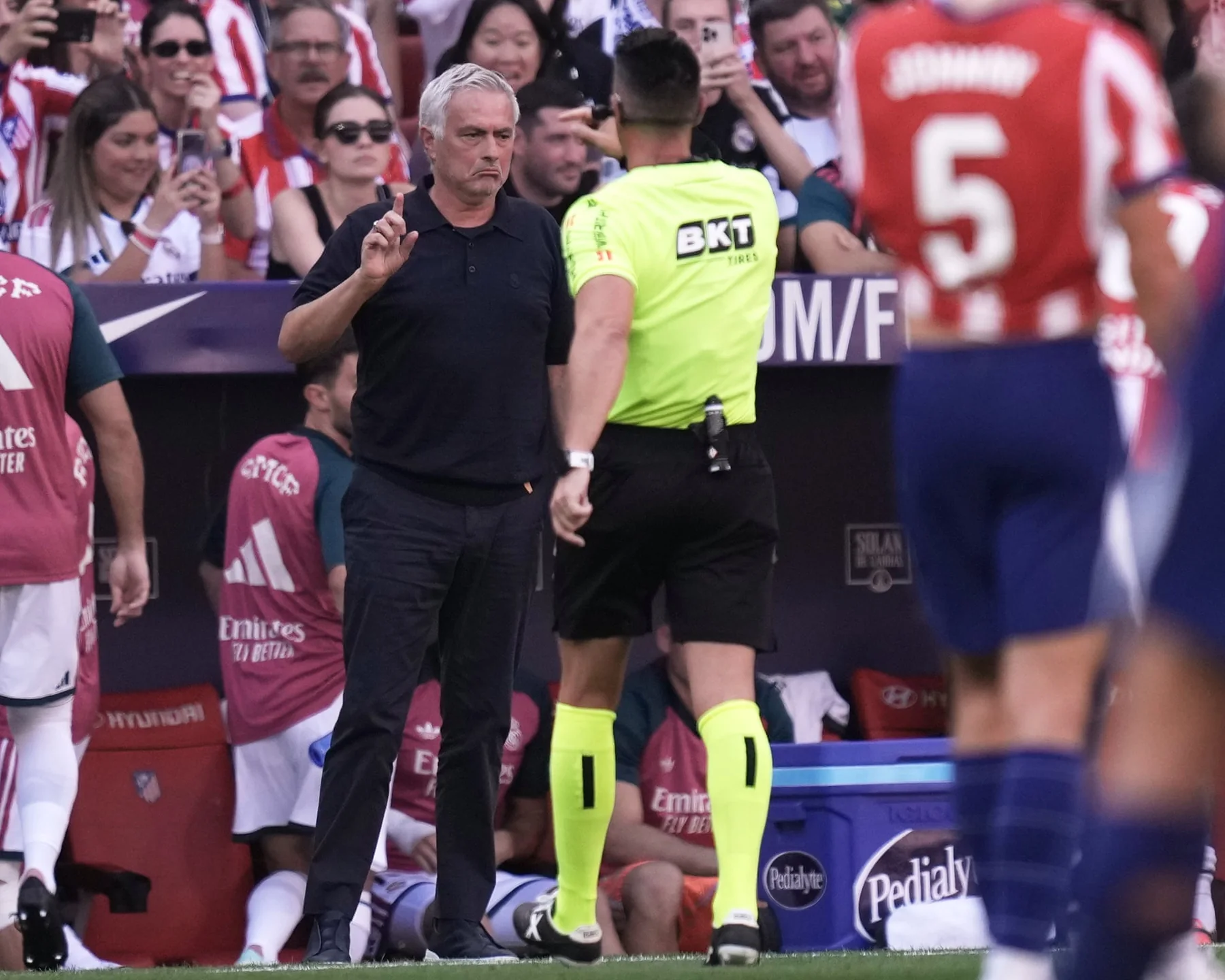
The immediate trigger was Real Madrid's 2–1 defeat away to Atlético on September 20, 2026. Madrid objected to challenges by Lee Kang-in on Federico Valverde and Cristian Romero on Jude Bellingham; coach José Mourinho used images of the incidents at his post-match press conference to argue that Atlético should have had two players dismissed. That sporting complaint became an institutional row when La Liga president Javier Tebas publicly challenged a broader narrative that the refereeing system was working against Madrid. The club then issued a formal statement about his conduct. These are three different actions by three different actors, and the order matters.
The result and Real Madrid's refereeing complaints
The Atlético match record gives the 2–1 score. The controversies do not make the result provisional. Madrid's on-field objection was strongest over the challenge on Valverde, which would subsequently be assessed by the referees' committee as deserving a red. Its complaint about Romero was also prominent in Mourinho's remarks, although that later review upheld a yellow for the Atlético defender. The distinction between those two outcomes is crucial when evaluating the club's larger case: one supported grievance cannot automatically validate every disputed incident or a claim about the system as a whole.
AFP and Reuters reporting describes Mourinho bringing two printed screenshots to the press conference and presenting them as evidence of red-card offences. He also imagined how a different pair of dismissals might have changed the match. That is a coach's argument about a counterfactual, not a finding that Atlético should have played with nine under the later review. A fan can acknowledge the emotion of a derby defeat without adopting the hypothetical score or treating the press conference as the committee's verdict.
Tebas's first response to the conspiracy narrative
Tebas did not initially post a detailed ruling on the Lee and Romero tackles. He replied publicly to a pro-Madrid commentary article and criticized what he saw as a recurring suggestion of a refereeing conspiracy. His argument, as described by The Guardian and the AFP/Reuters report, was that clubs should be treated equally regardless of their television audiences or commercial value. He also criticized the idea that the league would have little value without Madrid and questioned whether its on-pitch shortcomings were being obscured by the officiating debate.
That response widened the audience and the stakes. A manager may complain about a referee; a league president commenting on the club's public narrative raises questions about how a competition leader should communicate with a member club. Madrid argued that Tebas had moved beyond defending league-wide fairness into publicly attacking one club. Tebas argued he was rejecting a charge that threatened confidence in fair competition. The next two sections examine those claims from the parties' own texts. For the sporting record alone, supporters can start with the match result, then assess the subsequent statements separately.
What Real Madrid's September 22 statement actually says
Real Madrid's original Spanish statement is the central primary source. It is dated September 22 and is addressed to Javier Tebas in his capacity as La Liga president. It says the club considers his public remarks inappropriate for someone who must represent all member clubs. That is an accusation by Madrid, not an independent finding that the president breached a rule. The club's own English page warns that its translation was generated by AI and may contain inaccuracies; the Spanish wording should control any close reading.
The club's neutrality complaint
Madrid alleges that Tebas repeatedly uses an institutional position to criticize it publicly. It objects especially to his commenting on a journalist's article and, in the club's view, turning that reply into an assessment of its sporting strategy. It argues that the president's public behaviour damages trust in institutions expected to protect impartial competition. The club presents this as an ongoing pattern, not merely a reaction to one derby. Yet its statement does not provide a detailed inventory of all past interventions or a formal legal standard for what presidential neutrality requires. An accurate explanation should identify the complaint and also its evidentiary limits.
The distinction between neutrality and silence is part of the real disagreement. Madrid's argument is that a league president should not repeatedly attack a member or seem to take sides in a live dispute. That does not by itself establish that the president must avoid every public comment about a club. A reader can test the narrower question by looking at precisely what Tebas said in response to the commentary article and whether his comments addressed an argument about league-wide fairness or strayed into judging the club's football performance. The two parties reach different conclusions from the same exchange.
A call for different leadership, not an election result
The final part of the statement says Spanish professional football urgently needs a leader capable of administering the competition with neutrality. It emphasizes that the La Liga president is a manager serving the clubs rather than the owner of the competition. News headlines commonly describe this as a call for Tebas to resign or be replaced, and that is a fair interpretation of the political message. The original text, however, does not report a vote, name a successor, set an election date, or say Tebas has left office. It is a club demand expressed publicly, not the execution of a governance procedure.
This precision matters because a football fan might otherwise read the dispute as an immediate change to the league's management. It also keeps the club's valid role in expressing disagreement clear. Madrid is a member club with a strong commercial stake and an obvious interest in how the competition is represented. It can criticize the president's language and ask for different leadership. Whether its complaint persuades other clubs, or changes any formal office, is a separate question that requires evidence beyond a single statement. For supporters, the league table and match schedule continue to operate while that institutional debate unfolds.
How Tebas answered the demand
Tebas's own Spanish response is more useful than a second-hand description of an angry exchange. He accepts one premise of Madrid's statement: the league president does not own the competition. He immediately adds that Real Madrid's president does not own it either. From there his defence is that representing all clubs sometimes requires rejecting arguments from the most powerful one, particularly if those arguments imply refereeing should respond to the club's audience or commercial importance. Whether supporters find his tone appropriate is a matter of judgement; the position he chose to defend is clear.
Independence and criticism of the club-media narrative
The club had said he treated a journalist's opinion as if it were Madrid's own. Tebas answered that the wider narrative was not confined to one independent article. He pointed to Real Madrid TV and people he describes as club spokespeople, saying they had repeatedly suggested the league was being distorted against Madrid. That is Tebas's description of the club's media ecosystem. It should not be repackaged as a court finding, nor does it prove that the journalist was acting for the club. It does explain why Tebas considered his first social-media response an answer to a recurring institutional claim rather than an arbitrary attack on an unrelated writer.
He made an important qualification: criticizing a particular refereeing decision is legitimate. His objection was to turning each perceived mistake into evidence of an organized campaign against Madrid. That distinction allows a supporter to agree with the referees' later assessment of the Lee challenge while withholding judgement on a far broader allegation of directed bias. It also shows why the participants talked past each other. Madrid asked whether a league president should comment on its conduct at all; Tebas asked whether silence in the face of a broad accusation would itself undermine confidence.
The claim that every member club deserves equal treatment
For Tebas, neutrality does not mean declining to take a position. In his response he describes independence as using one's own judgement, resisting pressure, applying the same rules to all and defending the collective interest. He argues that representing every club must not become deference to one club's market power. That is a governance claim, not a technical explanation of the VAR decision in the derby. The tone may still divide readers, but the principle is intelligible: a league with many members has to consider teams beyond its largest global brand.
Madrid's challenge remains a serious one even if Tebas's principle sounds reasonable. A president can defend equal treatment and still be expected to choose words that maintain trust among member clubs. Conversely, a member club can demand respect without acquiring a veto over public criticism. The useful question for fans is whether either party supports its broad institutional claim with conduct and evidence beyond a single heated week. In the meantime, the league continues to contain the full set of member teams, each of whose supporters has an interest in fair competition. The direct texts give readers a way to evaluate the competing visions without assuming that either statement is an impartial verdict on the other's motives.
The refereeing review is a separate question
The dispute acquired force because there was a real, identifiable refereeing mistake. On September 22, the Spanish federation's Tiempo de Revisión programme listed three incidents from the derby for assessment. According to AS's detailed account of that review, the Technical Committee of Referees concluded Lee Kang-in should have received a red card for the challenge on Federico Valverde and that VAR should have intervened. It upheld the yellow card to Cristian Romero after the original booking was corrected and supported the penalty plus red card for Dean Huijsen. The committee's mixed conclusion is more informative than either a slogan that Madrid was wrong about everything or a slogan that every call favoured Atlético.
That technical review was not a ruling by Javier Tebas. His comments addressed claims about the league and refereeing as an institution. The CTA addressed whether selected on-field decisions met the relevant standards. Those processes can produce a finding in Madrid's favour on one incident while leaving the president's criticism of a broad conspiracy narrative unresolved. An individual error is evidence about that incident; proving deliberate or systematic targeting would require a much wider and different body of evidence. The public exchange did not provide such an adjudication.
| Question | Best record to inspect | What it establishes |
|---|---|---|
| What happened in the match? | Official match record and results | Atlético won 2–1; points stand |
| Were selected calls correct? | RFEF/CTA review and rules | Incident-specific technical assessment |
| Was the league president's conduct appropriate? | Madrid's statement and Tebas's reply | Competing institutional positions, not a formal verdict |
For fans, separating these questions protects the importance of the missed red. It prevents a documented error from being diluted by sweeping claims that the available record cannot prove. It also stops Tebas's argument about public narratives from being mistaken for a denial of what the CTA later found. The table reflects the played result, and the debate over official communication can continue without rewriting it.
Who chooses the La Liga president
The answer is in La Liga's published statutes, not in the volume of a social-media exchange. Article 12 describes the General Assembly as including the league president and registered member clubs or sporting companies with voting rights. Article 32 says the president is chosen by a free, direct and secret vote of the assembly members from eligible candidates. Article 35 sets a four-year term. In an election with more than one candidate, Article 36 places the choice in an Extraordinary General Assembly; when there is only one valid candidate, the Electoral Commission may proclaim that candidate without holding the extraordinary meeting.
The statutes also provide routes by which a presidency can end. Article 37 lists expiry of term, resignation and an approved vote of censure, among other specified circumstances. Article 11 gives the Extraordinary General Assembly competence to elect the president and exercise a censure vote. Those provisions explain why Madrid's public criticism can matter politically but is not, by itself, an official removal mechanism. A member club can try to persuade others; a formal change requires action through the procedures and bodies established by the league. No such assembly decision is documented by the September 22 club statement or Tebas's reply.
What the 2023 re-election tells us
The most recent election cycle provides a practical example. AP reported in December 2023 that Tebas was the sole candidate and would remain president through 2027. A prior La Liga announcement from 2019 described how its Electoral Commission proclaimed him for a four-year term when only one valid candidacy had been submitted. The current statutes expressly retain that sole-candidate route. This history does not prove anything about how every member club views him in 2026; an uncontested candidacy and unanimous enthusiasm are different things. It does show that the office rests on a league process rather than on the approval or veto of any one club.
To read a future headline accurately, look for the procedural verb. A club can criticize, request or propose. An election commission can proclaim a sole valid candidate. An assembly can elect or exercise a censure vote under the statutes. If a report says the president has been removed, it should identify the formal event and the official record. That is a higher evidentiary bar than counting how many prominent voices want him gone. The principle also serves supporters of every La Liga club: changes to the competition's leadership should be traceable to its shared governance rather than to the loudest press conference.
What supporters should watch after the exchange
As of September 30, 2026, the documented exchange consists of Madrid's club statement, Tebas's public answer and the separate referees' review of the derby. A new headline should be judged by what has actually occurred since then. Another post by either party would be a further argument. An official La Liga Electoral Commission announcement, Extraordinary General Assembly decision, resignation or approved censure vote would be a formal governance event. A new CTA programme would be an officiating development. These are different categories of news, with different consequences for clubs and supporters.
Start with the club's Spanish statement and Tebas's own response when evaluating a quote. Both sides use strong language, and a cropped phrase can obscure the point being answered. In Madrid's case, distinguish its objection to the president's tone from its view of the referee. In Tebas's case, distinguish his stated defence of equality among clubs from his criticism of Madrid's media narrative. Readers can disagree with either argument while still representing it faithfully.
For a claim that the presidency is changing, ask for a document or decision under the league's statutes. A call for someone to leave office is politically meaningful, but Article 11 and the election provisions assign formal choices to the league's own bodies. That is a check against confusing a club's desired outcome with an outcome already reached. It also avoids assigning every member club Madrid's position without evidence that those clubs have adopted it.
For football consequences, use the recorded results, current table and upcoming schedule. Madrid and Atlético will have to play their next matches regardless of the exchange, and performances in those matches can test some of the tactical concerns raised after the derby. The CTA's finding on Lee remains important evidence that a particular call was wrong. It does not answer every question about the league's governance, and Tebas's argument about governance does not erase that finding. Keeping both records in view is the most useful way to follow the dispute as a supporter.
Comments
Sign in with Google to comment. Keep the conversation useful and football-focused. New comments are reviewed before they appear.
Loading comments…