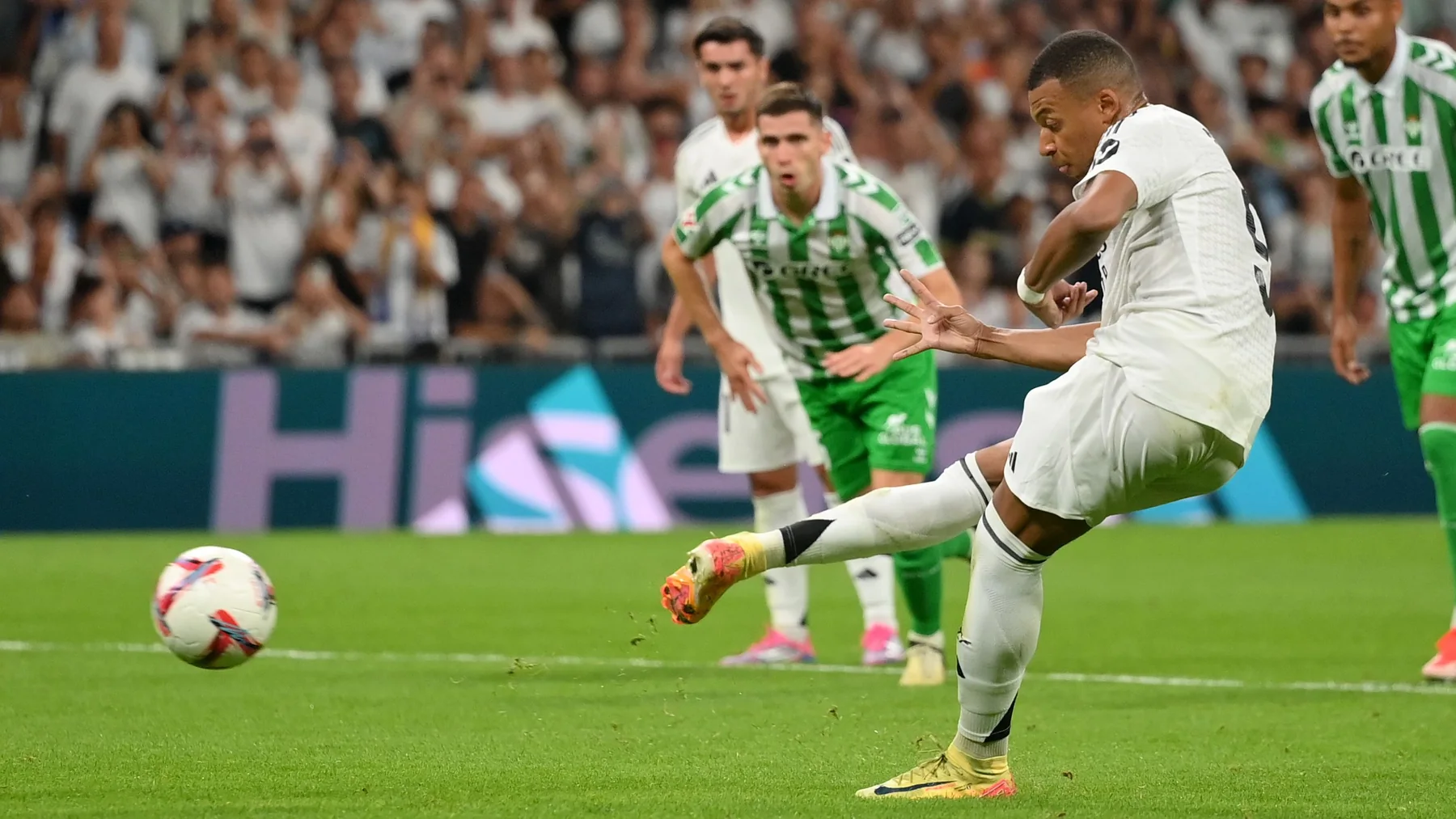
Real Madrid's complaint came from an intuitive sequence: Kylian Mbappe took a late penalty, Alvaro Valles saved it, Marc Bartra cleared the rebound, and television pictures appeared to show the Betis defender moving across the penalty-area line too soon. The official decision was not to retake the kick. This guide reconstructs the incident, applies IFAB Law 14 and explains why a debatable image did not become a VAR overturn.
The Decision in One Minute
Real Madrid's argument came from an intuitive sequence: Kylian Mbappe took a late penalty, Alvaro Valles saved it, Marc Bartra arrived to clear the rebound, and television pictures appeared to show the Betis defender leaning across the penalty-area line before the kick. Because Bartra then became directly involved, Madrid players and many viewers expected a retake. The match ended Real Betis 1-0 Real Madrid on 4 September 2026, so the decision was not a footnote. A successful retake could have changed the result.
What happened to Mbappe's penalty
The penalty offered Madrid a late route back into a difficult away game. Mbappe struck, Valles stopped the attempt, and the loose ball remained live. Bartra reacted quickly enough to prevent Madrid from turning the rebound into an equalizer. The dispute therefore concerned more than a defender wandering into the area without consequence: the defender identified in the replay also made the clearance.
That is why the clip generated such anger. To a viewer watching only Bartra's upper body, the action looks like early entry followed by an obvious benefit. To the officials, however, a player is not judged by the furthest point of his torso alone. The location and contact of the feet at the instant the ball is kicked are central to the applicable interpretation. One grounded foot was judged to remain outside the area, so Bartra had not committed punishable encroachment at that instant.
Why the officials allowed play to continue
The operational answer is that the video review found no clear offence requiring a retake. The goalkeeper's save was valid, the rebound stayed in play, and Bartra's clearance produced the next restart. VAR did not treat a forward lean by itself as proof that the defender had illegally entered.
This distinction matters because “he looks inside” and “he is legally inside” are not interchangeable claims. Freeze-frames compress a dynamic movement and invite viewers to trace shoulders or knees. The law needs an administrable boundary. In this incident, the decisive boundary was interpreted through the player's contact with the ground, not the projection of his chest over the line. Fans can disagree about whether that produces a fair football outcome, but it explains why the officials did not simply replay the kick. For the confirmed score and other completed matches, check our La Liga results page.
Reconstructing the Incident Step by Step
The cleanest way to understand the dispute is to stop treating the whole movement as one event. A penalty review has several legally distinct instants: the taker's contact with the ball, every other player's location at that instant, the goalkeeper's save, and the players who then affect the rebound. Mixing those moments produces confident but incompatible verdicts.
Positions at the moment of the kick
Mbappe's contact with the ball is the reference frame. Attackers and defenders other than the kicker must be outside the penalty area, behind the penalty mark and at least 9.15 metres from it until the ball is kicked. Bartra had begun moving forward, as defenders routinely do while trying to react first. The CTA's published explanation said that, at contact, one of his feet was in the air while his supporting foot still touched the ground outside the relevant boundary.
The line belongs to the area, but a body leaning above it does not necessarily establish the location used for the decision. This is the visual trap. A broadcast angle can show Bartra's head, shoulder or airborne leg apparently “inside” while the grounded supporting foot remains legal. A frame a fraction later can show a foot planted inside, but by then Mbappe has already kicked the ball. The later picture cannot retroactively move the player at the legally decisive instant.
The save, rebound and next touch
Valles stopped the penalty rather than holding it. Mbappe pursued the loose ball and Bartra reached the second phase, putting the ball behind for a corner. This involvement is important. If a defender commits encroachment and then directly affects the rebound, the offence cannot be dismissed as trifling merely because the original kick failed.
Yet involvement alone does not create an offence. It activates the consequences only after illegal early entry is established. Madrid's argument joined two propositions—Bartra entered early and Bartra cleared the rebound. The officials accepted the second but rejected the first. That is a narrower explanation than saying defenders may enter early whenever the goalkeeper saves.
What VAR checked
Video officials could examine whether an encroaching player became directly involved after the goalkeeper's save. They compared the kick-contact frame with Bartra's foot position and reviewed his later clearance. The review did not identify a clear factual breach under the Spanish guidance, so there was no recommendation for an on-field review and no retake.
VAR's role is often misunderstood here. It is not asked whether the sequence feels advantageous or whether a still image looks suspicious. It checks whether a reviewable offence demonstrably occurred and whether that offence affected the outcome. The second part was visible; the first was not established to the required standard. That distinction explains both the length of the review and the eventual corner restart.
What Law 14 Actually Requires
Law 14 begins with a simple positioning rule but applies it through a more selective enforcement test. Until the ball is kicked, players other than the identified taker and goalkeeper must be outside the penalty area, behind the penalty mark and at least 9.15 metres (10 yards) from the mark. The goalkeeper must keep at least part of one foot touching, in line with or behind the goal line when the ball is kicked.
Encroachment is not automatically a retake
The crucial update for viewers is that early movement and a punishable encroachment offence are not always the same thing. IFAB's 2026/27 Law 14 says a teammate of the goalkeeper is penalised for encroachment only when the movement clearly affects the kicker, or when that player plays the ball or challenges an opponent and prevents the attacking side from scoring, attempting to score or creating a goal-scoring opportunity.
This impact filter reflects how penalties actually look. Players on both sides often begin moving a fraction early. Ordering a retake for every marginal step would turn many penalties into repeated set pieces even where the movement changes nothing. The law instead concentrates on an entrant who interferes with the kick or becomes consequential in the rebound phase.
That does not excuse Bartra if he was legally inside too soon. Because he cleared the rebound, the impact limb would plainly be relevant. But the law still requires the first finding: did he occupy a prohibited position at the precise moment Mbappe kicked? The CTA answered no under its foot-contact interpretation. That is why simply quoting the impact provision cannot settle this dispute.
The impact test and the restart table
| Situation | Kick outcome | Usual decision |
|---|---|---|
| Defender enters early but has no clear impact | Goal or miss | Outcome normally stands |
| Defender enters early and distracts the taker | Miss or save | Retake |
| Defender enters early, then stops a rebound chance | Miss or save | Retake |
| Attacker enters early, then creates a rebound chance | Miss or save | Indirect free kick |
| Both teams commit impactful encroachment | Any | Retake in the ordinary case |
The table is a guide, not a substitute for the official text. Referees must also determine who entered, when they entered and whether the involvement meets the impact language. A goalkeeper offence has its own provisions, and illegal feinting or another more serious offence can change the restart.
For this match, the disputed branch is narrow. If Bartra was already in the area and then prevented Mbappe from a genuine second attempt, a retake would be logical. If his grounded position remained outside at the kick, the decision tree never reaches that remedy. The controversy is about how location is defined in a split second, not a blanket permission for defenders to influence rebounds.
Why the CTA Backed the Referee
Spain's Technical Committee of Referees, the CTA, selected the play for its weekly review program and defended the work of referee Alejandro Hernandez Hernandez and the video team. Its central conclusion was direct: under the guidance being applied, Bartra had committed no encroachment offence at the moment of Mbappe's kick.
The Spanish refereeing body's explanation
The committee described Bartra as having one foot in the air and the other in contact with the ground outside the area. It also addressed a phrase that had fueled confusion: an “airborne position” is not automatically measured by projecting every part of the player's body onto the grass. According to the CTA explanation reported by Spanish outlets, the special airborne concept applies when the entire body is off the ground. Bartra still had a supporting foot down, and that contact point controlled his location.
That explanation answers the narrow question the officials faced. It does not claim Bartra remained passive; everyone could see that he subsequently cleared the ball. Nor does it deny that his body and momentum were moving toward the rebound. It says there was no initial positioning offence, so his later participation was legal.
Real Madrid coach Jose Mourinho publicly asked whether VAR misunderstood the rule or chose not to apply it. His frustration was understandable in the context of a 1-0 defeat and a last-minute chance to equalize. The CTA's response was effectively a third possibility: the video officials knew the regulation, checked the necessary frame and concluded that the legal condition for a retake was absent.
Why a controversial outcome can still clear the VAR threshold
VAR is designed to correct clear and consequential errors in specified categories, not to replace every close spatial judgement with a new philosophical debate. Here the consequence was obvious, but the alleged illegality depended on a fine reading of foot contact. If the available pictures support the CTA's description, allowing the on-field outcome to stand fits the review system even when the optics remain uncomfortable.
The distinction protects two ideas at once. Madrid supporters are entitled to question whether the interpretation rewards a defender who times his forward movement at the edge of legality. The referee team is also entitled to apply the written measurement rather than the impression created by a player's upper body. Calling the decision controversial describes the public reaction; calling it wrong requires stronger evidence that Bartra met the law's definition of being inside before contact.
The league consequence should stay proportionate. One decision affected one major opportunity, but Madrid still had the rest of the match to create and finish chances. Fans assessing its place in the season should look at the evolving La Liga table, not treat an early-September flashpoint as a complete explanation of a campaign.
The Strongest Case for Real Madrid's Complaint
A fair explainer should not caricature Madrid's objection as ignorance. The club's strongest argument is based on football effect as well as geometry: Bartra anticipated the kick, moved toward goal, reached the rebound ahead of the attacker and prevented another attempt. That is exactly the kind of material involvement the modern impact test is supposed to capture when encroachment has occurred.
The frame that drove the argument
The most widely shared images show Bartra's upper body and one leg beyond the boundary as Mbappe strikes. Real Madrid TV argued that the kick should have been repeated, while former-referee discussions in Spanish media questioned either the clarity of the new wording or how the position had been interpreted. From a sporting perspective, the complaint has force: a defender who gains forward momentum before the legal signal appears to receive the practical benefit that the restriction is designed to prevent.
The law also says the penalty-area line is part of the area. If a clear angle showed Bartra's grounded foot touching that line at the moment of contact, the basic location finding would change. Because he then played the rebound and stopped an immediate attacking opportunity, Madrid would have a straightforward case for a retake. That conditional is important. The debate is not frivolous; it turns on centimetres, timing and what the clearest camera angle can prove.
There is also a policy concern. Rules that depend on whether a lunging player's last contact point remains outside can encourage athletes to exploit the border while their momentum is already well inside. Even if technically legal, that result may look inconsistent with the purpose of keeping players away until the kick. Supporters are entitled to ask IFAB and domestic referee educators to illustrate such edge cases more plainly.
Where the alternative reading becomes uncertain
The complaint becomes weaker when it leaps from a persuasive visual impression to the assertion that the footage conclusively proves a planted foot inside. Several angles do not offer a clean view of the exact contact point at the exact kick frame. A shoulder over the line is not enough under the CTA's explanation, and the defender's later landing inside does not prove his earlier location.
Nor should a club channel's conclusion be treated as independent adjudication. Real Madrid had an obvious competitive interest, just as Betis supporters had an interest in the decision standing. Former referees can disagree in good faith, especially when domestic teaching materials introduce a technical distinction that ordinary viewers have not previously encountered.
The most defensible conclusion is narrower than either partisan slogan. Madrid identified a real grey-area problem and an outcome with obvious impact. The CTA concluded that the prerequisite offence was absent because Bartra's supporting contact remained outside. Without a definitive image contradicting that factual finding, it is difficult to call the non-retake a clear VAR error, even if the rule's design deserves further debate.
How Fans Should Judge the Next Penalty-Area Controversy
Penalty encroachment clips reward instant outrage because viewers can pause at slightly different frames and draw different lines. A better method is to ask a fixed sequence of questions. That approach does not remove judgement, but it makes disagreements testable and stops unrelated grievances from swallowing the actual law.
A five-question replay checklist
- Which frame is the kick? Find the first contact between the taker's foot and ball. Do not use a later frame simply because it makes the early run look clearer.
- Which boundary applies? The penalty-area line is part of the area, and the arc enforces the 9.15-metre distance.
- What establishes the player's position? Check the feet and ground contact under the competition's current guidance.
- Did the early mover affect the kick or rebound? A marginal entrant is treated differently from a player who distracts, reaches a rebound or prevents a chance.
- What standard governs the review? Direct involvement is reviewable, but replay must provide a clear basis to overturn the original decision.
Apply those questions to Betis-Madrid and the point of disagreement becomes precise. The kick frame is identifiable. Bartra influenced the rebound. The contested issue is whether his relevant contact point had crossed into or touched the area at the kick. The CTA said it had not. Critics argue the guidance is counterintuitive or the image was read too generously. That is a meaningful rules debate, unlike a broad claim that VAR simply ignored encroachment.
Fans should also be cautious with cropped clips. A tight image can hide the ball and make it impossible to prove the instant of the kick; a wide image can establish timing but lack enough resolution to locate a stud against a painted line. The strongest analysis synchronizes more than one angle rather than selecting the frame that supports a preferred club.
What this episode means beyond one result
The incident exposes a communication problem. Football has shifted from a visible rule—stay out of the box—to a combination of location, ground contact, material impact and video-review thresholds. That may produce fewer unnecessary retakes, but it asks supporters to understand guidance they rarely see until a decisive controversy erupts.
La Liga and the CTA can reduce distrust by publishing decisive synchronized frames, relevant law text and VAR audio where regulations allow. IFAB can add an illustrated example involving a player whose body crosses the plane while one foot remains grounded outside. Transparency will not make rival supporters agree, but it can move the discussion from motives to evidence.
The sporting lesson is less dramatic. Penalty takers still control the clearest path to avoiding a rebound ruling: score the kick. Defenders will continue to time their first movement as aggressively as the law permits. Officials must apply the same location test to every club. When the next late penalty arrives, viewers should start with the five questions above, then check the confirmed fixture or result on our La Liga schedule today page. A careful verdict is slower than a viral freeze-frame, but it is more likely to survive the full replay.
Comments
Sign in with Google to comment. Keep the conversation useful and football-focused. New comments are reviewed before they appear.
Loading comments…