
Real Madrid's official 2026/27 squad snapshot
Real Madrid's clearest dated 2026/27 first-team snapshot is its official squad-number announcement, published on August 10, 2026. It names 26 players: two goalkeepers, ten defenders, seven midfielders and seven forwards. The current club roster page groups players by role and identifies José Mourinho as head coach. LaLiga's club page labels its own Madrid squad for the same season. As of September 29, these pages are a reliable starting point for a reader asking who belongs to the Madrid squad, but they answer a broader question than who will play in a single fixture.
The club's number list puts Thibaut Courtois at 1 and Andriy Lunin at 13. Its ten named defenders are Raúl Asencio, Éder Militão, Dean Huijsen, Trent Alexander-Arnold, Ibrahima Konaté, Marc Cucurella, Álvaro Carreras, Antonio Rüdiger, Ferland Mendy and Denzel Dumfries. The midfield group is Jude Bellingham, Eduardo Camavinga, Federico Valverde, Aurélien Tchouaméni, Arda Güler, Bernardo Silva and Thiago. Up front it lists Vinícius Júnior, Endrick, Kylian Mbappé, Rodrygo, Carlos Espí, Brahim Díaz and Yan Diomande. The English release uses some abbreviated names and carries a machine-translation disclaimer, so the current club player page is useful for checking full names and role labels.
There is a reason the official LaLiga page may look longer than the club's August number announcement. The league view can display additional younger players associated with the club. That does not turn every name on it into a permanent member of the same 26-name senior list, and it does not prove a starting place. A fan should preserve the exact scope of each source: the club's dated squad numbers, the current first-team roster, the league's season page and the next match sheet all have different jobs. Likewise, UEFA's Champions League squad belongs to another competition and cannot simply be substituted for a LaLiga list.
The football meaning of the roster lies in the choices it creates. Madrid have multiple ways to organize the back line and midfield behind Mbappé and Vinícius. A deep defensive block invites different passing and running patterns from an opponent prepared to press high. The list of 26 supplies the names from which Mourinho can draw; it cannot tell us which balance he will choose against the next opponent. Use our La Liga teams index for club context and the current fixtures page to identify the actual match before making a matchday judgment.
Goalkeepers and defensive depth
Real Madrid's August 10 squad-number release identifies two goalkeepers, Thibaut Courtois and Andriy Lunin. It names ten defenders, a large group that allows different combinations of central protection, ball progression and full-back width. A season roster can tell us those options exist. It cannot determine which goalkeeper or back four Mourinho will use after an international break, injury update or tactical adjustment.
Courtois, Lunin and the immediate goalkeeper question
Courtois wears 1 and Lunin 13 on the club's official list. The number is a reliable way to identify each player in a lineup, but it should not be used as a match prediction. Madrid's August 26 LaLiga game against Real Sociedad provides a dated example: the official league match page lists Courtois as the starter and Lunin among the substitutes. That describes one fixture. To answer the same question for the next opponent, check that game's lineup rather than copy the August selection forward.
Goalkeeper choice can influence how Madrid build attacks. A side facing a high press needs a clean first pass to prevent dangerous turnovers close to its own area; a side defending a lead may ask more of the goalkeeper's command of the box and long distribution. Those are tactical considerations, not player-specific claims about form. It is possible to discuss them while keeping the verified fact narrow: both goalkeepers are in the club's 2026/27 squad-number announcement, and the official match sheet tells you which one started a particular game.
The back line's range of options
The official list includes Asencio, Militão, Huijsen, Trent Alexander-Arnold, Konaté, Cucurella, Carreras, Rüdiger, Mendy and Dumfries. The August 26 Real Sociedad lineup used Dumfries and Carreras outside Konaté and Huijsen. That example shows how four of the listed defenders were combined on one night; it does not establish an unchangeable first choice. Substitutions can alter the balance further. Madrid's own September 12 report says Carreras won a penalty and scored against Rayo Vallecano, then discussed Cucurella's later defensive support. The full-back position can carry both attacking and recovery duties in the same match.
The list has football value beyond headcount. If an outside defender drives high, a centre back and holding midfielder must manage the space left behind. A full-back who stays narrower may make Madrid harder to counter but can leave more creative work to the wide forward. Likewise, a central pairing comfortable with passing through pressure can bring Bellingham or Valverde into better positions sooner. These are plausible relationships between roles, not a claim that any one pairing is always superior. Follow the next LaLiga fixture, note the opponent's style, and read the confirmed lineup before judging the defensive plan. A defender left on the bench may be healthy and fully part of the squad; selection is a separate decision.

Midfield roles and the shape of possession
Madrid's official number announcement groups Bellingham, Camavinga, Valverde, Tchouameni, Arda Guler, Bernardo Silva and Thiago in midfield. Seven names do not amount to seven interchangeable jobs. The coach has to decide how many players begin behind the ball, how the first pass escapes pressure and who can arrive near Mbappe without exposing the defenders. That is why the same squad list can support more than one shape over a season.
Control and protection in central areas
Bernardo offered a useful first-hand description after the September 12 LaLiga meeting with Rayo Vallecano. In the club's post-match account, he described helping the build-up flow to the attacking players and contributing to pressing and defensive work without the ball. The report says he started and played 69 minutes in that match. This is a more grounded guide to one player's assignment on one day than assuming every name tagged midfielder has the same function. Mourinho's August 21 preview also named Tchouameni, Camavinga, Valverde, Bernardo and Guler while discussing central options. That range allows Madrid to seek a different mix of passing security, ball winning and mobility according to the opponent.
The risk is clearest when Madrid lose the ball with both full-backs advanced. If one midfielder offers a simple passing outlet and another protects the space behind a forward runner, the team has a better route into attack and a first layer against the counter. If both push ahead at once, the centre-backs may face a much larger area to defend. These are tactical trade-offs, not a judgment about any player's current fitness or a promise that Mourinho will choose a particular pair. The official LaLiga standings provide the season context, while a match sheet will show who actually filled the central places.
Forward runs from midfield
Bellingham and Valverde offer another question for opponents: which midfielder will break beyond the line of the ball? Madrid can create a passing lane toward Vinicius or Mbappe when a runner occupies a defender, but the timing matters. A run too early can crowd the forwards; a run after an opponent has shifted wide may open the central space. Guler and Bernardo can also alter the angle of the final pass. The club's August preview treated Guler as a player who could grow into central positions rather than describing one fixed role for him. That is a reason to watch his position in the actual lineup, not to assign him a permanent label from a roster page.
Thiago's appearance in the official midfield group also reminds readers that first-team lists can include a developing player alongside established starters. The decision that matters for the next fixture is narrower: who is named in the travelling group and which midfielders start. Check the upcoming LaLiga fixture, then read the confirmed lineup. The squad overview tells you what combinations are possible; the match-specific selection tells you which combination Mourinho chose and gives you a better starting point for judging how Madrid may control the game.
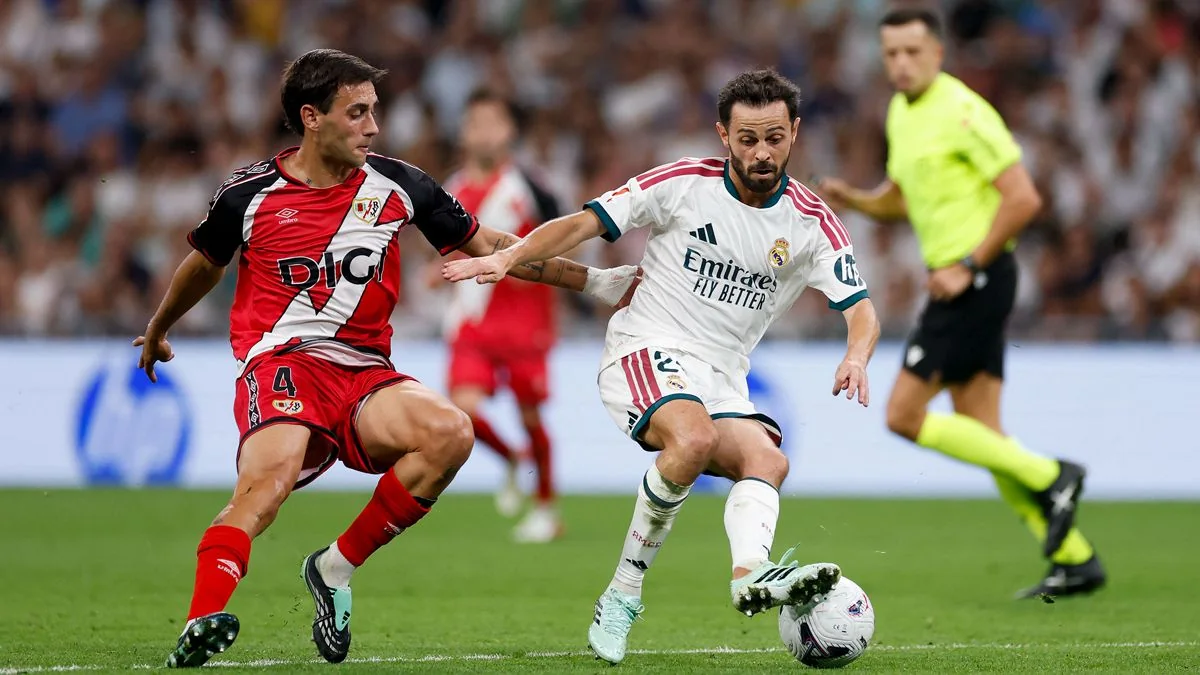
How the forwards can change a match
The club's 2026/27 number announcement names Vinicius Junior, Endrick, Kylian Mbappe, Rodrygo, Carlos Espi, Brahim Diaz and Yan Diomande as forwards. That group has different routes toward goal. Some can receive wide and carry at a defender; others can finish a move through the middle or change the pace after a substitution. The useful question is therefore not just how many attackers appear on the list, but which combination will threaten the next opponent's weakest space.
Wide running and space for Mbappé
LaLiga's official page for the September 12 game against Rayo Vallecano offers a concrete example. Its starting lineup shows Mbappe in the central attacking role, with Vinicius and Diomande also selected. The result was 4-1, and Mbappe scored twice, once from the penalty spot and once in added time. Those details explain what happened in that fixture; they are not a forecast for Madrid's next lineup or score. The club match report describes a strong first half and a later second goal for Mbappe after Rayo had reduced the margin.
When a wide attacker drives inside, the nearest full-back can either overlap or hold a deeper position to protect against a turnover. That choice changes the space Mbappe sees. If the defence collapses around him, the far-side winger may have room to receive; if the opponent stays wide, a central runner can attack the channel between defenders. Vinicius and Diomande have the ability to give Madrid two outlets across the front, but how they are used depends on the opponent and the team behind them. The result against Rayo shows one successful combination, while the next opponent may demand a different balance. Check the latest results for the actual sequence of matches rather than using a season roster to infer form.
Different routes from the bench
The same Rayo match page lists Brahim, Endrick and Espi among the substitutes. Their presence gave Mourinho attacking changes to make after kickoff, while midfield substitutions also altered the structure supporting those forwards. A listed substitute is genuinely available for that match, but a player absent from a sheet cannot be assumed injured or dropped without a dated explanation. The club's September 14 press conference specifically described squad depth and varying player profiles. Mourinho also referred to Rodrygo as an option in January, a reminder that an August number list and a September matchday selection may diverge in important ways.
For a fan reading the next team sheet, watch the bench as carefully as the starting eleven. A pace-focused substitute may be useful against tired defenders; a player who combines in tight spaces may help when the opponent sits deep. Those are possibilities rather than declared plans. The substitution pattern from the previous fixture can inform a question, not settle it. Start with the upcoming Madrid match, then check the club's dated squad call and LaLiga's lineup as kickoff approaches. That sequence will tell you whether the full range of forwards is available and which options Mourinho actually has on the night.

LaLiga registration is not the same as a UEFA squad list
A common search mixes three different questions: is a player named on Real Madrid's first-team list, does the official league page show him for 2026/27, and is he eligible for a Champions League match? Those questions point to different sources. The club's August 10 number announcement is a dated first-team snapshot. The LaLiga Real Madrid squad page is the league's season view. UEFA's Champions League squad page is the governing body's list for a different tournament. None of these, on its own, says who starts the next domestic fixture.
The difference is visible in the page details. LaLiga's Madrid squad includes young players whose numbers fall outside the core 26 in the August club announcement. UEFA's 2026/27 Madrid squad similarly includes youth names and marks some with an asterisk explained as List B. UEFA states that a player needs to be registered on either List A or List B to take part in Champions League matches. That UEFA requirement is about UEFA competition; it cannot be read back as a LaLiga registration rule. Even the position labels are not perfectly identical: UEFA groups Diomande with midfielders, while Madrid's own number announcement places him among forwards. Position labels are editorial groupings as well as tactical descriptions, so this mismatch is not proof that one source has the wrong player.
For LaLiga questions, begin with LaLiga's club squad page and the current match page. For Champions League eligibility, use UEFA's squad and its registration explanation. To understand Madrid's preferred senior core and numbers on a known date, use the club's announcement and check the live roster for later changes. That sequence avoids a misleading claim that every UEFA player is automatically in the domestic match squad or that every LaLiga player must appear in the same senior list. Our guide to official registered-player checks walks through the distinction for any club.
There is also a timing issue. A list captured before a transfer, injury or youth promotion can be accurate for its publication date and stale for a later match. If you see conflicting names, compare the dates and competition labels before drawing a conclusion. Then seek the most recent official squad call for the match you care about. A roster is a map of potential options; a dated match sheet is the evidence for the actual selection. This is particularly helpful when comparing Madrid with another team in the LaLiga teams directory, because the same source hierarchy keeps the comparison fair.
Where to verify the next Real Madrid match squad
A fan asking whether Mbappe, Bellingham or another Madrid player is in the squad for the next LaLiga game needs a more specific answer than the season roster provides. Start with the correct fixture and its date, then move to Madrid's dated squad call, then to the official lineup and bench. These are separate stages. The club roster covers a season; the call-up narrows the group for one game; the lineup identifies the actual starters and substitutes. None should be substituted for the next.
Read the dated squad and official lineup together
The club's September 19 announcement for the Atletico derby shows how useful a call-up can be. It lists three goalkeepers, including Sergio Mestre, and six forwards, including Mbappe, Vinicius, Endrick, Espi, Brahim and Diomande. The August club number list, by contrast, named two goalkeepers and seven forwards. Neither document needs to be wrong: one is a broad dated squad-number release, and the other is a selection for a single away fixture. The different counts tell readers why a roster should never be copied into a match preview as if every name will travel.
Next, wait for the actual starting lineup. LaLiga's page for the September 12 Rayo match shows one Madrid eleven and a separate list of substitutes. A player in the call-up might start, sit on the bench or be absent from the final match sheet; each outcome answers a different question. The lineups also reveal shape more reliably than the position labels on a season page. Madrid's forwards may be spread across the pitch or one may operate in support behind another. The numbers alone cannot show that. Checking the match page near kickoff prevents a preview written days earlier from masquerading as a confirmed XI.
The quickest routine is simple. First, open the current LaLiga schedule and identify Madrid's next league opponent and local match date. Second, read the latest squad-call article on Madrid's first-team news page, checking that its opponent and publication date match the fixture. Third, look at the official LaLiga match page for starters, bench and later the result. If a call-up has not appeared, say so instead of guessing. If a name is missing, avoid assigning an injury, disciplinary reason or transfer status without a dated official explanation.
A reader who needs to understand the league page's wider player list can use our guide to official registered players. It explains how to keep a season listing separate from matchday availability. For Madrid, the practical reward is a cleaner football judgment: once the eleven is confirmed, you can assess whether Mourinho chose extra midfield cover, two wide runners or a different defensive balance against this particular opponent. Until then, the 2026/27 squad is a menu of possibilities, and every match requires a fresh check.
Comments
Sign in with Google to comment. Keep the conversation useful and football-focused. New comments are reviewed before they appear.
Loading comments…