
What each word in Real Betis Balompié means
Real Betis Balompié combines a royal title, a historic name associated with Seville's river and the Spanish word for football. Real means royal in this club name; Betis recalls the Roman name of the Guadalquivir; Balompié means football. The three words explain different layers of the club's identity. They are not a claim that Betis is a city, that the club belongs to the royal family or that it plays a different sport from other La Liga teams.
Real: the royal title
Spanish uses real for things relating to a king or the monarchy. The same spelling can also mean real or genuine in another context, but that is not the meaning in Real Betis. LaLiga's account of the club's origins dates the honorary royal title granted by Alfonso XIII to 1914. Its presence records a historical distinction rather than explaining the modern club's ownership.
That interpretation also helps an international supporter recognise the word in several Spanish team names. It is a title attached to a specific club's history, rather than a general classification of sporting quality. Calling one club Real does not mean another club is less authentic, and the adjective does not turn a football fixture into a royal event. In ordinary use, supporters often shorten the full name to Betis while the formal title remains part of the identity.
Betis: a name connected to the Guadalquivir
Betis comes from Baetis, the Roman name associated with the Guadalquivir river that runs through Seville. The city's official tourism account of Triana also identifies Río Betis as the Roman name. This places the club's name in the city's geography and deeper history. A visitor walking beside the Guadalquivir is therefore seeing the landscape behind the name, even though the club was founded much later than Roman Seville.
Keep the link precise: Betis is the football club's proper name, while Guadalquivir is the river's present name. A search for the word can also reveal Calle Betis, the riverside street in Triana, or historical references to the region. Those connections enrich the meaning without making every place called Betis a club facility.
Balompié: the Spanish word for football
The Royal Spanish Academy's dictionary identifies Balompié as football, formed from the words for ball and foot. It is a Spanish alternative to fútbol, the adapted form of the English word. Betis retained this distinctive sporting term in its formal name. The final accent belongs to the Spanish spelling and marks the stressed syllable.
For a fan reading a team sheet or fixture listing, Real Betis, Betis and Real Betis Balompié identify the same club. The full version carries more of the origin story; the shorter form is simply convenient in conversation. The La Liga teams directory is a useful starting point for placing that name alongside the rest of Spanish football.
Why Betis celebrates 1907 despite the 1914 merger
Betis gives its founding date as 12 September 1907. The present full name took shape through a merger in 1914, so the two dates answer different questions. The first marks the beginning of the club's historical line; the second explains how the name combined elements from its predecessors. A reader does not need to choose one date and discard the other to make the story consistent.
The club's official history describes the 1907 beginnings through students in Seville and a club known as Sevilla Balompié. It records the early choice of a Spanish word for the sport, an important part of why Balompié survives in the modern name. The present club did not invent that word as a marketing addition long after its foundation; the language choice belongs to its early identity.
Sevilla Balompié and Betis Football Club
Sevilla Balompié and Betis Football Club were distinct organisations. The latter's beginnings are traditionally dated to 1909 in the club's oral history; its official account distinguishes that tradition from the first documented matches in 1910. In the merger process, Sevilla Balompié approved the union on 6 December 1914 and Betis Football Club followed two days later. The official history also records the civil governor's approval of the statutes and name change in August 1915. These are stages in a process, rather than competing versions of a single birthday.
| Date | What it explains |
|---|---|
| 1907 | The foundation celebrated by Betis |
| 1909 | Traditional founding date of the separate Betis Football Club predecessor |
| 1914 | The merger and combined Real Betis Balompié identity |
| 1915 | Formal approval recorded in the club history |
The distinction is particularly helpful when reading an anniversary message beside a history of the crest. Anniversaries can follow the institution's earliest beginning, while a badge or a full name can reflect a later stage. The club's 110th-anniversary article in 2017, for example, clearly follows the 1907 date. It treats the subsequent changes as chapters within that continuing history.
The merger also explains why the modern name feels unusually rich. Betis and Balompié preserve recognisable pieces of two earlier identities, and Real adds the royal distinction. For a supporter, retaining those pieces is a compact way of carrying the origin story into every fixture listing. Understanding that combination makes the full name more informative than a literal translation alone and prevents confusion between an early Seville club name and today's city rivals.
Green and white, the crest and the Verdiblancos nickname
The word Verdiblancos means green-and-whites, the nickname drawn from Betis's familiar colours. It tells a reader something immediate about the shirt while the formal name tells a longer story about language, place and origins. The two descriptions work together: one is a visible identity on the pitch, and the other is the institution's name. Neither depends on a particular player's presence in the team.
The Celtic connection and the Andalusian colours
The club's historical account of the colours links them to Manuel Ramos Asensio and the arrival of shirts from Scotland. It describes Sevilla Balompié wearing green and white in November 1910 and explains Ramos's connection with Celtic through his years studying in Scotland. The story places a familiar shirt combination in the exchanges that helped early football develop, rather than treating it as a design created entirely in isolation.
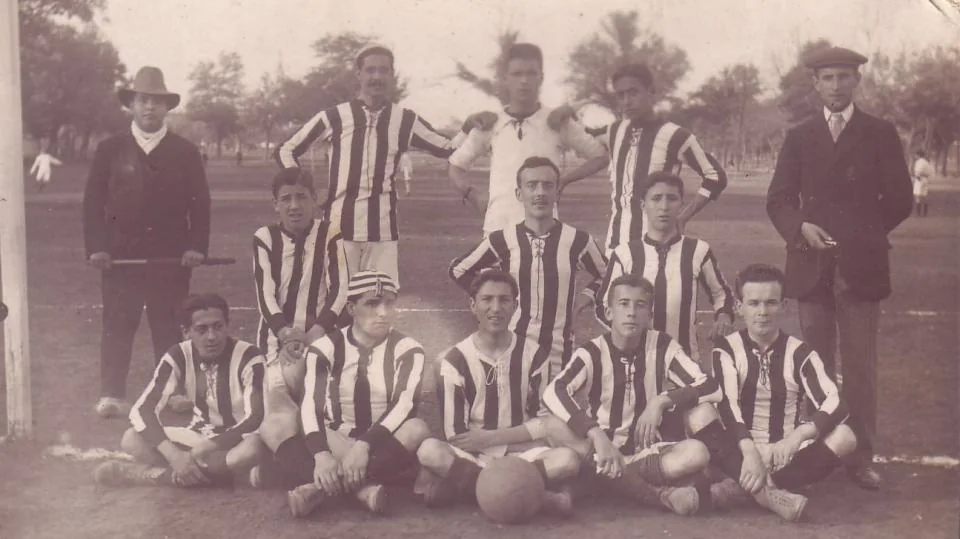
Green and white also resonate with Andalusia's colours, giving the modern shirt a local association. However, that association should not erase the documented football pathway through Ramos and Celtic. A colour can accumulate meaning over time. The club's history includes changes and interruptions in the early kit, so it is more accurate to describe the emergence of the present identity than to suggest that every shirt since foundation has looked the same.
Betis itself acknowledged the connection when it honoured Ramos's family around a match against Celtic. For supporters, that is a concrete example of how historical colour choices can become part of a contemporary football occasion. An away shirt with different colours does not cancel this heritage; clubs can experiment with match kits while maintaining a stable visual identity.
Reading the crown and the thirteen stripes
The crest offers another compact expression of the name. Its crown echoes Real, the intertwined letters refer to Betis Balompié, and the green-and-white striped triangle makes it instantly recognisable. LaLiga's crest history follows the changes rather than presenting the current badge as unchanged from 1907. The final combination of familiar elements belongs to a later stage in the club's history.
Local reporting on the crest identifies 8 January 1957 as the approval date of the design combining the crowned circle and the thirteen-striped triangle. This explains why older team photographs and documents can show a different badge without belonging to a different club. When you compare them, look for recurring pieces of the identity instead of expecting identical shapes. The stripes and crown are useful historical clues, while elaborate claims about a hidden meaning for every stripe should not be treated as established club history without evidence.
Real Betis, Sevilla FC and the city's derby
Real Betis are based in Seville, the Andalusian city called Sevilla in Spanish. Their leading city rivalry is with Sevilla FC, and the match is widely presented as El Gran Derbi. Betis's name looks less obviously like the city's current name, but its river connection is no less local. Recognising that connection helps a visitor understand why two different names can express belonging to the same place.
One historical distinction deserves particular care: Sevilla Balompié was not Sevilla FC. The similar wording can lead an unfamiliar reader to imagine that the present rivals merged in 1914. They did not. Sevilla Balompié was the predecessor that combined with Betis Football Club, while Sevilla FC remained a separate institution. Sevilla's own history records a February 1909 meeting between a Sevilla FC side and Sevilla Balompié, explicitly describing them as different societies.
The language also carries no rule that a city's football team must use its modern city name. Clubs can be named for districts, historical places, founders, sporting societies or older local terms. Betis provides a particularly clear Spanish example: a word associated with the ancient river becomes the name shouted for a modern team. Sevilla FC uses a more direct city-and-sport combination. Neither naming choice makes the other club an outsider to Seville.
LaLiga's derby guide describes a rivalry shared through families, neighbours and friends. That is a more useful starting point than assigning every supporter to a fixed class, political opinion or neighbourhood. A club's origins and a city's social history can be studied without reducing present-day fans to a stereotype. For someone attending or watching their first derby, recognising the different identities matters more than repeating an oversimplified label.
Read the fixture carefully when planning a visit. Real Betis versus Sevilla FC identifies Betis as the home team; reversing the order identifies Sevilla as the home team. The home venue and kickoff should then be confirmed for the specific event. The full club name is an identity, not a stadium address, and a historic association with one ground does not replace the current match listing.
The La Liga schedule and viewing guide can help you locate the next league meeting and its legal coverage. Watching the derby with this background changes the experience: the green-and-white name and the city-name rival are separate expressions of Seville's football history, meeting in a game whose importance extends beyond an ordinary fixture.
What the name means to Béticos today
A Bético is someone associated with Betis, most commonly a supporter in football conversation. The word moves from an institution's name to a personal attachment: a shirt, a family memory, a first match or a team followed from another country. Knowing the full name helps explain those attachments without requiring a newcomer to have inherited them. A fan can begin with a player or a game and discover the older identity over time.
That is why Betis's language remains useful even when the team changes. A new coach, a different striker or a temporary move of venue changes the football setting, but the words on the badge connect successive teams. The historic name gives supporters a way to recognise the club across those changes. It also supplies a richer introduction than a list of current results, which can describe a season without explaining why the team matters to people.
Viva el Betis manque pierda
The famous expression Viva el Betis manque pierda means roughly “Long live Betis, even if they lose.” The local form manque expresses the sense of although or even if. You may also see the more colloquial rendering Viva er Beti. These forms belong to supporter speech, so a literal dictionary-by-dictionary reading can miss the warmth and identity carried by the phrase.
In an Antena 3 programme explaining the motto, Joaquín described it as unconditional attachment rather than conformity. That distinction is central. Supporting the club through a defeat does not mean supporters prefer defeat, stop wanting trophies or suspend all criticism of the team. Loyalty concerns the continuing relationship with the club; judgment concerns how the football is being played.
The club's anniversary account places the expression in the difficult years around its spell in the third division. Its meaning therefore reaches beyond the convenient idea of cheering only for success. Yet Betis's history also contains success, including the 1934/35 league championship and Copa del Rey victories in 1977, 2005 and 2022. Remembering hardship and celebrating a cup are compatible parts of the same identity.
For an international fan, the best way to approach the phrase is to keep both its language and its sporting ambition. Learn what it means, recognise its place in Betis culture and then watch the team with the same attention to tactics and performance that you would give any other club. There is no need to imitate a local accent to understand the sentiment, and no reason to reduce supporters to one slogan.
The league table shows how Betis are doing now, while the results page gives the match-by-match story. Their full name answers a different, lasting question: which institution is being followed? Royal title, river heritage and a Spanish word for football together identify Real Betis Balompié; the supporters give those words their continuing life.
Comments
Sign in with Google to comment. Keep the conversation useful and football-focused. New comments are reviewed before they appear.
Loading comments…