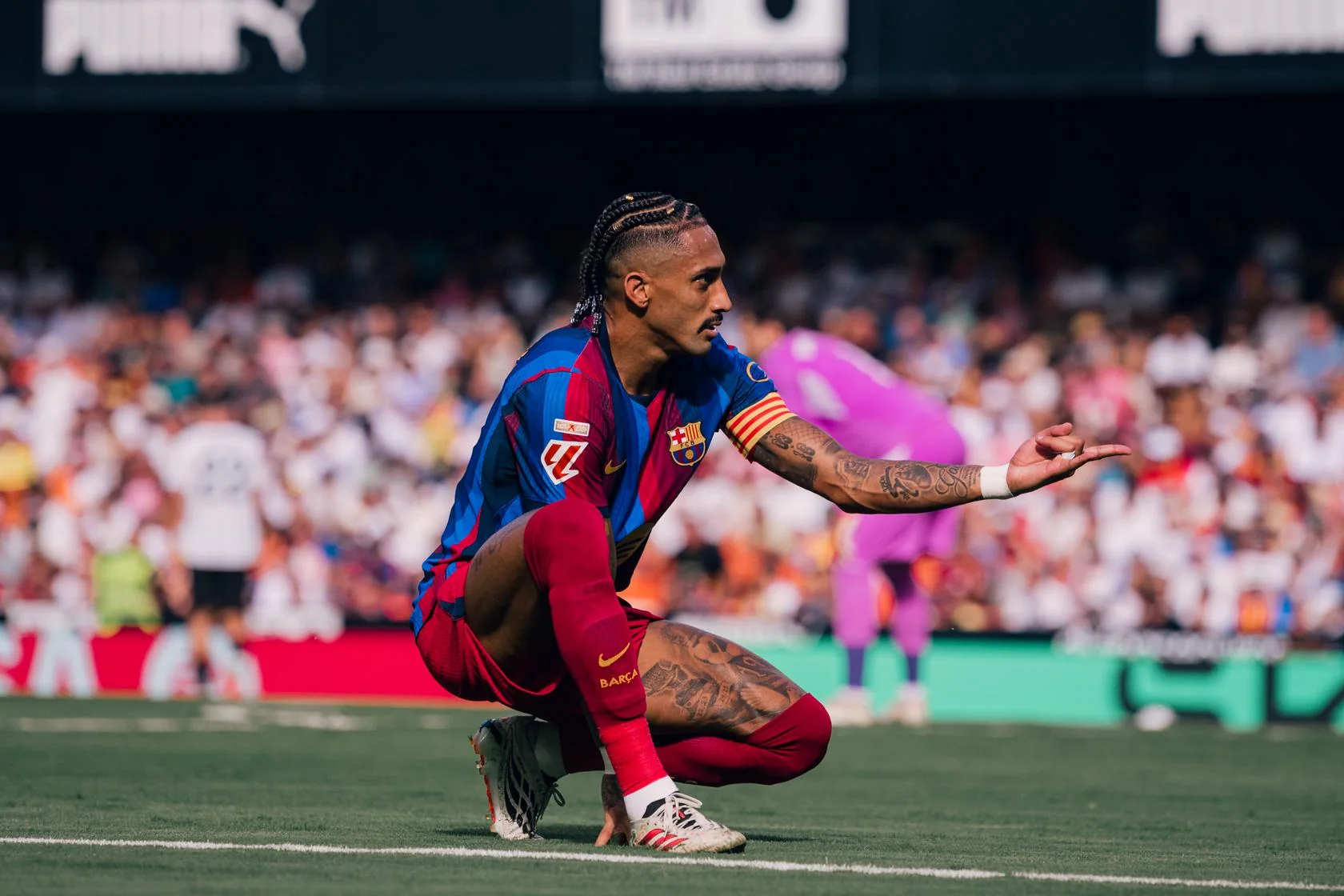
Raphinha’s Barcelona profile at a glance
Raphinha is Barcelona’s Brazilian No. 11, a left-footed forward whose contribution extends from scoring to creating chances and pressing. His full name is Raphael Dias Belloli. Born in Porto Alegre on 14 December 1996, he is 29 on 14 October 2026 and turns 30 in December. Barcelona and LaLiga list him at 176 centimetres and 64 kilograms. Those details help identify the player, but his movement explains much more about his football than the broad label “forward”. Barcelona’s player profile and LaLiga’s player page agree on his basic identity.
He joined Barça from Leeds United in July 2022. That arrival matters because he reached Spain as an established senior professional, with experience in Portugal, France and England. He was not an academy graduate moving directly into the first team. Each stage gave him a different attacking problem to solve, from earning a place in European football to creating openings in the Premier League. Barcelona became another adaptation: supplying width and incisive actions in a team regularly facing opponents who defend deep.
The number on his shirt is an identifier rather than a tactical instruction. A player wearing 11 can start near the touchline, move into an inside channel or finish close to the centre-forward. Likewise, being left-footed does not require him to stay on the right wing. Distinguishing his preferred foot, starting position and eventual attacking location is the first step towards understanding why a lineup diagram can understate his importance.
This guide separates that role from his statistics. Barcelona goals across all competitions are different from league goals; senior Brazil appearances are another record again. Completed campaigns provide a fair historical comparison, while the 2026/27 figures below are a dated snapshot of a season still in progress. That distinction lets you compare his development without confusing an exceptional opening month with a final season total, or treating every assist figure as if all providers used precisely the same definition.
What position does Raphinha play?
The useful answer is a versatile forward, frequently operating from the left or in central attacking spaces, who has also played on the right. His career cannot be captured by one permanent dot on a formation graphic. A winger’s starting location, his position when Barcelona build an attack and his location when the ball reaches the penalty area can be three different places. Under Hansi Flick, that freedom became central to Raphinha’s impact.
Why a left-footed winger can thrive on the left
Fans often expect a left-footer to play on the right and cut in to shoot. Raphinha shows why that is only one option. Starting on the left can let him attack the space between a full-back and centre-back, combine with a midfielder and reach the box before a marker can pass him to another defender. UEFA’s analysis of Barcelona’s 4–0 victory over Dortmund in April 2025 highlighted a combination with Pedri followed by a run down the inside-left channel and a cutback towards Robert Lewandowski. The danger came from the timing of the movement, not simply his stronger foot. UEFA’s Dortmund tactical review explains the pattern.
Nor does drifting inside mean abandoning wide play altogether. In UEFA’s September 2025 Newcastle analysis, Raphinha carried the ball forward from an outside position, while switches of play helped Barcelona escape pressure and create individual duels. The interpretation is that flexibility offers two different threats: he can receive wide when a defence crowds the centre, then arrive centrally once the attack develops. A full-back must decide whether to follow him inside or protect the flank. Either decision creates a question for the next defender. UEFA’s Newcastle review illustrates both wide progression and central arrivals.
Runs, combinations and pressure without the ball
A particularly clear example is his hat-trick against Bayern Munich on 23 October 2024. Barcelona won 4–1. Bayern’s own report describes Fermín López releasing him for the opening goal, then finishes from left-sided situations later in the match. These were different solutions within the same performance: accelerating through a gap, beating the goalkeeper, and finding shooting positions from another angle. That variety explains why calling him exclusively a touchline dribbler misses part of his threat. Bayern’s match report provides the sequence.
Movement has value even when it ends without a touch. A run can pull a defender away from a teammate or create a passing lane. In the Dortmund example, UEFA counted 39 runs behind the defence. That is a specific match observation, not a claim that he produces the same number every week. It shows what to watch beyond goals: when he starts a run, whose attention it attracts, and whether the passer has time to find him.
His defensive contribution follows the same logic. TNT Sports’ analysis of the Bayern game described him pressing from the left towards the central build-up, while teammates covered other spaces. The implication is collective: pressure works when the next pass is restricted as well as the ball carrier being hurried. Raphinha’s energy matters because it serves that shape. For a fan assessing his performance, an unsuccessful press can still reveal whether the forwards and midfield are moving together. TNT’s role analysis and Opta’s Flick-era assessment give useful context for that observation.
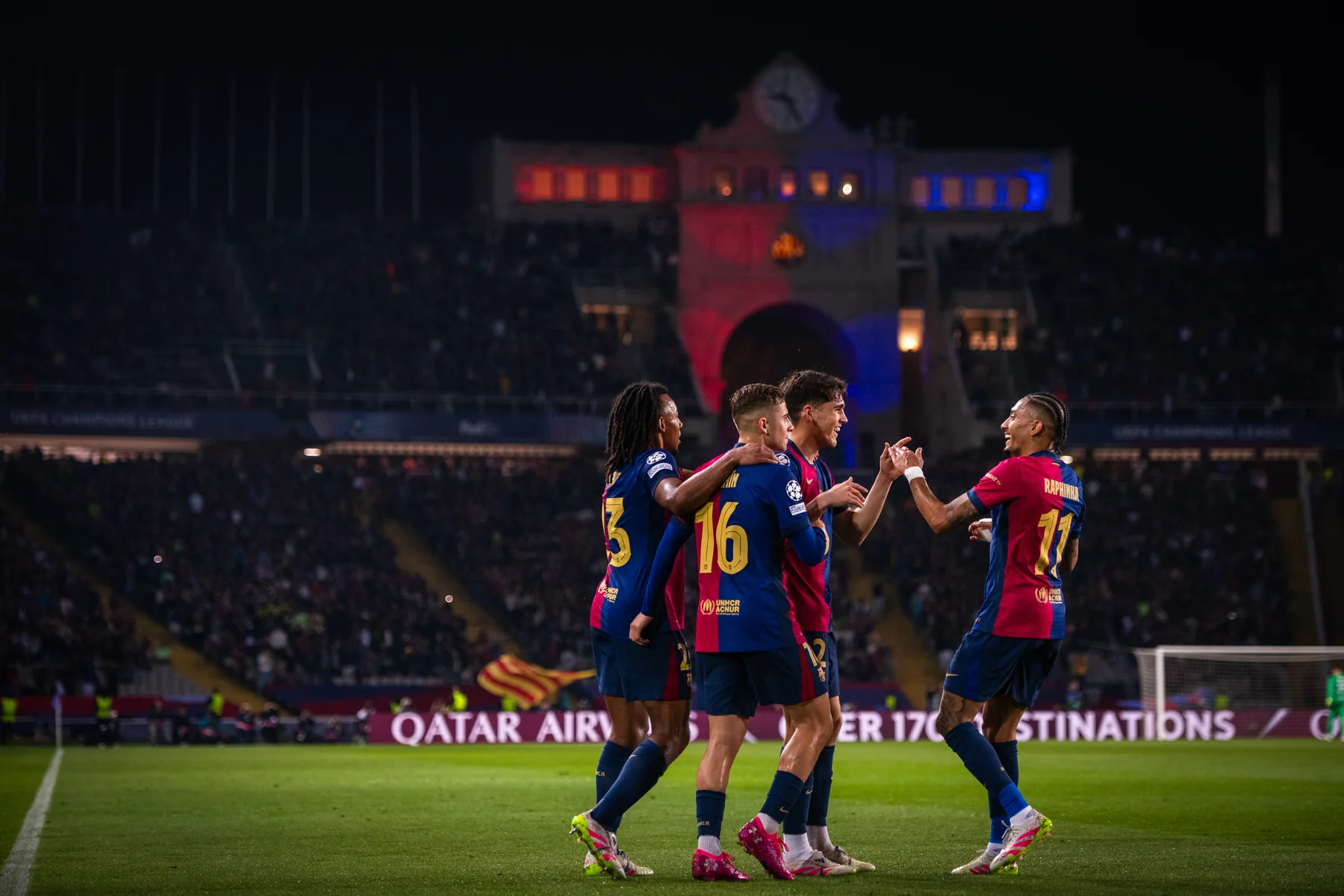
The career route that brought him to Barcelona
Raphinha’s European path began with Vitória de Guimarães before Sporting CP and Rennes. Rennes’ own arrival announcement places him at Vitória from 2016 to 2018 and at Sporting in 2018/19. At Sporting he won the Portuguese Cup and League Cup. His transfer to Rennes was announced on 2 September 2019. Those steps explain why his subsequent move to England was the next stage of an established career rather than his first experience abroad. Rennes’ signing announcement sets out that chronology.
The French club’s departure notice on 5 October 2020 credited him with eight goals in 36 matches. That record has a clearly identifiable boundary: his Rennes spell. It should not be added casually to a table of league-only goals from other clubs. Career totals become misleading when one row includes cup matches and the next excludes them. The club-by-club route remains useful even without constructing a single grand total from incompatible columns. Rennes’ transfer notice also confirms Leeds as his next destination.
Leeds supplied a particularly concrete example of performing under pressure. His first goal for the club decided a 1–0 win at Everton. Later, in the 2021/22 survival battle, he won and converted a penalty at Brentford on the final day. Leeds’ farewell also highlighted his contribution to Joe Gelhardt’s late winner against Norwich. These are examples of individual actions with immediate team consequences, rather than a vague claim that a winger “carried” an entire side. Their importance lies in the match situation: a chance created or converted could change the club’s league status.
On 15 July 2022, Leeds confirmed his completed transfer to Barcelona after 67 appearances and 17 goals across all competitions. The fee was officially undisclosed in that announcement. Barcelona’s agreement in principle had been announced two days earlier, pending his medical. Keeping the two dates separate avoids presenting an agreement as a completed move. Leeds’ completion announcement and Barcelona’s initial agreement document the sequence.
The football interpretation is that he arrived with several ways to affect a game: individual wide play, decisive finishing and experience of urgent match situations. Barcelona would demand more patient work against compact defences as well as combinations with elite teammates. That change of environment helps explain why his Spanish career developed over several seasons. A transfer provided the opportunity; the role, teammates and coach shaped how effectively he could use it.
Barcelona goals and assists, season by season
Start with the competition before comparing numbers. The table below uses Barcelona’s published all-competition goal figures for completed seasons. The final row is the league’s ongoing 2026/27 record viewed on 14 October 2026. Its narrower scope is deliberate: it prevents twelve league goals being mistaken for the entire club record, or a partial campaign being compared directly with a full one.
| Season | Scope | Goals | Useful context |
|---|---|---|---|
| 2022/23 | Barcelona, all competitions | 10 | First season and first Barça league title |
| 2023/24 | Barcelona, all competitions | 10 | Second season before Flick’s arrival |
| 2024/25 | Barcelona, all competitions | 34 | 18 of these were LaLiga goals |
| 2025/26 | Barcelona, all competitions | 21 | Third league title with the club |
| 2026/27, ongoing | LaLiga only; page viewed 14 October 2026 | 12 | Seven appearances, three league assists |
The first two seasons: a productive starting point
Barcelona’s May 2025 renewal announcement credited his debut season with ten goals and twelve assists, followed by ten goals and thirteen assists in 2023/24. The current player biography gives eleven assists for that second campaign instead. That disagreement is a reason to attribute assist figures to the particular account, rather than present a single supposedly universal total. The ten-goal figure in each of those seasons is consistent across these club accounts. The May 2025 announcement provides the earlier comparison.
Twenty goals across those first two seasons form a meaningful baseline. They show that his later rise did not begin from an absence of end product. Equally, the presence of assists means a scoring-only comparison would miss part of what he already supplied. When judging development, the useful question is how his responsibilities and access to scoring positions changed, alongside whether he remained an effective creator.
The 2024/25 breakthrough and the following campaign
His 34-goal 2024/25 campaign is the clear step upwards. LaLiga’s season-award announcement records eighteen league goals and nine league assists, and names him its best player. Those league figures belong alongside the broader club total, not in place of it. Eighteen goals in the title race carry a different competition context from a total that also includes Champions League and domestic cup matches. LaLiga’s award account gives the league-specific numbers.
The assist question needs the same precision. Barcelona’s current biography credits 22 assists in 57 matches during 2024/25; its separate 3 June 2025 retrospective reports 25. These publications do not establish one common assist definition. Goals are therefore the clearer comparison here, while each assist count should retain its attribution. The difference does not undo the evidence of a remarkable attacking season, but it does make an unattributed “goals plus assists” total less reliable. The June retrospective illustrates the discrepancy.
For 2025/26, the club profile credits him with 21 goals despite injury problems, including two against Real Madrid in the Spanish Super Cup final. This is an all-competition figure. A lower total than 34 does not by itself diagnose weaker finishing: availability, minutes and the chances a team produces also matter. The same profile lists his third Barcelona league title, giving team achievement alongside individual output rather than making the two interchangeable.
Reading the ongoing 2026/27 record correctly
On the pages viewed on 14 October 2026, LaLiga lists twelve goals and three assists in seven appearances, while UEFA lists two goals and no assists from one Champions League appearance. Together those specific competition records describe fourteen goals in eight appearances. They are a snapshot, not a projected final total. LaLiga’s record and UEFA’s record preserve the separate boundaries.
For a career milestone, Barcelona’s 27 September report placed him on 89 goals in 185 competitive club matches. Keep that publication date attached to the number. A later goal would change the total without changing the truth of the earlier milestone. For the current league race, use the LaLiga top-scorers page; for historical comparison, use the completed-season rows and retain their scope.
Brazil appearances and the distinction between club and country
Raphinha made his senior Brazil debut against Venezuela on 7 October 2021, while still a Leeds player. He entered after half-time as Brazil recovered to win 3–1. His delivery produced Marquinhos’ headed goal, and he supplied Antony for another. UOL’s contemporary report also describes his involvement in the move leading to Brazil’s penalty. That debut is a useful early example of his influence arriving through more than scoring: crossing, passing and destabilising a defence all contributed to the comeback. UOL’s debut report records the actions.
An international appearance is a Brazil cap, regardless of which club employed him that week. It belongs in his national-team record. That separation matters when following a player through several transfers: the Brazil career continues across club changes, but it does not become part of Barcelona’s appearance total. International tournaments also ask him to combine with different teammates in a much shorter preparation period.
World Cups and Copa América in his international career
He appeared at the 2022 World Cup and then at the 2024 Copa América. Against Colombia in the latter tournament, his direct free-kick opened the scoring in a match that finished 1–1. CONMEBOL’s technical report identifies that set-piece goal. It adds another specific dimension to his attacking record: alongside runs into the box and open-play creation, his left foot can threaten from a dead ball. CONMEBOL’s 2024 technical report gives the tournament context.
His 2026 World Cup was interrupted by injury after starting Brazil’s first two matches. FIFA’s 20 June report described a right-thigh muscle injury after he left the 3–0 win over Haiti, while remaining with the squad for treatment. Brazil later lost 2–1 to Norway in the round of sixteen. Those are historical tournament events, not a diagnosis of his fitness for the next Barcelona match. They also explain why selection for a World Cup and a substantial number of tournament minutes are different achievements. FIFA’s injury report and its Brazil tournament review document the sequence.
How to follow his next Barcelona matches
Raphinha’s early 2026/27 form made his next appearances especially interesting. Barcelona’s 2 October account of his September player-of-the-month award recorded seven goals and two assists in four league games that month, including consecutive hat-tricks against Racing Santander and Sevilla. That sequence demonstrates sustained immediate impact across several matches, while still belonging to a small part of the campaign. The September award account gives the dated results.
Availability then became the immediate question. On 9 October, Flick confirmed that Raphinha would miss Getafe and Galatasaray; AS subsequently reported that he did not travel to Istanbul. A possible return later in October remains different from a confirmed selection. Check the next league match listing alongside the club’s named squad, and use the viewing guide to find the appropriate legal broadcast for your location. Flick’s availability update and AS’s travel report establish what was known.
Once he plays, look beyond the score. Does he start wide or centrally? Who occupies the centre-backs when he runs behind? Does a teammate supply width as he moves inside? Those questions connect the game in front of you with the Bayern and Dortmund examples above. Afterward, the results page supplies the league outcome, while his performance deserves a wider assessment: the chances created, the spaces opened and the pressure applied are part of the same attacking contribution.
Comments
Sign in with Google to comment. Keep the conversation useful and football-focused. New comments are reviewed before they appear.
Loading comments…