La Liga clubs own the stronger historic record in the biggest direct European finals, but the Premier League leads the latest five-year UEFA association ranking. Both claims are true because “head to head” can mean matches, knockout ties, finals or total trophies. Here is the transparent comparison a fan can actually use.
First define the record you are comparing
There is no single UEFA-published number labelled “La Liga vs Premier League all-time head-to-head.” A valid answer depends on what the researcher counts. One dataset may include only the European Cup and Champions League; another adds the UEFA Cup, Europa League and Conference League; a third mixes in the Super Cup or old Cup Winners’ Cup. Some count individual matches, while others count who won each two-legged tie.
For this guide, the useful comparison is men’s competitive UEFA club football. Friendlies and summer exhibitions are excluded because substitutions, fitness and competitive incentives differ. Spain-versus-England national-team matches are also excluded: Barcelona against Manchester United belongs here; Spain against England does not. Domestic league titles cannot be head-to-head results because the clubs never meet in those competitions.
- Individual matches: every leg produces a win, draw or loss.
- Knockout ties: the aggregate winner advances, even if it lost one leg.
- Finals and trophies: a one-off final decides a champion, while total association trophies include victories over every nationality, not just the other league.
That distinction prevents a familiar statistical mistake. Imagine a Spanish club loses 1–0 in England and wins 3–0 in Spain. The match ledger says one win apiece, but the Spanish club won the tie 3–1 on aggregate. Neither description is wrong; they answer different questions. Penalty shootouts also require a declared convention because official match records generally treat a game level after extra time as a draw even when one team advances on penalties.
Competition formats complicate cross-era totals further. UEFA’s current Champions League league phase gives each club eight different opponents in single matches. Earlier group formats offered home and away meetings with the same opponent, while knockout rounds and most older ties use two legs. More teams and more matches create more opportunities for England-Spain meetings, so a raw total from one era should not automatically be treated as evidence of superiority.
Membership must be fixed to the match date too. A club that is in the Championship today may have represented the Premier League when it played in Europe; a Spanish club can likewise move between Primera and Segunda. Our working principle is to classify a club by the top division through which it qualified for that European campaign and to state the date range beside any total.
This article therefore avoids presenting an unstable scraped number as eternal fact. It focuses on the most auditable comparison—direct finals, famous knockout outcomes and official association honours—and explains exactly what each reveals. For the current Spanish field, our La Liga teams list is the clean starting point before following those clubs into Europe.
The direct European finals between Spanish and English clubs
Finals give the cleanest direct comparison because the prize, date and opponent are unambiguous. Through the end of 2025/26, clubs from Spain and England had met in eleven European Cup/Champions League or UEFA Cup/Europa League finals. Spanish clubs won nine; English clubs won two. That count treats a penalty-shootout champion as the final winner and excludes the Super Cup, Cup Winners’ Cup and Inter-Cities Fairs Cup so the scope remains consistent.
| Season | Competition | Final | Winner |
|---|---|---|---|
| 1980/81 | European Cup | Liverpool 1–0 Real Madrid | England |
| 2000/01 | UEFA Cup | Liverpool 5–4 Alavés, extra time | England |
| 2005/06 | Champions League | Barcelona 2–1 Arsenal | Spain |
| 2005/06 | UEFA Cup | Sevilla 4–0 Middlesbrough | Spain |
| 2008/09 | Champions League | Barcelona 2–0 Manchester United | Spain |
| 2009/10 | Europa League | Atlético 2–1 Fulham, extra time | Spain |
| 2010/11 | Champions League | Barcelona 3–1 Manchester United | Spain |
| 2015/16 | Europa League | Sevilla 3–1 Liverpool | Spain |
| 2017/18 | Champions League | Real Madrid 3–1 Liverpool | Spain |
| 2020/21 | Europa League | Villarreal 1–1 Manchester United, 11–10 pens | Spain |
| 2021/22 | Champions League | Real Madrid 1–0 Liverpool | Spain |
The sequence tells several stories. Liverpool supplied both English wins: a tight 1981 European Cup final against Real Madrid and the extraordinary nine-goal UEFA Cup final against Alavés in 2001. Spain then won the next nine direct finals in these competitions. UEFA itself noted that Villarreal’s 2021 victory was the tenth consecutive Spanish success against English opposition across European finals when other UEFA showpieces were included.
Barcelona’s two victories over Manchester United are remembered not only for the scores but for the authority of the performances. The 2009 and 2011 sides controlled possession, territory and the rhythm of the final against an English champion accustomed to dictating matches. Their 2006 comeback against ten-man Arsenal began the major-competition sequence shown here.
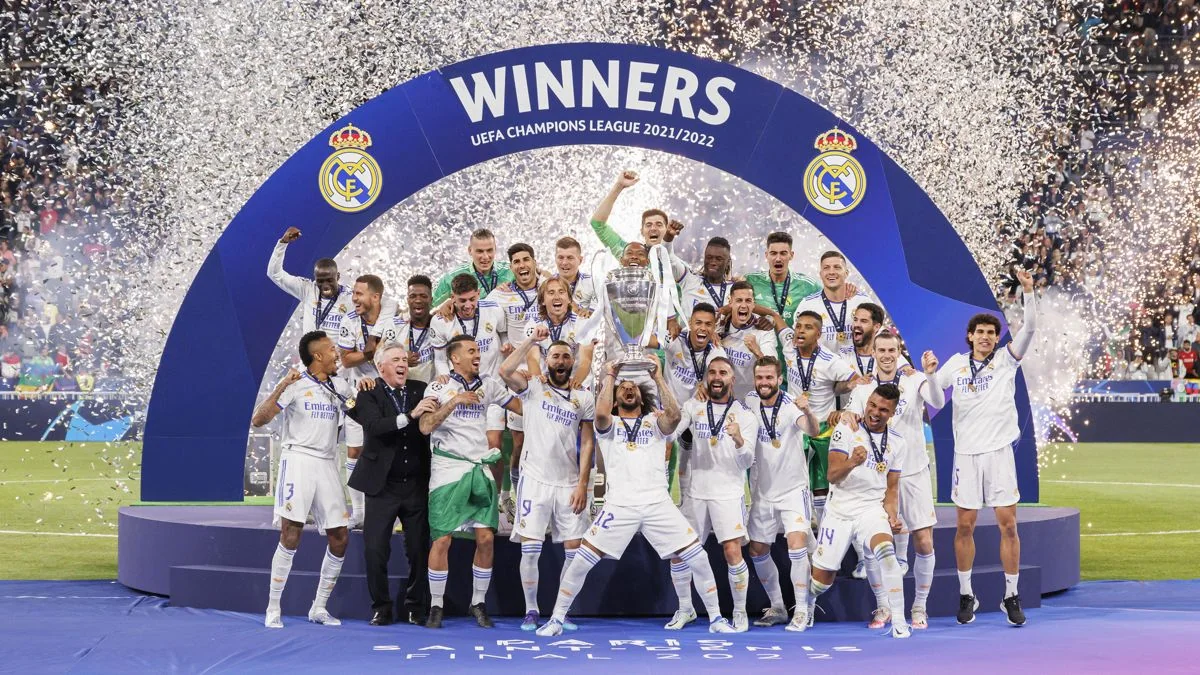
Real Madrid’s Liverpool trilogy demonstrates why eras matter. Liverpool won their first final meeting in 1981. Madrid then won the 2018 rematch 3–1 and the 2022 final 1–0, with Vinícius Júnior scoring and Thibaut Courtois central to the victory. The pairing moved from English superiority in the old European Cup to Madrid’s mastery of modern Champions League knockout nights.
The Europa League column shows Spanish depth beyond the two giants. Sevilla beat Middlesbrough and Liverpool, Atlético overcame Fulham, and Villarreal survived a 22-kick shootout against Manchester United. Those results are important because a league comparison based only on Real Madrid and Barcelona can hide how effectively Spain’s next tier converted European runs into trophies.
Finals remain a selective sample: reaching one requires surviving opponents from many other countries first. Still, if a fan asks which side owns the direct championship-match record in the two principal UEFA competitions, the answer is clear at the stated cutoff: La Liga clubs lead 9–2. Our La Liga winners history provides the domestic counterpoint to these European nights.
The knockout ties that shaped the rivalry
If finals measure nerve on one night, two-legged ties measure adaptation. Coaches see the opponent once, change pressing triggers and matchups, then manage an aggregate score that can alter the value of every attack. England-Spain knockout history contains enough swings to show why counting isolated wins can miss the larger football story.
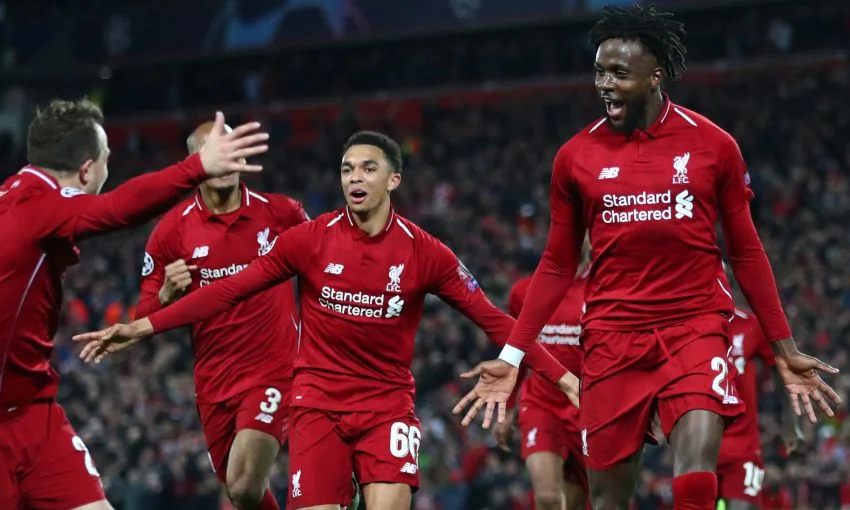
Liverpool’s 2019 semifinal against Barcelona is the clearest English example. Barcelona won the first leg 3–0 at Camp Nou, a score that looked decisive even though Liverpool had created chances. At Anfield, Jürgen Klopp’s team won 4–0 without injured forwards Mohamed Salah and Roberto Firmino. Georginio Wijnaldum scored twice after coming on at halftime, and Trent Alexander-Arnold’s quickly taken corner created Divock Origi’s clincher. The ledger records one win for each country; the tie records one of Liverpool’s greatest European recoveries.
Real Madrid produced the Spanish counterargument in 2022. Carlo Ancelotti’s side first survived Chelsea in a quarterfinal that ended 5–4 on aggregate after extra time. Against Manchester City, Madrid trailed 5–3 across the tie as the second leg reached 90 minutes. Rodrygo scored twice in roughly a minute, Karim Benzema converted an extra-time penalty and Madrid advanced 6–5. City had led for almost the entire contest; Madrid owned the decisive moments.
Those comebacks should not obscure quieter English successes. In the 2006 semifinal, Arsenal protected a 1–0 first-leg lead against Villarreal. The Spanish side controlled much of the return, but Jens Lehmann saved Juan Román Riquelme’s late penalty and Arsenal reached their first Champions League final. It was not a dominant scoreline; it was a demonstration that defending space, surviving pressure and winning the critical duel can decide a tie.
Barcelona-Chelsea added another recurring tactical argument across the 2000s and early 2010s: possession and positional control against transition power, physical duels and compact defending. Different editions produced different winners, controversies and stylistic conclusions. The temptation is to turn each result into proof that one national philosophy is superior. In reality, squad cycles and matchup details mattered as much as the badge on the league.
For a fan comparing records, the best practice is to record both layers. Note the two match results, then record the aggregate qualifier. Add context such as red cards, extra time and the old away-goals rule when it actually decided progression. A league can split the two legs 1–1 yet still lose the tie decisively, or win more individual games while fewer clubs reach the next round.
This is why our La Liga results should be the starting point for current scores, not the endpoint of historical analysis. The result tells you what happened that night. The tie tells you who solved the whole problem.
Trophy depth: what association totals reveal and hide
The all-time honours board strengthens Spain’s historic case, but it also introduces a different question. Through 2025/26, UEFA credits Spanish clubs with 20 European Cup/Champions League titles, compared with England’s 15. In the UEFA Cup/Europa League, Spain leads 14–11. These are association totals against the whole continent, not victories earned only against the other league.
Spain: the higher summit
20 European Cups/Champions Leagues and 14 UEFA Cups/Europa Leagues through 2025/26.
England: the wider spread
Six different European champions, more than any nation, plus six different UEFA Cup/Europa League winners.
Spain’s European Cup lead is extraordinarily concentrated. Real Madrid own 15 of the 20 trophies and Barcelona the other five. Atlético Madrid and Valencia have reached finals without winning the competition. That concentration is not evidence that the rest of La Liga contributed nothing—deep runs and Europa League successes say otherwise—but it means the top-line number is inseparable from Madrid’s unique history.
England’s 15 titles are distributed across Liverpool, Manchester United, Chelsea, Nottingham Forest, Aston Villa and Manchester City. UEFA identifies England as the country with the most different European Cup/Champions League winners. It also lists nine different English finalists, compared with four from Spain. If a supporter defines league strength as the number of clubs capable of reaching the summit across generations, England has the stronger breadth argument.
The second competition complicates the caricature. Spain’s 14 UEFA Cup/Europa League trophies include Sevilla’s record seven, Atlético’s three, Real Madrid’s two, plus one each for Valencia and Villarreal. England’s 11 are spread across six winners. Spain therefore combines a larger total with meaningful variety, even though Sevilla again creates a major concentration at the top.
Final appearances add another useful lens. A league that supplies many finalists but converts fewer may have broad elite access without the same trophy efficiency. Conversely, a small group of serial winners can create an imposing title total while telling us less about the median club. “Depth” must specify whether it means many credible entrants, many semifinalists, many finalists or many champions.
Money and domestic competitiveness should be kept separate too. Broadcasting revenue can help English clubs build expensive squads, but expenditure does not award an old European trophy retroactively. Spain’s academy traditions and technical strength can help clubs overperform budgets, but one brilliant generation does not guarantee the next. Historical honours measure what was achieved, not what every current club would do in a hypothetical cross-league table.
The honest conclusion is two-sided. Spain owns the larger Champions League and Europa League trophy totals at the cutoff. England owns the broader spread of European Cup winners. Fans can explore the current Spanish clubs in our La Liga teams guide, but should resist treating either historic pattern as a complete ranking of today’s 20 against today’s 20.
Which league is stronger now? A better way to judge
History favours Spain in major trophies and direct finals, but “which league is stronger now?” requires a shorter lens. At the close of 2025/26, UEFA’s five-season men’s association ranking placed England first with 119.519 points and Spain third with 97.046, behind Italy. In the single-season coefficient, England ranked first and Spain second. Both earned an extra Champions League place for 2026/27 through the European Performance Spot system.
Those figures produce a fair dated conclusion: English clubs had the stronger recent collective UEFA record at the end of 2025/26, while Spanish clubs retained the superior long-term Champions League, Europa League and direct-finals legacy. The two statements can coexist because they measure different periods.
UEFA’s association coefficient is a much better current-strength tool than social-media win totals. It includes the results of every participating club across the men’s Champions League, Europa League and Conference League. For the seasonal European Performance Spot, the points are divided by the number of entrants, preventing an association from winning simply because it started with more clubs. It still is not perfect: draw difficulty, injuries and a single exceptional run can influence one season.
- Five-season association coefficient: the clearest recent multi-club baseline.
- Current-season coefficient: form across all three UEFA competitions.
- Direct ties: who advanced when the leagues actually met.
- Depth: how many clubs reached the last eight, semifinals and finals.
- Conversion: whether finalists completed the job and lifted trophies.
The matchup sample also needs context. A season in which six wealthy English entrants face five Spanish sides can generate many games, but the identity of those clubs matters. Real Madrid facing Manchester City is not evidence about the relative quality of every lower-half team. Conference League results broaden the sample, yet those clubs may be prioritising domestic survival or rotating heavily.
Style is similarly fluid. The old shorthand—technical Spanish possession against fast, physical English transitions—can still appear in individual games, but coaches and players move constantly between leagues. Pep Guardiola shaped Manchester City after his Barcelona education; Unai Emery carried Spanish knockout expertise into multiple English jobs. Modern elite teams borrow from the same global tactical market.
So the most defensible answer is updated, scoped and humble. Spain leads the historic honours and the 9–2 direct-final count in the two major UEFA competitions through 2025/26. England leads UEFA’s five-year association ranking at that cutoff and delivered the best single-season coefficient in 2025/26. The next campaign can change the current column, not the history column. Follow upcoming Spanish fixtures through our La Liga schedule, then judge European meetings as full ties rather than isolated scorelines.
Comments
Sign in with Google to comment. Keep the conversation useful and football-focused. New comments are reviewed before they appear.
Loading comments…