The 2026/27 La Liga field has 20 clubs, including promoted Real Racing Club, RC Deportivo and Málaga CF. This identity guide pairs every current club name with the fastest way to recognize its badge, then explains the crowns, civic symbols, stripes and initials that make Spanish football crests distinctive.
Current field
20 clubs
Promoted
Racing, Deportivo, Málaga
Verified
30 August 2026
La Liga teams logos with names: 2026/27 quick list
The 2026/27 La Liga field contains 20 clubs. The list changed after the previous season because Real Racing Club, RC Deportivo and Málaga CF were promoted, while Mallorca, Girona and Real Oviedo are no longer in the top division. That season label matters: a perfectly drawn logo can still make an inaccurate guide if it belongs to a club outside the current league.
The table below pairs LaLiga's current club names with simple visual cues. These cues describe what a fan can see at a glance; later sections explain the history behind selected crowns, civic emblems, stripes and initials.
| Club name | Fast crest-recognition cue |
|---|---|
| Athletic Club | Red-and-white striped shield with a detailed upper panel |
| Atlético de Madrid | Red-and-white striped shield below Madrid's bear-and-tree image |
| CA Osasuna | Crown above a red-and-blue shield with a central lion |
| Celta | Sky-blue Cross of Saint James behind a small central shield |
| Deportivo Alavés | Blue-and-white pennant shape carrying the club name |
| Elche CF | Tall civic-style shield framed in green |
| FC Barcelona | Cross and Catalan stripes above blue-and-red bars and a ball |
| Getafe CF | Blue circular badge surrounding the Getafe municipal shield |
| Levante UD | Red-and-blue stripes beneath a black bat |
| Málaga CF | Blue-and-white striped shield with city imagery in the upper section |
| R. Racing Club | Green, white and black circular badge with a flag motif |
| Rayo Vallecano | White shield crossed by a red diagonal sash and marked RVM |
| RC Deportivo | Crowned circular badge built around a blue-and-white diagonal flag |
| RCD Espanyol de Barcelona | Crowned blue-and-white circular badge with the club name around it |
| Real Betis | Crowned green-and-white triangle with interlocking B letters |
| Real Madrid | Crowned circular MCF monogram crossed by a blue diagonal band |
| Real Sociedad | Crowned football wrapped in a blue-and-white flag |
| Sevilla FC | Red-and-white shield combining a monogram, stripes and historic figures |
| Valencia CF | Black bat above a pointed shield with black, white and warm-color sections |
| Villarreal CF | Crowned yellow circular badge with blue initials and red detailing |
Several names need a little translation for international readers. “R. Racing Club” on LaLiga's interface refers to the Santander club commonly called Racing Santander. “RC Deportivo” is Deportivo de La Coruña. “Celta” is the Vigo club. Athletic Club means the Bilbao institution, while Atlético de Madrid is the capital club; similar English spellings do not make them the same organization.
This is also why a badge guide should show names beside images. A crown alone is not enough because several Spanish clubs have one. Red-and-white stripes do not uniquely identify Athletic or Atlético. A blue-and-white circle might suggest Espanyol until the viewer notices Deportivo's diagonal flag or Racing's green border. Recognition comes from combining silhouette, color, letters and local emblem.
For current squads, schedules and individual club pages, use the La Liga teams index. The identity table here is fixed to the 2026/27 top-flight membership verified on 30 August 2026; the site index is the better destination when promotion and relegation change the league again.
What the crowns and “Real” names mean
In Spanish club names, “Real” means “Royal.” It is an honorific, not the English word meaning genuine, and it does not imply that Real Madrid is the only “real” team in the league. Royal patronage was granted to multiple clubs, especially during the reign of Alfonso XIII, and many incorporated both the title and a crown into their identities.
Royal titles are club-specific history
Real Madrid provides the clearest documented example. The club says Alfonso XIII granted Madrid the title on 29 June 1920. Madrid Football Club became Real Madrid Football Club, and the right to display a royal crown became part of its crest history. The circular MCF monogram and diagonal band remained essential recognition features; the crown added a new historical layer rather than replacing them.
Politics also changed what appeared on the shirt. During the Second Spanish Republic, Real Madrid removed the royal title and crown. Both later returned. That episode is a reminder that a badge is not a timeless file: it is a visual record that can be altered when governments, institutions or club decisions change.
Seven members of the 2026/27 field carry the royal idea in a full or commonly expanded name: Real Madrid, Real Sociedad, Real Betis, Real Racing Club, Real Club Deportivo, Real Club Deportivo Espanyol and Real Club Celta de Vigo. League interfaces often shorten several of them to Racing Club, RC Deportivo, RCD Espanyol or simply Celta. The crown can remain visually prominent even when “Real” is not written in the short match label.
How to tell the crowned badges apart
The crowned badges are easy to separate once a fan looks below the crown. Real Madrid has the MCF monogram and blue diagonal. Real Sociedad wraps a blue-and-white flag around a football. Betis places green-and-white stripes in a triangle beneath interlocking letters. Espanyol uses a blue-and-white circular field surrounded by its name. Deportivo builds around a diagonal flag, Racing uses a green circular design, and Celta's defining silhouette is the Cross of Saint James.
There is an important exception to the shortcut “crown equals Real.” A crown may be inherited from civic or regional heraldry instead of a royal title granted directly to the club. Osasuna's crown refers to the Kingdom of Navarre, while Villarreal's comes through the city's arms. Neither appears in the 2026/27 list under a Real name.
The practical recognition rule is two-step. First, notice the crown. Second, read the central device. A ball and flag suggests Real Sociedad; a monogram in a circle suggests Real Madrid; a triangle points to Betis; green around a round badge points toward Racing. The crown narrows the search but rarely completes it.
Fans who want the current club profile rather than badge history can use the Real Madrid team page. In an identity guide, the broader lesson is that royal language and royal imagery overlap often, but Spanish civic heraldry creates enough exceptions that the rest of the crest always matters.
City symbols hidden inside La Liga club badges
Many La Liga badges are miniature maps. They borrow from a city coat of arms, a regional flag, a patron saint or another symbol that supporters already associated with home. That makes a complicated crest easier to remember: instead of memorizing every line, identify the one local device that does the most work.
Barcelona combines city, country and club
Barcelona's badge is a clear four-part example. The club dates the underlying design to a competition held in 1910. At the top left is St George's Cross, which also appears in the arms of Barcelona; at the top right are the red-and-yellow stripes of the Catalan flag. The lower half shifts to the club's blue-and-claret colors and places a football in the centre. City, country and football identity share one shield.
For a quick recognition test, compare that structure with another blue-and-red badge. Levante also uses blue and red, but its tall shield is topped by a black bat. Barcelona has neither that silhouette nor a crown. The St George cross and Catalan stripes in the upper quarters are the decisive Barça cues, even when the badge is reproduced very small.
The Valencia bat works like a skyline
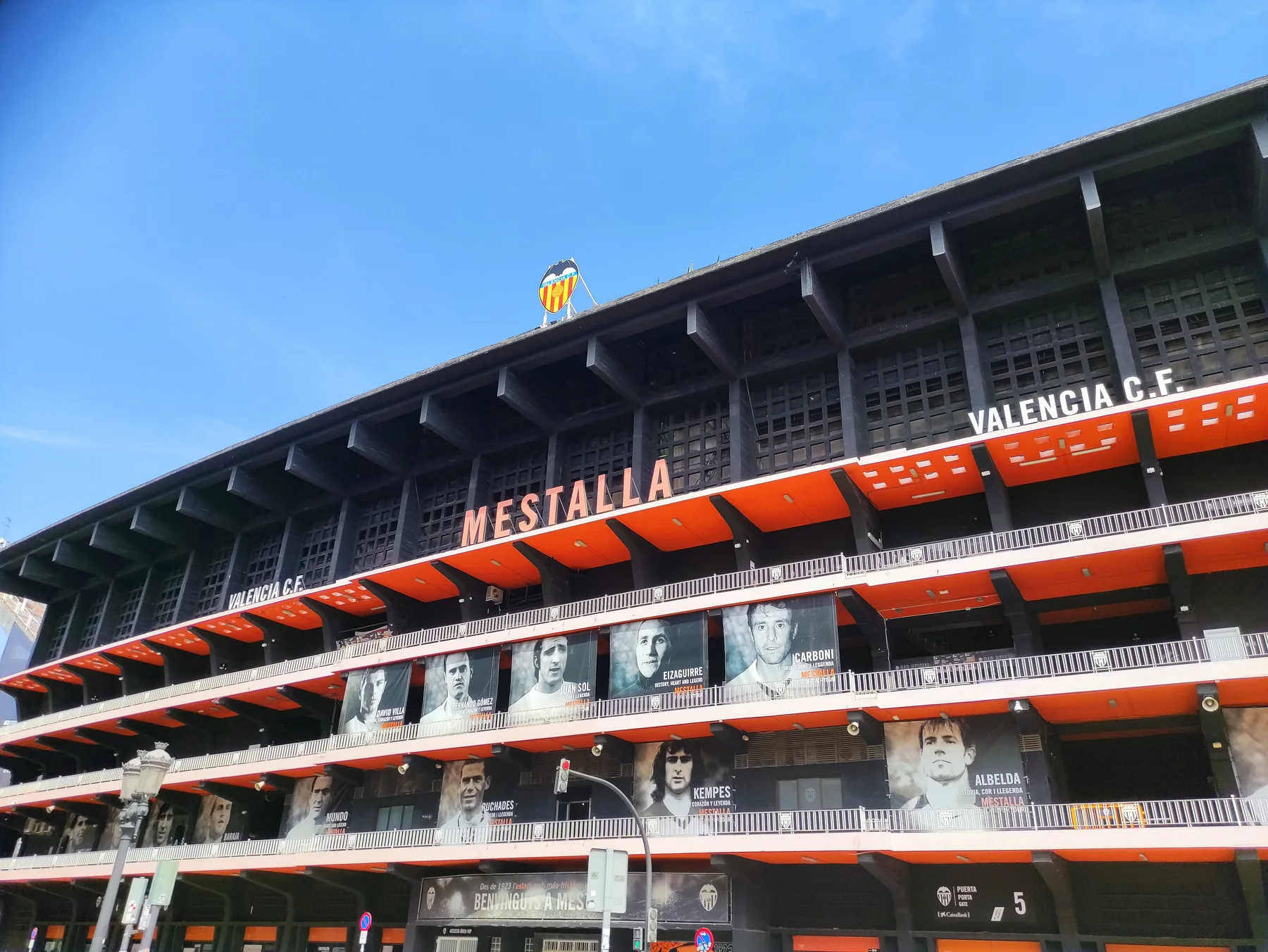
Valencia's bat is an even stronger single device. The club explains that the animal came through the coat of arms of the city of Valencia and has been linked to Valencia CF from the start. It sits above the shield with outstretched wings, creating a profile that remains recognizable when lettering and internal colors are too small to read. The bat also appears around Mestalla, reinforcing the connection between team, stadium and city.
Levante's crest also carries a bat because Levante is another Valencia club. The shared civic symbol does not mean the teams have the same badge. Valencia CF places the bat over a shield with a black upper field, central football and yellow-and-red bars. Levante's main field is built from blue-and-red vertical stripes. In this case, color is the second check after silhouette.
Seville and Galicia add their own signatures
Sevilla FC compresses more detail into its shield. The club traces the current structure to Pablo Rodríguez's design, first used in October 1921. One upper panel shows the patron saints Fernando, Isidoro and Leandro from the municipal arms. Another contains the intertwined S, F and C of the older club emblem. Red-and-white stripes and an old-style football complete the composition. When the small figures are difficult to see, the black SFC monogram is the fastest separator from city rival Betis's green triangle.
Celta's high-signal symbol is the Cross of Saint James. LaLiga's crest history identifies that red cross, the double C, crown and sky-blue field as the core set. Its narrow arms and sword-like lower point create a silhouette unlike a conventional shield. For an international fan, “sky-blue Santiago cross” is a more durable memory hook than trying to read the small central letters.
Other 2026/27 badges use similar local layering. Getafe places a municipal shield inside a blue circular identity, while Málaga combines blue-and-white club stripes with a detailed city panel. The safe editorial rule is not to guess what every tower, animal or stripe means. Start with official club history; where none is available, describe the visible device without inventing a legend.
The Barcelona team page connects the current squad and fixtures to one of the world's most familiar crests. The broader lesson applies to all 20 clubs: local symbols turn a logo list into geography, and geography makes the badges easier to remember.
Stripes, sashes and initials: how to recognize each crest
Color is the quickest way into a crest, but it should not be the last step. La Liga contains multiple red-and-white, blue-and-white and blue-and-red identities. A dependable recognition sequence is: outline, dominant symbol, stripe direction, then initials. Using all four prevents most look-alike errors.
Athletic and Atlético share history, not one identity
Athletic Club and Atlético de Madrid are the classic test. Both use red-and-white vertical stripes, and their similarity has real history behind it. Athletic's own crest review notes the link to Athletic Club de Madrid, originally connected to the Bilbao club. Atlético likewise says its first badge was the same as Athletic Bilbao's before the Madrid side developed its own identity.
The modern separation is in the top field. Athletic Club has detailed Bilbao and Biscay imagery, including the Gernika tree, wolves and the San Antón bridge and church. Atlético has the bear and strawberry tree associated with Madrid, surrounded by seven stars on blue. If the image is tiny, Atlético's upper field reads as a simpler blue block, while Athletic's looks like a landscape scene. The printed name “Athletic Club” on the Bilbao badge is another confirmation.
Atlético's current identity also illustrates why fans should check dates. The club says the badge restored on 1 July 2024 grew from its historical 1917 design and was selected after a member vote. Older shirts, game packs and logo downloads may show the streamlined crest introduced before that restoration. Both can be authentic to their period; only one is the current 2026/27 mark.
Direction and shape beat color alone
Two other stripe directions are powerful shortcuts. Rayo Vallecano uses a red diagonal sash across a white shield, reinforced by the letters RVM. Elche is associated with a green horizontal band across white. Elche's history credits coach Anton Fivber with introducing that shirt feature in the 1920s, after which it became the team's principal visual identity. “Red diagonal” points toward Rayo; “green horizontal” points toward Elche.
Initials are most useful when they are unusually arranged. Barcelona's FCB sits across the middle of a quartered shield. Real Madrid weaves M, C and F inside a circle. Sevilla intertwines SFC in black. Atlético normally does not need ATM lettering because the Madrid emblem and stripes do the work. Celta's double C sits at the centre of the Santiago cross, while Valencia uses its full name on a blue band rather than relying only on VCF letters.
| If you notice this first | Check this second | Likely club |
|---|---|---|
| Red-and-white vertical stripes | Madrid bear and stars | Atlético de Madrid |
| Red-and-white vertical stripes | Detailed Bilbao/Biscay landscape | Athletic Club |
| Red diagonal on white | RVM letters | Rayo Vallecano |
| Green horizontal identity band | Green-framed civic shield | Elche CF |
| Green-and-white triangular stripes | Crown and double B | Real Betis |
| Blue-and-white circular stripes | Crown and surrounding name | Espanyol |
| Blue-and-white diagonal flag | Crown and circular outline | RC Deportivo |
| Yellow circular field | Blue CVF initials and crown | Villarreal CF |
This method also works when color reproduction is poor. In a monochrome newspaper image, the bat still separates Valencia; the Santiago cross still identifies Celta; Betis retains a triangle; Real Sociedad retains a ball-and-flag silhouette. Shape is more stable than shade.
The La Liga teams index is the practical next step after identifying a badge because it connects the name to fixtures and club details. Recognition is not about memorizing twenty complex drawings pixel by pixel. It is about finding the one or two features that remain distinctive at scoreboard size.
The three promoted club logos returning in 2026/27
The three crests most likely to be missing from an outdated 2026/27 graphic are those of Real Racing Club, RC Deportivo and Málaga CF. All three returned to the top flight after long absences. None is a newly created La Liga brand, so a correct guide should frame them as restored members with established identities.
Racing and Deportivo take the direct places
Racing won one of the two direct promotion places after 14 seasons outside the top division. Its badge is circular and predominantly green, white and black, with a flag element through the centre. The full name is Real Racing Club de Santander, but LaLiga may show “R. Racing Club,” and English coverage often says Racing Santander. Those labels point to the same Cantabrian club.
RC Deportivo earned the second direct place and returned eight years after its previous top-flight season. The A Coruña club is not simply “Deportivo” in the generic sense of a sporting club. Its crowned circular badge, blue-and-white diagonal flag and surrounding Real Club Deportivo wording distinguish it. Historical context makes the return especially notable: Deportivo won La Liga in 1999/2000.
Málaga returns through the play-offs
Málaga completed the promoted trio through the play-offs. After a 0-0 first leg against Almería, Málaga won the return 2-1 and came back to La Liga after eight years. Its tall shield uses blue-and-white stripes and a detailed upper section linked visually to the city. Málaga's 2026/27 away-shirt announcement specifically celebrated the original club crest embroidered in full color, underlining continuity rather than a rebrand for promotion.
| 2026/27 incoming club | Route up | First identity check |
|---|---|---|
| Real Racing Club | Direct promotion | Green circular badge and central flag motif |
| RC Deportivo | Direct promotion | Crown plus blue-and-white diagonal flag |
| Málaga CF | Play-off winner | Tall blue-and-white shield with city panel |
The three outgoing names are just as important when checking a graphic. Mallorca, Girona and Real Oviedo do not appear in LaLiga's 2026/27 club directory. A page that includes them alongside the other established sides is probably showing the 2025/26 field, even if its title or update date suggests otherwise.
Opening fixtures offered another current-season cross-check. LaLiga scheduled Deportivo and Racing to begin at home, against Elche and Villarreal respectively, while Málaga opened away to Atlético. Fixtures change dates and times, but the matchups confirm that the promoted badges belong in the 2026/27 top-flight set.
That distinction matters for collectors, game editors and casual viewers. A downloadable pack can be technically perfect—transparent background, sharp vector paths, correct colors—and still be wrong for the requested season. Membership verification must come before asset quality. Use the current La Liga schedule when you need live 2026/27 match context rather than a static badge list.
How fans should use and verify La Liga logos
Football conversation uses “logo,” “badge” and “crest” almost interchangeably. “Crest” or “badge” usually feels more natural for the emblem worn on a shirt, while “logo” is common in search, design and download pages. The vocabulary is less important than verifying the correct artwork.
Verify season and version before format
Start with membership. Check LaLiga's official club directory for the requested season before downloading anything. This catches the largest error in current packs: a clean 2025/26 set relabeled or mistaken for 2026/27. Racing, Deportivo and Málaga must be present in this season's top-flight collection; Mallorca, Girona and Real Oviedo must not.
Next, check version history. Atlético's 2024 restoration is a good test case. An older streamlined Atlético crest is not necessarily fake; it may be correct for a shirt or match from an earlier period. It is wrong only when presented as the current 2026/27 badge. The same principle applies to commemorative marks, retro kits and one-season anniversary logos. A historic asset needs a historic label.
Choose a file without changing the identity
Then choose a suitable file. SVG is vector artwork, so it scales without becoming pixelated and is useful when authorized high-resolution reproduction is required. PNG is a raster format that can preserve transparency and works in many apps or game editors, but quality depends on its pixel dimensions. WebP is efficient for editorial web photographs and graphics, though it is not automatically the official master file for a club mark.
File availability is not the same as permission. LaLiga's pressroom supplies official competition artwork in formats such as PNG, PDF and ZIP, but its brand manual still controls proportions, spacing, color applications and minimum size. It warns against distortion, rotation, altered typography and improvised compositions. Valencia's brand manual similarly specifies approved crest applications and size rules. A user should not stretch a shield to fill a square or recolor it merely because the downloaded file opens in an editor.
Names also need verification. Match the official short label to the full club: Racing Club is the Santander team, Deportivo means RC Deportivo de La Coruña in this list, and Celta is the Vigo club. Do not “correct” Athletic Club to Atlético Bilbao or remove accents from Atlético de Madrid when accurate text is available. Names and marks are one identity system.
For a fan merely learning the badges, there is no need to download a commercial asset pack. The official directory and the recognition cues in this guide answer the identification problem. For a publisher or designer, official final artwork and the relevant usage rules are the safer route. The La Liga teams index keeps the football context—club pages, schedules and membership—beside the names.
The most reliable logo guide therefore does more than display twenty attractive files. It attaches a season, preserves exact club names, distinguishes current and historic versions, and tells the reader where to verify change. That is what keeps a visual reference accurate after the next promotion, redesign or commemorative release.
Comments
Sign in with Google to comment. Keep the conversation useful and football-focused. New comments are reviewed before they appear.
Loading comments…