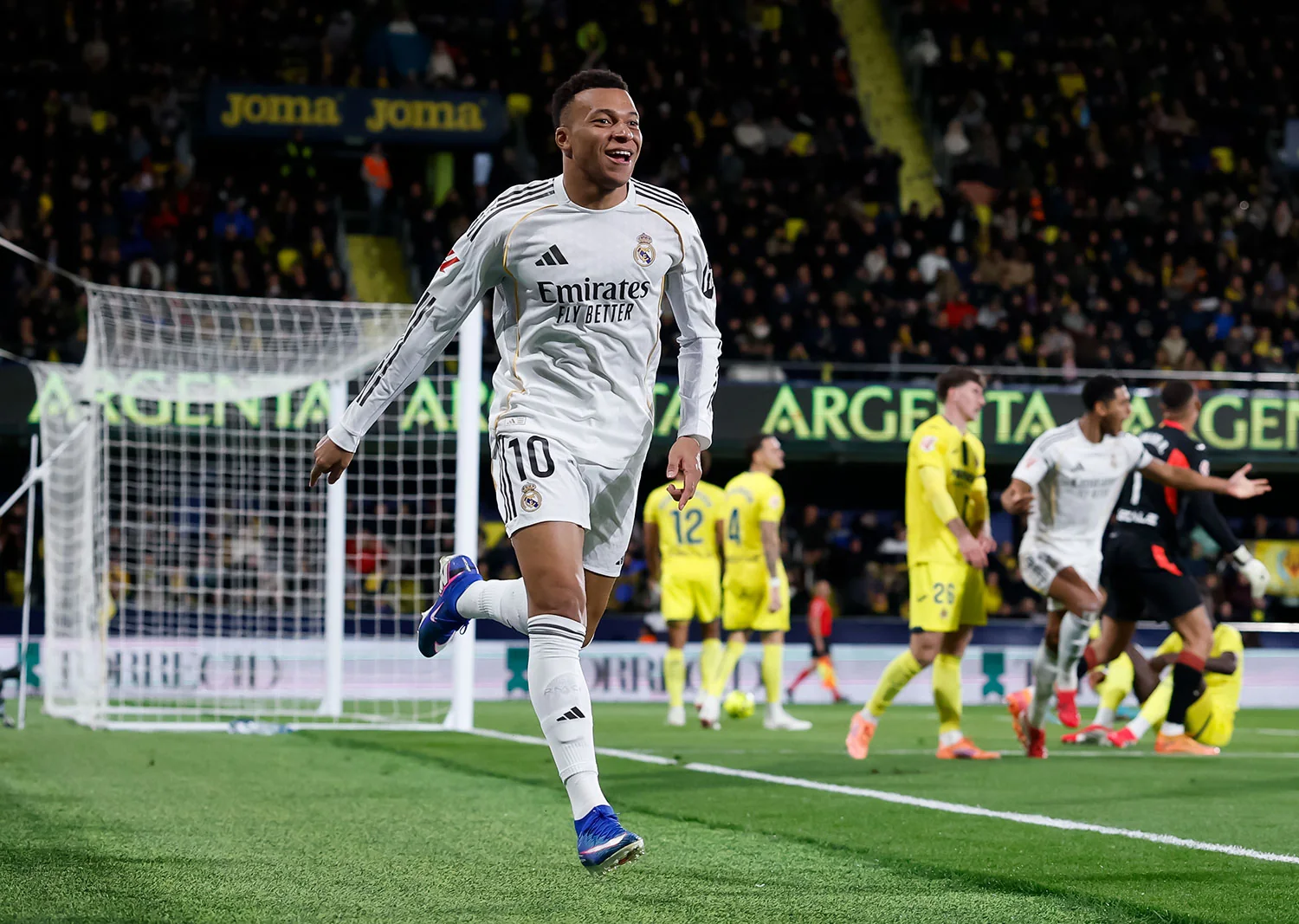
2025/26 player review
Kylian Mbappé finished the 2025/26 La Liga season with 25 goals and five assists in 31 appearances, winning a second consecutive Pichichi for Real Madrid.
This fan-first review separates final totals from per-90 rates, explains his home and away production, tests the goals against shot and xG context, and judges an outstanding individual campaign inside Madrid's second-place finish.
Mbappé's Final 2025/26 La Liga Stat Line
Kylian Mbappé finished the 2025/26 La Liga season with 25 goals and five assists in 31 appearances for Real Madrid. He started 29 matches, played roughly 2,600 minutes and won the Pichichi as the league's leading scorer. Eight of the 25 goals were penalties. He was booked four times and was not sent off.
25
Goals
First in La Liga
5
Assists
Thirty direct contributions
31
Appearances
Twenty-nine starts
2,606
Minutes
Opta Analyst total
LaLiga's public scorer table shows 0.81 goals per appearance, which is simply 25 divided by 31. A minute-based rate answers a different question: over 2,606 minutes, he produced about 0.86 goals per 90 and 1.04 goals plus assists per 90. The per-90 figure is higher because two appearances came from the bench and several starts ended before full time.
Minute totals differ slightly between providers—Opta Analyst lists 2,606 and StatMuse 2,599—so this guide does not blend their rate calculations. The seven-minute gap barely changes the football conclusion, but naming the source keeps the arithmetic reproducible. Goals, appearances and the five-assist total agree across the core leaderboards.
The availability context matters. A 38-match league leaves seven fixtures outside his appearance total, yet he still beat Muriqi's 23 in 37 matches and Budimir's 17 in 37. Mbappé's scoring was not merely a product of playing every round. His combination of volume and efficiency created enough separation to survive a late push and finish two goals clear.
For the current campaign, the La Liga top scorers table resets the race. The numbers here are a final 2025/26 snapshot and should not be mixed with his new-season total.
Home, Away and How His Madrid Role Changed
Mbappé scored 11 league goals at home and 14 away. The split suits his best-known weapon: when a home side advances and leaves grass behind its defensive line, his first steps can turn a normal pass into a one-on-one. Yet 11 at the Bernabéu is too large to describe him only as a transition forward. Madrid's home opponents often defended deep, forcing him to find finishes through crowded central lanes, cutbacks and penalty-box movement.
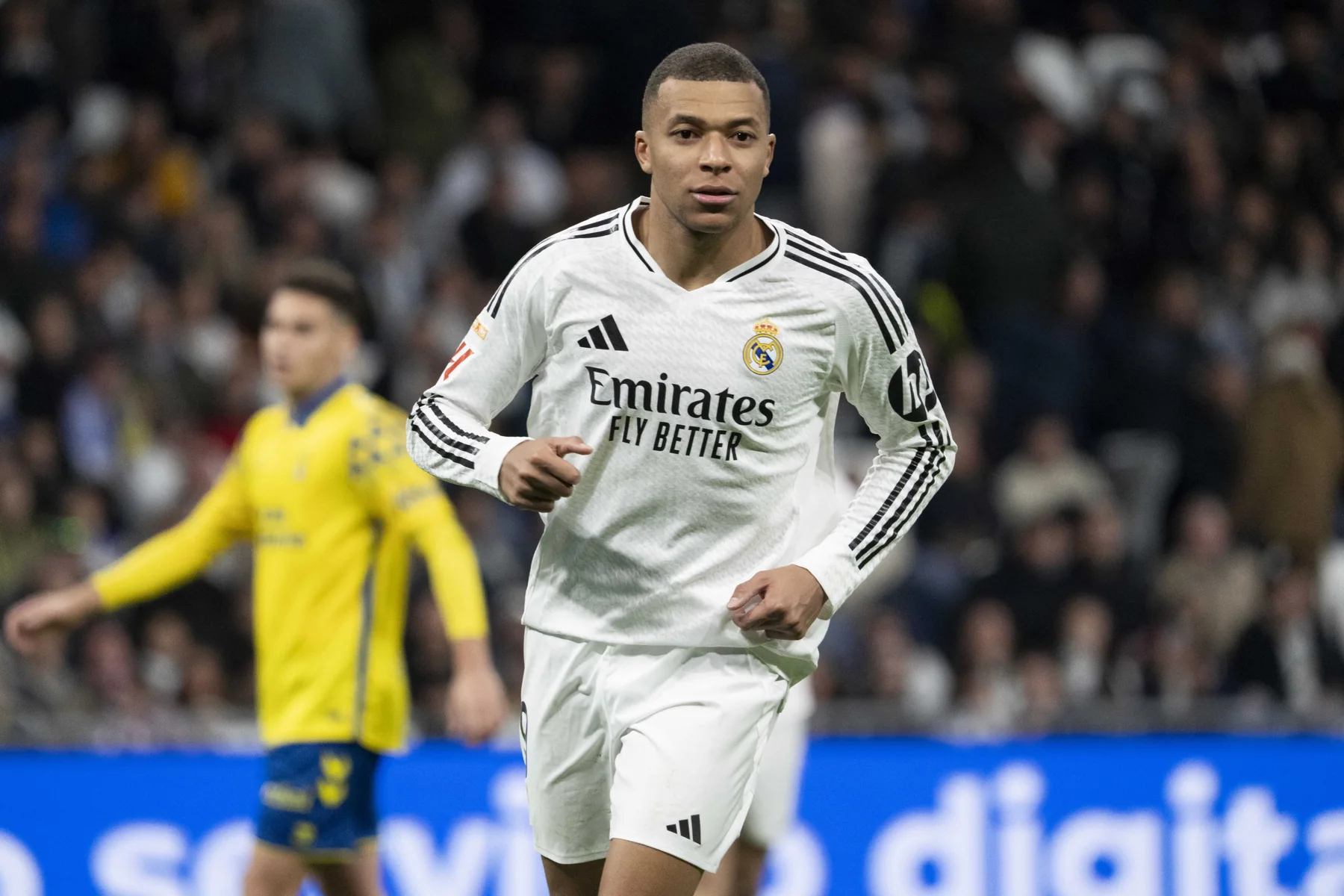
His position was better understood as a set of responsibilities than a fixed dot. He could begin from the left, share that corridor with Vinícius, move inside as the highest attacker or drop toward the ball before accelerating beyond it. The challenge was spacing: if both star forwards came short and left at the same time, Madrid lost width and a presence pinning centre-backs. When their movements were staggered, one could receive while the other attacked the newly opened channel.
At home: solve the block
Eleven goals came in matches more likely to demand short combinations, patient box occupation and finishing through numbers. His 146-shot season shows how consistently Madrid still found him.
Away: attack the space
Fourteen goals reflected the danger of giving him a runway. An away opponent trying to impose itself could be punished as soon as Madrid escaped the first pressure.
The five assists and event-based creation totals also resist the idea that he only waited for a final pass. StatMuse credits him with 73 successful dribbles and 23 big chances created. Those figures should stay attached to that provider, but the match pattern is recognisable: carries drew extra defenders, and a defender stepping toward Mbappé could free a teammate even when the move did not end in his shot.
Defensive work remained part of the tactical discussion. Early-season LaLiga Football Intelligence data reported 12.47 pressures per 90, almost unchanged from 12.41 the year before, while the coaching message emphasised regaining the ball faster. Pressure count alone cannot show quality—angle, timing and teammate coordination matter—but it explains why Madrid's front-line balance was judged on more than goals.
The fan takeaway is not that away Mbappé was “better.” Home and away presented different problems, and he topped the league by solving both. Use the La Liga teams guide to compare the opponents and stadium contexts behind that 11-14 split.
Shot Volume, xG and What 25 Goals Reveal
Mbappé's Pichichi was built first on access to shots. FBref records 146 attempts, 63 on target and 25 goals. That works out to 5.84 shots per goal, 43.2% of attempts on target and roughly 17.1% of all attempts scored. The totals describe a forward who kept arriving in shooting positions; they do not depend on a small handful of improbable finishes.
| Stage | Total | Fan reading |
|---|---|---|
| Shots | 146 | 5.06 per 90 |
| On target | 63 | 43.2% of shots |
| Goals | 25 | 17.1% conversion |
| Non-penalty goals | 17 | Eight goals were penalties |
Opta's season model, reported by AS, assigns him 23.9 expected goals. His 25-goal finish is about 1.1 above that number—good finishing, but not a vast statistical escape. The stronger story is repeatable process: Mbappé generated enough chances to lead the xG conversation and then converted near that elite expectation. A scorer who relies on low-volume wonder goals is more likely to swing sharply; this profile has a sturdier foundation.
Expected-goal models are not interchangeable. FootyStats publishes 26.5 total xG and 20.2 non-penalty xG, while StatMuse's event set returns 14.69 non-penalty xG. Differences in shot locations, provider event feeds and model training produce different answers. It would be invalid to take total xG from one service and non-penalty output from another to manufacture a finishing gap.
Penalties belong in the 25 because they changed real scores, yet they answer a role-dependent question. Mbappé converted eight of nine, giving Madrid reliable value from the spot. Removing them leaves 17 open-play and set-play goals; retaining them measures his full assigned scoring job. Both views are useful as long as the label is visible.
For fans reviewing the match evidence, the La Liga results archive shows where those goals changed points. xG helps describe chance quality; the result page shows whether the finish became an opener, equaliser, winner or consolation.
How Mbappé Won a Second Straight Pichichi
A Pichichi race has no preset winning score. The target is one more than the closest rival, and in 2025/26 Mbappé's 25 goals beat Vedat Muriqi's 23. Ante Budimir finished third with 17, while Ferran Torres and Lamine Yamal reached 16. That two-goal margin is the proper competitive context: Mbappé was pushed, but he finished with clear daylight rather than sharing the lead.
The race stayed alive because Muriqi kept scoring for Mallorca while Mbappé's total advanced more slowly late in the campaign. On the final matchday, both leading forwards scored. Mbappé's goal in Real Madrid's 4-2 victory over Athletic Club took him to 25 and closed the contest. It was a fitting final act: he did not merely wait for an earlier advantage to survive the last weekend.
| Season | Goals | Apps | Goals per app | Runner-up |
|---|---|---|---|---|
| 2024/25 | 31 | 34 | 0.91 | Lewandowski, 27 |
| 2025/26 | 25 | 31 | 0.81 | Muriqi, 23 |
The comparison prevents a misleading headline. His second Pichichi was not statistically stronger than his first: the total fell by six, and goals per appearance dropped from 0.91 to 0.81. His 2024/25 haul also earned the European Golden Shoe. The 2025/26 honour says something different. Different opponents, a different tactical season and fewer appearances still produced the same domestic rank.
Back-to-back scorer titles are a test of repeatability. Defenders enter the second year with more video, clearer plans for denying his favourite channels and no surprise about his pace. Madrid also continued working through the spacing questions created by elite left-sided attackers sharing one forward line. Mbappé remained the league's most productive scorer despite those adjustments.
That does not make the award a complete judgment of his football, and it certainly does not turn a runner-up league campaign into a team trophy. It does establish that the scoring crown was earned against the players on the same schedule. Fans can examine the complete order and the new-season reset on the La Liga top scorers page.
Brilliant Individual Season, Runner-Up Team: The Fair Verdict
The league table supplies the boundary around every individual review. Real Madrid finished second on 86 points, eight behind Barcelona's 94. Madrid scored 77 goals and conceded 35; the champions scored 95. Mbappé therefore led La Liga's individual chart while playing for a team that was comfortably strong, but not the competition's most productive or most consistent across 38 rounds.
His 25 goals accounted for 32.5% of Madrid's league total. Add five assists and he recorded 30 direct goal contributions, although that figure should not be described as 39% of team goals because an assist and the corresponding teammate goal are two views of the same scoring event. The clean takeaway is simpler: nearly one Madrid goal in three came from his own finish, and he also supplied the final pass for five more.
The one-sentence verdict
Mbappé had an elite 2025/26 La Liga season: he won a deserved second straight Pichichi, created chances as well as finishing them and remained Madrid's defining scorer, but his total and rate fell below his 2024/25 peak and his club finished a clear second.
There is no contradiction in praising the player and criticising the team outcome. A forward can decide a large number of matches without controlling how the side progresses the ball under pressure, protects transitions, defends set pieces or manages the minutes after taking a lead. Equally, 25 goals should not place him beyond tactical examination. His positioning, combination with Vinícius and contribution to the first line of pressure all affected how Madrid functioned between the goals.
The 18-goal gap between Barcelona's attack and Madrid's is especially instructive. Barcelona spread 95 goals through a collective that included 16 each from Lamine Yamal and Ferran Torres plus contributions across the squad. Madrid had the league's leading marksman but a lower team ceiling. That is why the Pichichi and championship can point to different clubs without either result being strange.
Against Mbappé's own standard, 2025/26 belongs one tier below the 31-goal, European-Golden-Shoe debut league season. Against everyone else in Spain, it finished first. Context should sharpen the judgment rather than dilute it: 25 in 31, five assists, a two-goal winning margin and approximately 0.86 goals per 90 are exceptional numbers, even if they did not deliver the trophy Madrid values most domestically.
Fans revisiting the season can use the final La Liga table for the 38-round team picture and the results archive for the match-by-match story. Keep those layers beside the scorer data and the conclusion holds: brilliant striker season, deserved individual award, unfinished team job.
Comments
Sign in with Google to comment. Keep the conversation useful and football-focused. New comments are reviewed before they appear.
Loading comments…