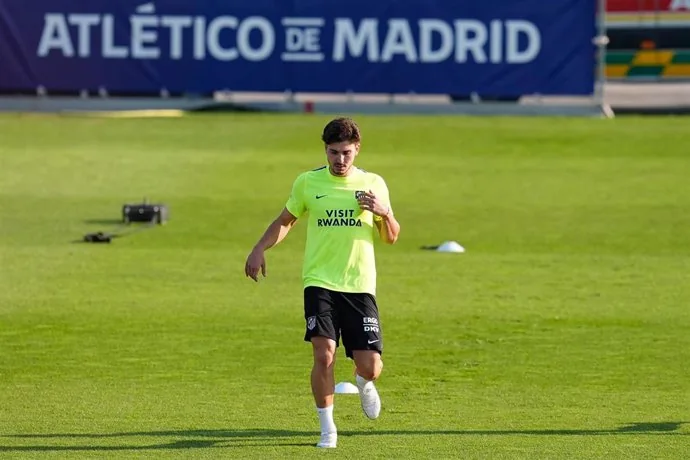
Julián Álvarez's position and current club
Julián Álvarez is an Argentine forward at Atlético Madrid. His main position is centre-forward, with the mobility to play around a strike partner or receive behind the front line. Atlético's current 2026/27 squad lists him as number 19, and the league profile classifies him as a forward. He was born in Calchín on 31 January 2000, making him 26 on 14 October 2026.
The basic identity matters because searches for his name often mix a position question with a transfer story. Atlético's 2024 signing announcement confirmed a six-season agreement running until 2030. His presence in the current squad establishes where he plays now. Reports about interest from Barcelona, Arsenal or Real Madrid should not be substituted for a completed move or used to relabel his present club.
A striker who can work around another forward
Calling Álvarez a centre-forward does not mean he spends every attack standing between two central defenders. Atlético describes him as quick, skilful and good at combining, with the ability to operate as a playmaker. Those qualities help explain why he can lead the attack in one passage and move underneath another striker in the next. The roster label identifies his broad role; the spaces he occupies depend on teammates and the ball.
A second striker usually has another attacker providing a reference near the centre-backs. That can free Álvarez to receive a short pass, turn or make a run from a defender's blind side. As the leading striker, he must also offer depth so that the opposition cannot simply follow him into midfield. The useful distinction is what he is doing during a particular move, rather than whether a lineup graphic places his name one line higher or lower.
His listed height is 170 centimetres. That does not prevent central play: a striker can make himself available through timing, changes of direction and quick combinations instead of relying primarily on aerial duels. Watch how he positions himself before the ball arrives and whether his movement opens a route for somebody else. These are practical ways to understand a mobile forward without assuming that every short attacker is a winger or that every central attacker must be a target man.
The movements that define his playing style
The most revealing part of Álvarez's game often comes just before a touch. He changes his relationship with the nearest defender, offers a passing angle and then moves again as the ball travels. In Guardiola's early assessment, his short movements, goalscoring instincts and work without the ball were central strengths. The manager envisaged him operating centrally, including spaces between midfield pockets and the striker.
Pressing and the first pass after a turnover
Pressing is most useful when it has a destination. An attacker can approach a defender from an angle that blocks one pass and encourages another, allowing a teammate to anticipate the next action. For a viewer, the question is whether Álvarez's run helps the whole side compress the ball or simply takes him out of the move. Effort is visible; coordination requires watching the players around him.
A FIFA tactical review of Argentina's 2022 matches supplies a useful example against Australia. After an attempted forward pass was intercepted, Álvarez reacted to win the second ball and headed it toward Alexis Mac Allister. That sequence illustrates how being close enough to react can sustain an attack even when the first pass fails.
The next decision matters as much as the regain. A rushed shot can waste a promising turnover, while a simple pass can give a better-positioned teammate the first clear view of goal. Watch whether Álvarez receives facing forward, protects a contested ball or releases it quickly. These actions explain how a forward contributes to pressure without appearing in the final scorer-and-assister line.
Linking play without leaving the penalty area empty
Dropping toward midfield offers a short connection, but the attack still needs somebody to threaten behind the defence. The same FIFA review identifies Álvarez's channel run between Poland's right-back and centre-back as a movement that opened space for Mac Allister between the lines. Moving away from the ball can therefore help progression just as much as coming close to collect it.
That support-and-depth balance is a useful way to judge his Atlético role. If a strike partner stays high, Álvarez can connect underneath; if the partner comes short, his run beyond can stretch the line. These are tactical possibilities, not a fixed promise that each game follows one pattern. Against a compact defence, small changes of angle may be more valuable than a long sprint. Against a retreating back line, timing the forward run becomes decisive.
Follow the entire move through to the box. The important test is whether the forward who helped build an attack can arrive where the final pass is likely to go. A good linking action and a dangerous finishing position are complementary tasks. Treating them as competing identities obscures why Álvarez can be a striker while spending part of a possession outside the area.
From River Plate to Manchester City and Atlético
Álvarez's first-team career began at River Plate, after he joined the club's youth ranks in 2016. His professional debut came on 27 October 2018. By the end of that spell he had built an extensive senior record: Atlético's arrival biography gives 122 River appearances and 54 goals. Those are totals from the Argentine club chapter, rather than a league-only return or a projection of what he would achieve in Europe.
The next dates need to be separated. Manchester City agreed his signing in January 2022, while he continued at River before arriving in Manchester that summer. A transfer agreement and the first match for a new team are different milestones. His two City seasons then placed him in an attack where he had to adapt his movement to teammates, often including Erling Haaland.

City's 2023/24 season review records 25 starts alongside Haaland, with Álvarez used as a second striker, on the wing or as a number ten. When Haaland was unavailable, he also led the line. That is a more complete account than describing him only as an understudy. The challenge was to contribute centrally while also finding other ways to fit into a side with an established specialist striker.
City's departure announcement confirmed the permanent Atlético move in August 2024 and put his City record at 103 appearances and 36 goals in all competitions. Atlético announced the agreement on 12 August; his competitive debut followed at Villarreal on 19 August. That timeline answers the common question about when he joined without confusing the announcement with his first league appearance.
| Career chapter | Key milestone | What changed |
|---|---|---|
| River Plate | Senior debut, 27 October 2018 | A youth player became a regular senior attacking option. |
| Manchester City | Arrival in summer 2022 | Central finishing was combined with several supporting roles. |
| Atlético Madrid | Signing announced 12 August 2024 | A new league and attacking partnership context followed. |
Each chapter helps explain a different part of the player. River supplied sustained senior responsibility, City required positional flexibility, and Atlético asks those skills to operate in Spanish football. This is a development path rather than evidence that he permanently abandoned his original position. The useful continuity is a forward who can connect a move, threaten space and finish it, even when the surrounding formation changes.
Goals, assists and the right statistical comparison
Álvarez has produced goals in several football environments, but his returns need their competition labels. His City record of 36 goals covers two seasons and all competitions. Within that spell, the club's 2023/24 review gives 19 goals and 13 assists from 54 appearances. Neither figure is a Premier League-only total, and the two-season number should not be presented as one year's output.
A significant Atlético milestone came on 18 March 2026. The club's centenary announcement recorded 100 official appearances, 46 goals and 16 assists since his arrival. This was a record at that milestone, not his complete Atlético total as of October. It nevertheless shows that his scoring contribution had already continued well beyond the move from Manchester.
Atlético seasons and the unfinished 2026/27 campaign
For the current league campaign, the Spanish-language La Liga profile, checked on 14 October 2026, shows four appearances and 128 minutes, with no goals or assists. FotMob's league summary gives the same basic line. These are early 2026/27 league figures. They do not include Champions League appearances, Argentina matches or earlier Atlético seasons.
| Record | Appearance and scoring anchor | Scope |
|---|---|---|
| Manchester City, 2023/24 | 54 appearances; 19 goals; 13 assists | All competitions in that season |
| Atlético milestone, 18 March 2026 | 100 appearances; 46 goals; 16 assists | Official club career to that date |
| Atlético, 2026/27 league | 4 appearances; 128 minutes; 0 goals; 0 assists | La Liga snapshot checked 14 October 2026 |
Minutes change the interpretation of the current line. Four appearances totaling 128 minutes provide much less playing time than four full matches. A short substitute appearance may involve chasing a game, protecting a lead or entering against tired defenders. It is too small a sample to describe a forward's entire season, and it cannot be compared directly with a completed campaign without explaining the difference.
For a fuller football assessment, combine the scoring record with the opportunities being created. Does he get touches inside the box, receive the final pass in stride or have to manufacture difficult shots? Is his partner occupying the centre-backs while he arrives from behind? Those questions connect the statistics to his role. Use the league scoring table for league comparisons, while keeping cup and international production in their own categories.
Argentina, the World Cup and the meaning of his trophies
Álvarez's Argentina career has supplied another setting for his central-forward qualities. The national association's 2024 player biography records Copa América wins in 2021 and 2024, the 2022 Finalissima and the 2022 World Cup. Those are distinct international honours, earned alongside his club successes rather than added to Atlético's own trophy record.
The level of involvement differed across tournaments. CONMEBOL's account of his first Copa América goal notes that he played one match in the 2021 edition. His first goal in that competition arrived against Canada in the 2024 opener. Being part of a winning squad is a real achievement, but it should not be described as the same role in every victory.
What the 2022 tournament showed about his role
At Qatar 2022 he scored four times, including twice in Argentina's 3–0 semifinal victory over Croatia. This is his total for that particular World Cup, rather than an all-time figure that automatically remains unchanged after later tournaments. The knockout contribution explains why that campaign became such a prominent part of his reputation: his goals helped Argentina progress at moments when one result decided whether the competition continued.
His role alongside Lionel Messi is also useful for understanding a striker's relationship with a creative teammate. When one attacker receives to make the pass, another must offer a route toward goal. A well-timed run can stop the defensive line from stepping freely into the creator's space. The forward then needs to remain available if the ball moves wide or the initial passing lane disappears.
That relationship does not require the striker to touch the ball in every phase. Sometimes the contribution is to hold a defender's attention, sometimes to combine briefly and then break away. At other moments it is to apply pressure when possession changes. Looking at all three tasks gives a better account of his value than simply deciding whether Messi or Álvarez was the more important name on the team sheet.
His club honours broaden the picture. The City spell included two Premier League titles and the 2022/23 Champions League and FA Cup, while River brought a Copa Libertadores victory early in his career. These achievements demonstrate experience in successful teams across different competitions. They do not mean every future final, league campaign or strike partnership will follow the same pattern. The more useful lesson for an Atlético supporter is that his scoring and supporting skills have already been tested in several demanding settings.
Watching Álvarez in an Atlético match
Start with the confirmed lineup and identify the players around him. In Atlético's 13 October 2026 lineup against Manchester United, Álvarez and Kang-in Lee were named in the front line, with Álex Baena and Giuliano Simeone among the supporting midfield players. Jonathan David and Alexander Sørloth were substitutes. That is a concrete example of his current attacking context, rather than a permanent hierarchy for every fixture.
During the opening possessions, look for the nearest defender he is trying to influence. Does he keep that player deep, come short to receive or run diagonally as a teammate advances? Then watch who fills the space he leaves. If the attack gains a passing lane or room for a runner, the movement may have helped even when Álvarez does not receive the ball.
When Atlético loses possession, widen your attention beyond the striker. A forward's first run can direct the opposition toward a teammate's pressure, but it needs support behind it. Notice the distance to the midfield and whether the side can compete for the next ball. This helps distinguish a coordinated press from a sequence in which an attacker works hard while the opposition still has easy passing options.
Finally, follow him into the finishing phase. Count the chances he can realistically attack, not merely the crosses sent somewhere toward the area. Check whether he is arriving onto the ball, receiving with a defender on his back or shooting after a difficult recovery. Compare that picture with the scoring record after the match, using the results page for the league outcome.
The fixture calendar helps you choose the next Atlético league game to watch. Return to the actual lineup when it is announced, because availability, opposition and rotation can change his task. His career shows why the forward label is correct; watching the surrounding movements explains which version of that role the match requires.
Comments
Sign in with Google to comment. Keep the conversation useful and football-focused. New comments are reviewed before they appear.
Loading comments…