The Short Answer: La Liga Has No Championship Final
No. La Liga does not have a championship final, semifinals or a postseason playoff for the title. Spain's top-flight champion is the club that finishes first in the league table after the regular 38-match schedule. Every club plays the other 19 teams twice—once at home and once away—and the points earned across all those matches determine the winner.
Teams
20
Matches per club
38
Title final
None
That structure makes La Liga different from leagues that divide their season into an opening and closing tournament, use conference playoffs or stage a Grand Final. A club cannot finish fourth and then win three knockout games to become Spanish league champion. The whole campaign is the title race: consistency in August counts in the same points total as a decisive victory in May.
The phrase “La Liga final” still appears for three reasons. Some fans use final to mean the last matchday. Others mean the particular match in which a club mathematically clinched the title. A third group is actually searching for a Spanish cup final involving La Liga clubs. Those uses are understandable, but none describes a championship game organized by La Liga.
The practical test is simple. If the page shows a 20-team standings table and numbered matchdays, it is the league. If it shows a knockout bracket, semifinal pairings or a single trophy match, it is another competition. The current La Liga table is therefore the place to see who is closest to the title, not a final bracket.
How the 38-Match League Decides the Champion
La Liga is a double round-robin competition. Each of the 20 clubs faces 19 opponents at home and the same 19 away. That creates 38 matches per club and 380 matches across the division. There is no reset after the first half and no seeding into a knockout phase.
Points formula
Total points = (wins × 3) + draws
A defeat earns zero points. Goals matter for tiebreaking and match outcomes, but there is no bonus point for scoring several goals.
A simple example shows the system. A club that wins 24 matches, draws eight and loses six collects 80 points: 72 from the wins and eight from the draws. A spectacular cup-style run cannot replace points dropped earlier. Beating a direct title rival is valuable because the winner gains three while the opponent gains none, but it is still recorded as one league result rather than an elimination.
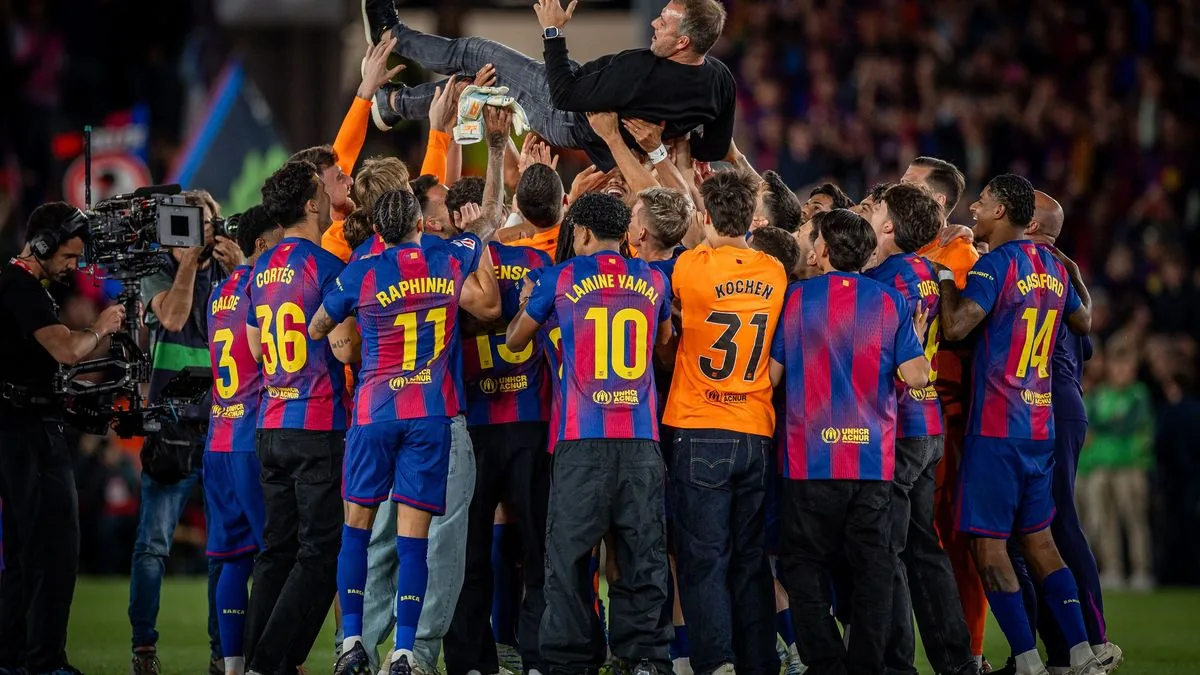
The completed 2025/26 table offers a real check on the arithmetic. Barcelona finished with 31 wins, one draw and six defeats. Multiplying 31 by three and adding one produces 94 points, the total shown by both LALIGA and the RFEF. Real Madrid's 27 wins and five draws produced 86. Barcelona therefore won the championship through the superior season total, not through a later final against Madrid.
August to January
Every result starts building the same cumulative table.
January to May
The return fixtures add to—not replace—the first-half points.
After Matchday 38
The club ranked first is champion unless it already clinched earlier.
This is why a draw away to a mid-table team can matter months later. The title is an accumulation problem: clubs balance attacking ambition, injury risk, European travel and squad rotation while trying to maximize the same finite pool of league points. To audit the table yourself, use the La Liga results archive and add each club's wins and draws.
How mathematical clinching replaces a final
To test whether the race is over, calculate each challenger's maximum: current points plus three for every match left. If the leader has 82 points and the nearest rival has 74 with two games remaining, the rival can reach only 80. The leader is champion immediately, even before playing again. If the rival's maximum can equal the leader, the relevant tiebreakers still need to be considered.
This “maximum points” method explains why the presentation date and the last matchday can differ. The trophy is earned once the standings cannot be overturned, while the remaining scheduled games must still be played. Those fixtures continue to determine final point totals, qualification places and relegation; they simply no longer create a new title round.
Final Matchday, Title-Deciding Match and Final Are Different
Football language can make this question harder than the format really is. “Final match,” “final day,” “title decider” and “the final” sound similar, but they describe different things. Only the last phrase normally means a knockout championship game.
| Term | Correct meaning | La Liga example |
|---|---|---|
| Final matchday | The last numbered round of the schedule. | Matchday 38. |
| Title-deciding match | A result that makes first place mathematically secure. | It can occur before the last round. |
| Must-win “final” | A metaphor for a high-pressure league game. | It still awards the standard three points. |
| Championship final | A knockout game whose winner takes the trophy. | La Liga does not have one. |
The 2025/26 season demonstrates the distinction. LALIGA scheduled its final matchday for May 23–24, 2026, yet Barcelona had already secured the championship three rounds earlier. A win over Real Madrid left an insurmountable advantage. The remaining league matches still counted toward the final table, European qualification and relegation, but no opponent could catch the leader.
Sometimes the race does survive until Matchday 38. In that case, several games—not one neutral-site final—may decide the title at the same time. Organizers can align kickoffs for fixtures affecting the same sporting objective so no contender plays with knowledge of another final result. Supporters may experience one game as the emotional title decider, while the official mechanism remains the combined table.
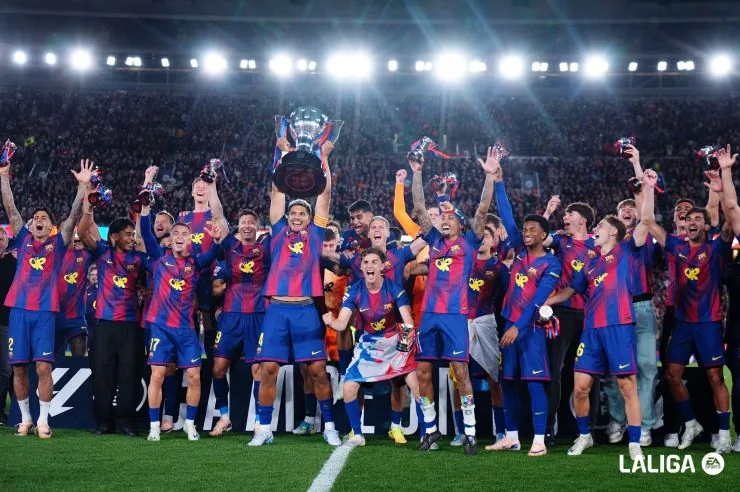
A trophy ceremony can create another visual illusion. The champions may receive and lift the trophy after a home game, or celebrate once the title is clinched. That presentation is recognition of the league campaign; it is not proof that the preceding match was a final. Check the daily La Liga schedule: league games are labelled by matchday rather than semifinal or final round.
What Happens When Teams Finish Level on Points
Equal points do not automatically create a championship final. The 2026/27 competition rules contain an ordered set of tiebreakers. For two tied clubs, La Liga looks first at the goal difference across the two league meetings between those clubs—not overall goal difference.
Two clubs tied
- Head-to-head goal difference
- Overall league goal difference
- Overall goals scored
- Fair-play ranking
- If still unresolved, a neutral-site match
Three or more clubs tied
- Points in a mini-table among tied clubs
- Goal difference in those meetings
- Overall league goal difference
- Overall goals scored
- Fair play, then potentially a neutral match
Suppose Club A beats Club B 2–0 at home and loses the return 1–0. Their head-to-head goal difference is plus one for A and minus one for B, so A ranks higher if their overall points are level. It does not matter at that first step that B may have a better goal difference against the other 18 teams. Overall difference is considered only if the direct comparison remains level.
A three-team tie needs a mini-table because a simple pairwise comparison may be circular: A can outperform B, B can outperform C and C can outperform A. The rules count only the league games among the tied clubs and compare their points. If that does not fully separate them, the next criterion is goal difference in those same meetings.
The rulebook does retain a possible neutral-site match at the end of the sequence. That is an emergency tiebreak after head-to-head, overall scoring and fair play all fail—not a scheduled postseason and not a normal annual final. RFEF would designate the venue after hearing LALIGA and the affected clubs. In practice, reaching that last step would require an extremely unusual statistical tie.
Spanish Competitions That Do Have Semifinals and Finals
If a search result advertises a Spanish semifinal or final, the event can still feature Barcelona, Real Madrid or another La Liga club. The competition name—not the clubs involved—tells you whether it is actually La Liga.
| Competition | Format clue | What the final decides |
|---|---|---|
| La Liga | 20-team, 38-round table | No final; first place is champion |
| Copa del Rey | Knockout rounds; two-legged semifinals | Spanish cup champion |
| Spanish Super Cup | Four teams; two semifinals and a final | Super Cup champion |
| Segunda promotion playoff | Teams placed third to sixth; two rounds | Third promotion place to La Liga |
The Copa del Rey is the likeliest source of confusion. It is Spain's major domestic cup, organized by the RFEF and played alongside the league season. Its finalists may both be La Liga teams, but the trophy is the Copa del Rey. For 2026/27, the cup final is scheduled for Saturday, April 24, 2027. Calling that event “the La Liga final” would misidentify both the tournament and the title at stake.
The Spanish Super Cup uses a Final Four model. The 2027 edition will bring Barcelona, Real Madrid, Real Sociedad and Atlético Madrid to Istanbul between February 2 and 7. Two single-match semifinals lead to a final. League and Copa performance determine qualification, which explains why search pages often mention La Liga champion or runner-up, but the games belong to the Super Cup.
Promotion creates a third ambiguity. La Liga's second tier—LALIGA HYPERMOTION—does use a playoff to allocate the final promotion place. Clubs finishing third through sixth contest semifinals and a decisive second round, both over two legs under the current format. The winner reaches the top division; it does not become La Liga champion.
European competitions add more false matches: the Champions League, Europa League and Conference League each have their own knockout finals. A Spanish club's participation does not turn them into La Liga fixtures. Before searching for dates or tickets, identify the badge and organizer, then use our La Liga guides for competition-specific explanations.
When the 2026/27 La Liga Season Ends
The 2026/27 La Liga season is scheduled to end with Matchday 38 on Sunday, May 30, 2027. That is the final round's nominal date, not the date of a separate championship final. The title may be secured earlier, or several matches on the last weekend may collectively settle it.
Matchday 38 pairings
Athletic Club vs Rayo Vallecano
Real Betis vs Atlético Madrid
Elche vs Racing Santander
Espanyol vs Alavés
Getafe vs Barcelona
Levante vs Celta Vigo
Málaga vs Sevilla
Osasuna vs Valencia
Real Madrid vs Deportivo
Real Sociedad vs Villarreal
These pairings are fixed in the official calendar, but the displayed Sunday functions as the matchday anchor. Individual games can be assigned around the weekend, and matches affecting the same objective may receive coordinated kickoffs once the sporting scenarios are clear. A fan should wait for the detailed announcement before treating a day or time as travel-ready.
To know whether the title will still be open, calculate the maximum points each challenger can reach. With three points available per remaining match, a team eight points behind with two games left cannot catch the leader: only six points remain. Conversely, a three-point gap with two rounds left is not safe because six points remain and tiebreakers may become relevant.
The final round also decides more than first place. European qualification and relegation can stay alive after the champion is known, which is why several May games may carry high stakes. Calling only one of them “the La Liga final” hides the interconnected table scenarios.
- For the title: check points, matches remaining and tiebreakers.
- For attendance: confirm the exact kickoff with LALIGA and the host club.
- For viewing: verify the local broadcaster and timezone near matchday.
Our current match schedule is the right page once exact dates and times replace the season framework. There is no “La Liga final ticket” to buy; choose the actual Matchday 38 fixture you want to attend and use that host club's official ticket channel.
Last reviewed: August 27, 2026. The end date and pairings are official; exact late-season kickoffs remain subject to scheduling.
Comments
Sign in with Google to comment. Keep the conversation useful and football-focused. New comments are reviewed before they appear.
Loading comments…