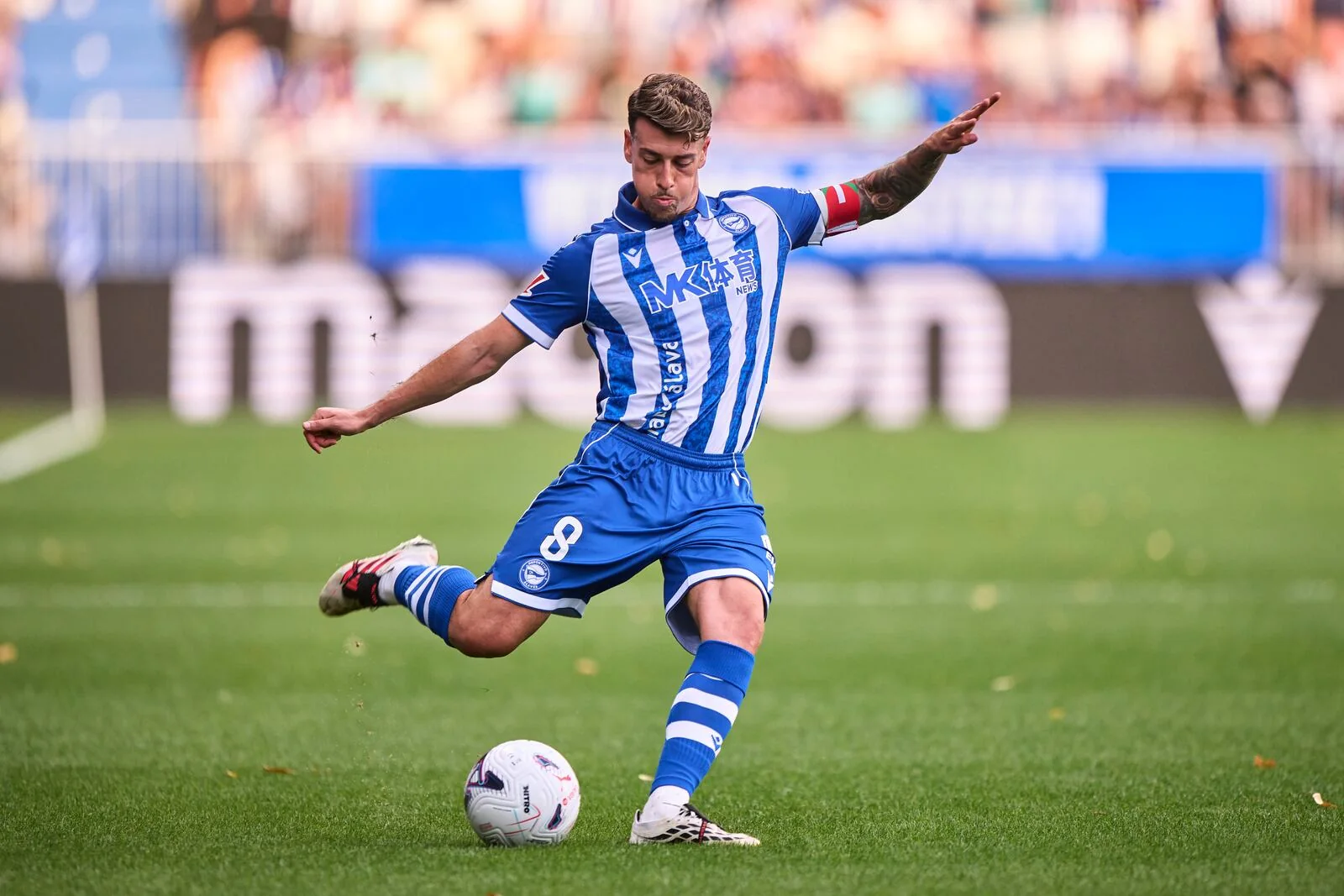
The Alavés squad for 2026/27
Quique Sánchez Flores coaches Deportivo Alavés in 2026/27, with Antonio Sivera in goal, Antonio Blanco in central midfield and a choice of senior centre-forwards. This squad guide identifies the players and shirt numbers checked on October 14. The official club roster supplies the core personnel, with MARCA's current season list helping identify the numbers and more specific positional labels.
| Number | Player | Role to recognise |
|---|---|---|
| 1 | Antonio Sivera | Goalkeeper |
| 2 | Nicolás Valentini | Centre-back |
| 3 | Youssef Enríquez | Left-back |
| 4 | Denis Suárez | Midfielder |
| 5 | Facundo Garcés | Centre-back |
| 6 | Ander Guevara | Midfielder |
| 7 | Ángel Pérez | Wide player |
| 8 | Antonio Blanco | Midfielder |
| 9 | Mariano Díaz | Striker |
| 10 | Carles Aleñá | Midfielder |
| 11 | Toni Martínez | Striker |
| 12 | Hugo Novoa | Wide player |
| 13 | Adrián Rodríguez | Goalkeeper |
| 14 | Nahuel Tenaglia | Defender |
| 15 | Lucas Boyé | Striker |
| 16 | Ville Koski | Centre-back |
| 17 | Jonny Otto | Full-back |
| 18 | Mikel Rodríguez | Midfielder |
| 19 | Pablo Ibáñez | Midfielder |
| 20 | Aitor Mañas | Striker |
| 21 | Abde Rebbach | Wide player |
| 22 | Miguel Rodríguez | Wide player |
| 23 | Carlos Protesoni | Midfielder |
| 24 | Selu Diallo | Midfielder |
Three further names on the club page are Xanet Olaiz, Izei Hernández and Grégoire Swiderski, associated with numbers 27, 29 and 31. They help explain the longer lists you may see when younger options appear alongside the senior group. The table is an identification guide; a player's place in it does not certify fitness, registration for every competition or selection for an upcoming match.
The wide roles need some flexibility. Ángel Pérez and Abde Rebbach can appear in different positional categories depending on how a roster is organised. A match formation gives a more immediate picture: a player positioned high to provide width may retreat into the defensive line when the opposition has the ball. Calling him a forward in a squad listing does not remove that responsibility.
Shirt numbers are helpful when the shape changes during play. You can follow Blanco's number eight as he offers a central passing option, or notice whether number seven Pérez is receiving the ball ahead of the midfield or recovering beside the defenders. Watching these movements gives more information than treating the first formation graphic as a map that must stay fixed for ninety minutes.
Forwards also need to be read as a group. Mariano's number nine identifies him, but Boyé or Toni Martínez can occupy the central attacking spaces too. Adding another striker can change which opponent each one engages and which midfielder has room to advance. The role descriptions below explain those relationships through current personnel and completed match examples.
Use the La Liga schedule to find the next game and the league table to follow the team's progress. Keep the squad beside those tools as a guide to who is involved. The last section addresses departures and availability so that this list can support your understanding of the season without being mistaken for an announced starting eleven.
Goalkeepers and the defensive unit
The defensive group is easiest to understand by separating the goalkeeper, the centre of the line and the two flanks. Alavés has players capable of filling more than one defensive job, so a roster category is only the beginning. The coach can change the balance between covering the penalty area and advancing down the sides without replacing the entire unit.
Antonio Sivera and the goalkeeper options
Sivera's importance extends beyond his number one shirt. The captain agreed an extension until June 2030 in August, continuing an association that began in 2017. The renewal report from Europa Press records 179 club appearances at the announcement. It is a milestone in his Alavés career, rather than the number of appearances he has today.
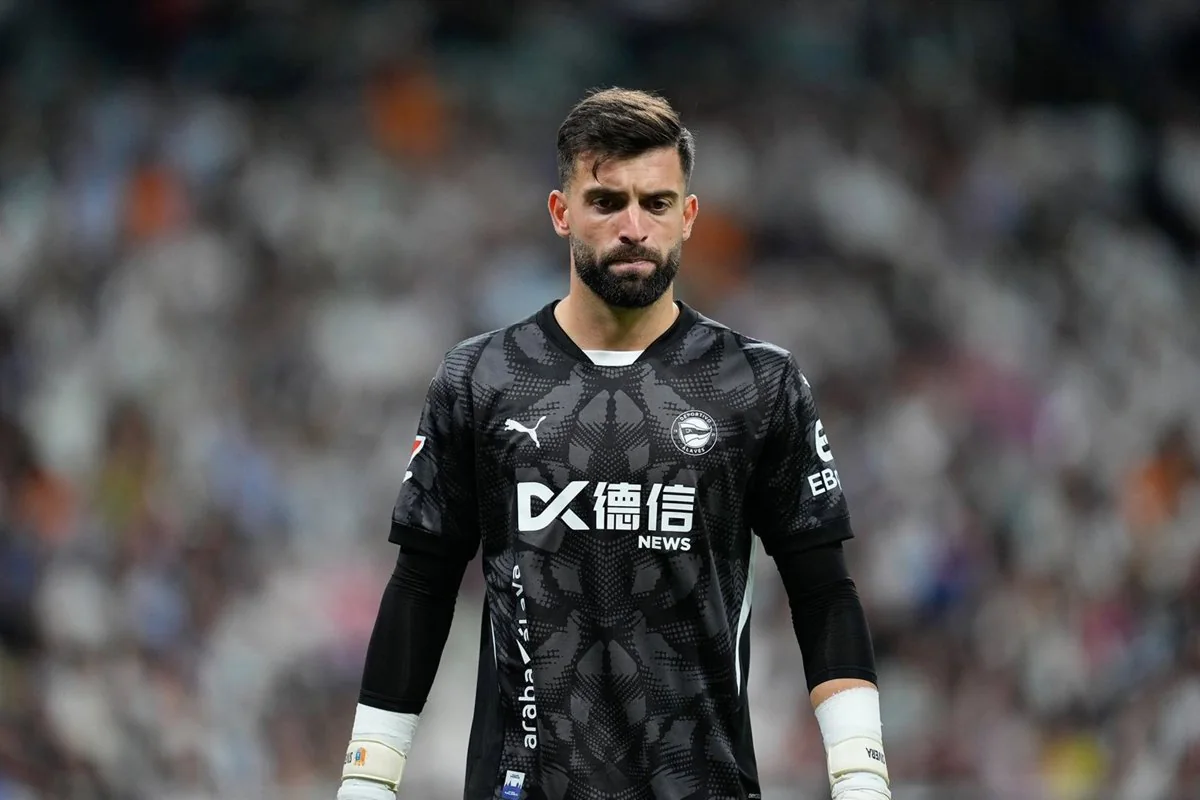
The club's team page also includes Adrián Rodríguez and Grégoire Swiderski. This gives the goalkeeping group depth, with match selection still determined by the coaching staff. Different competitions and circumstances can produce different choices; the three names should not be read as a promise that each will start a particular proportion of games.
During a match, Sivera's choices on the ball are useful to follow. A short pass can invite pressure onto the defenders and midfielders; a longer delivery shifts the contest toward the forwards and the second ball. The goalkeeper needs support whichever route the team takes. Watch who offers the next passing option after a save or a back-pass, as well as the goalkeeper's positioning when the opponent attacks the space behind the defence.
Centre-backs, full-backs and width
Koski and Valentini are specialist central options, with Garcés also on the squad list. Tenaglia and Jonny give the unit further positional flexibility. The October 10 match against Atlético provides a recent example of rotation within the defensive group: Koski replaced Valentini, as documented in AS' review. The actual substitution matters more than assuming a season roster fixes the same defenders for every ninety minutes.
Ángel Pérez offers a clear explanation of the flank role. Speaking to Cadena SER in August, he described the physical demands of playing wing-back and the protection supplied by another centre-back. His account helps explain why a player known for attacking speed may still be an essential part of the defensive shape.
The extra central defender can cover the inside channel while the wing-back contests the outside. If the wide player has gone forward, the return run becomes important as soon as possession changes. This is the relationship to watch when Pérez or Rebbach provides width: who steps toward the opponent, who stays inside, and who follows the runner? Novoa and Youssef offer further flank options, but their duties depend on the selected formation and the developing game.
How the midfield options fit together
Blanco is a useful starting point for understanding the central unit because his work connects defending with the next attack. AS' September analysis highlights his passing, positional judgement and recovery work. That combination explains why assessing his contribution only through goals would leave out much of the job.
When Alavés has possession, follow the passing triangle around him. A centre-back needs an option ahead, the midfielder needs somewhere to release the ball, and another player must move into a position that an opponent cannot cover at the same time. The quality of that connection is visible even when a move ends with a simple pass toward the touchline rather than an immediate chance.
The squad contains Denis Suárez, Carles Aleñá, Pablo Ibáñez, Guevara, Protesoni, Selu Diallo and Mikel Rodríguez as further central possibilities. Their presence allows different combinations around Blanco. Rather than labelling the whole group interchangeable, notice which player stays behind the attack, which one joins the forward line and who is close enough to challenge for a loose ball.
This becomes especially relevant when the wing-backs advance. A central midfielder can help the team keep possession long enough to bring the wide player into play, then be needed again if the pass is intercepted. A more attacking selection does not eliminate the covering task; it redistributes that task between the players who remain behind the ball.
The most informative moments often come immediately after a turnover. Does a midfielder delay the opponent's first pass, or is he still moving forward when the counter begins? Can a teammate offer a nearby outlet after possession is recovered? These observations help explain the shape of Alavés' midfield without turning a squad label into a fixed instruction for every fixture.
Mikel Rodríguez and Miguel Rodríguez are different players
Mikel is the number 18 central midfielder signed from Real Sociedad B. The July 16 announcement, reported by Europa Press, confirms a contract until 2031. His previous second-tier season comprised 33 league appearances, two goals and two assists. The move introduced another midfield profile, with the announcement emphasising ball circulation, defensive involvement and movement into the opposing area.
The previous club matters: Real Sociedad B's league experience was the platform for Mikel's move to Alavés. It gives context to his development without treating him as a player already established in the parent club's senior eleven. His number 18 and full first name are the simplest way to distinguish him in a team list.
Miguel is the number 22 attacker who arrived from Utrecht. The Dutch club's July 27 transfer notice describes two seasons in the Netherlands and eight Europa League appearances with two goals. His background concerns attacking positions and a different route into the Alavés squad.
The similar names can create confusion in shorthand lineup graphics or transfer lists. Keep Mikel 18 and Miguel 22 paired with their respective previous clubs when reading them. Neither is an alternative spelling of the other, and selecting one does not represent the same tactical choice as selecting the other. The current availability section below supplies the further distinction between being an Alavés player and being ready for the next match.
The forwards and the early scoring picture
Alavés can draw on Boyé, Mariano, Toni Martínez and Mañas for central attacking positions, with wide options around them. The choice concerns how to create and use space as well as who has scored most recently. Two forwards can share the work against the opposing centre-backs, while a different selection can place more emphasis on runners approaching from midfield or the flank.
The September 6 match against Osasuna is a useful illustration of several parts working together. Alavés won 5-2 and Boyé scored three times. Osasuna's official account describes two finishes from distance and a header, with Mariano and Pablo Ibáñez scoring the remaining home goals. The hat-trick was therefore more varied than a sequence of close-range finishes.
The opener involved a headed pass from Mariano to Boyé. Aleñá assisted Boyé's next goal, and Pérez crossed for the header, according to La Liga's match record. Each contribution arrived from a different part of the attack. The scoring forward supplied the finish, but his partner, a midfielder and a wide player all helped construct the opportunities.
For fans, those combinations suggest a better way to follow the forwards than waiting for shots. Notice where Boyé comes toward the ball, whether another attacker can return a pass into his path and how the wide delivery changes his route into the box. A move that begins outside the area can still end with the striker in a dangerous central position, and a lay-off can be as useful as an immediate attempt to turn and shoot.
Reading goals alongside attacking roles
The early league totals checked on October 14 put Boyé on five goals and Mariano on three. The current AiScore statistics and the live Fichajes squad table show those figures after Alavés' first eight league fixtures. This is a dated snapshot of 2026/27 league football; it should not be read as a completed season record.
The Osasuna hat-trick accounts for three of Boyé's five goals. That makes it an important part of the total and a reminder that goals can arrive unevenly across a short run of matches. It is possible to have an excellent scoring start without scoring in every game. The number identifies the output so far, while the individual match explains where a large portion of it came from.
Mariano's involvement in Boyé's opener is a further reason to look at combinations. A striker can provide a pass that makes the partner's finish possible, challenge a defender so another player has room, or help the team retain a difficult delivery. Scoring remains decisive, but it is not the only useful attacking action.
Toni Martínez and Mañas can affect the same relationships when selected or introduced from the bench. Watch whether a substitution changes who stays between the centre-backs, who comes short and who follows up the second ball. Use the league scorers page to follow the changing totals, then connect those numbers to the actual tasks performed by the attacking players.
Transfers, availability and the next starting lineup
The season roster becomes more useful when you know how it was assembled and which names require an availability check. Alavés kept much of its established group while adding specific options. A summer signing can still be unavailable in October, and a player connected with the club in an older transfer list may now belong to another team.
Summer arrivals and players away from the club
AS' post-window review identifies four additions: Koski on a permanent basis, Mikel Rodríguez, Miguel Rodríguez and Valentini. It also reports that Novoa and Selu Diallo remained despite interest in loan moves. Those decisions explain the combination of new personnel and continuity in the current squad.
Valentini's arrival from Fiorentina added a left-footed centre-back. The August 7 signing report confirms his contract through June 2029. Together with the permanent retention of Koski, that move addressed the central defensive options rather than simply adding more attackers to the group.
Owono is an example of a departure that needs the correct season attached. He played at Andorra on loan in the previous campaign, then moved there permanently in August 2026. EITB's transfer report and La Liga's Andorra transfer record distinguish the latest move from the earlier loan. He therefore should not be presented as a current Alavés goalkeeper competing for the next first-team start.
These examples show why a preseason photograph or an old squad table can be misleading. A returning loanee may stay, leave again or move permanently. Read the completed transaction and its season before deciding that a familiar name belongs in the match squad. A rumour that a player could leave also differs from a transfer that was actually announced.
Why the squad list does not predict the next eleven
Availability is the immediate issue for Mikel Rodríguez and Garcés. In his October 8 press conference, reported by AS, Quique identified both as injured players who had undergone surgery. He also confirmed Mañas' recovery from the head knock suffered at Santander. The roster can include all three, but the medical situations are different.
That update also treated Koski's condition as a late decision, before he subsequently appeared against Atlético. It illustrates why a preview's “doubtful” label and the final match selection may differ. The decision belongs to the specific fixture and the information available at that time; it is not a permanent description of the player.
Discipline can change selection as well. The club's October 10 match report listing records Pérez's dismissal in the 1-2 loss to Atlético, with Alavés playing more than thirty minutes short-handed. Before the next match, read the relevant competition's confirmed disciplinary information alongside the call-up. The shirt-number table alone cannot establish whether a dismissed player is eligible for a later fixture.
Finally, distinguish the travelling or matchday squad from the eleven who start. A place on the bench is participation in the squad, while a substitution records a later role in the game. The official lineup supplies the final answer. Once it is announced, use the roles in this guide to understand the coach's choices: how many central defenders, who provides the width, how the midfield balances possession and cover, and which forwards are asked to combine.
Comments
Sign in with Google to comment. Keep the conversation useful and football-focused. New comments are reviewed before they appear.
Loading comments…