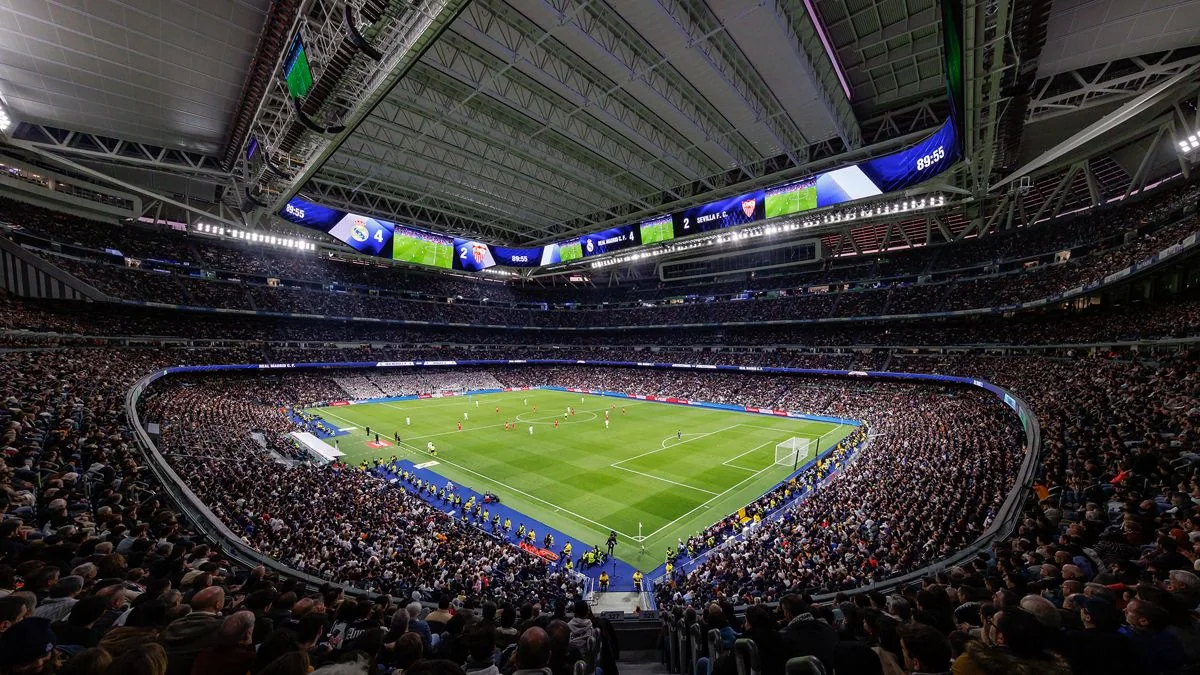
The Money Gap in One View
The Premier League has substantially more financial power across its 20 clubs than La Liga has across its top division. The cleanest recent like-for-like benchmark comes from Deloitte's review of the 2024/25 season: English top-flight clubs generated £6.8 billion in aggregate revenue, while the Spanish league was reported at roughly €4.1 billion. The currencies differ, so the figures should not be subtracted without choosing a dated exchange rate, but the order and size of the advantage are unmistakable.
The league-wide comparison
The important word is aggregate. This comparison adds the football revenue of every club in each division. It does not say that the Premier League champion earned a fixed amount more than the Spanish champion, and it does not turn every La Liga club into a small business. Real Madrid and Barcelona remain global commercial institutions; Atlético Madrid also operates at a scale above many English teams.
The structural advantage appears most clearly lower down the table. English clubs share a larger central-rights pool and participate in a domestic market with deep broadcast and commercial demand. That gives mid-table and newly promoted teams revenue expectations that many Spanish counterparts cannot match. It also explains why the transfer activity of an English relegation candidate can look more aggressive than that of a club competing for Europe in Spain.
The gap should nevertheless be discussed alongside costs. Deloitte reported a sharp rise in Premier League clubs' combined pre-tax losses in the same 2024/25 season. More revenue supports larger budgets, but wages, transfer amortisation, agent payments, financing expenses and infrastructure can consume it. Revenue is capacity, not guaranteed profit or sporting competence.
Why one viral payout graphic can mislead
Social posts often label a club distribution chart “prize money.” In reality, a year-end payment may combine equal broadcasting shares, facility or appearance fees, merit components and international-rights allocations. A La Liga graphic may use a different season, exchange rate, competition scope or reporting definition. Comparing the largest number on each image can therefore produce a confident but invalid conclusion.
La Liga's own 2024/25 financial report illustrates the definition problem. It lists €5.464 billion in normalized total income for Spanish professional football, while Deloitte's club-revenue comparison places La Liga near €4.1 billion. Both can be accurate because they are measuring different populations and accounting lines. One can cover a broader professional-football ecosystem and normalized income; the other is designed for cross-league club turnover.
For a useful comparison, align the same season, the same number of clubs, the same currency date and the same revenue definition. Then distinguish central league distributions from each club's total turnover. The La Liga table tells us sporting position; it does not reveal the composition of a club's income. This discipline removes sensationalism without minimising the real English advantage.
Where the Revenue Difference Comes From
Television is the largest engine of the money gap, but it is not acting alone. The Premier League combines valuable UK rights, broad international demand, commercial sponsorship and increasingly productive stadiums. Each stream supports the others: global broadcasts build audiences, audiences attract sponsors, and international interest raises the value of future rights sales.
Domestic and international broadcast rights
Deloitte calculated £3.4 billion of broadcast revenue across Premier League clubs in 2024/25, about half of their aggregate turnover. The league's official 2025–28 rights list shows the geographic reach behind that figure, with broadcasters across Europe, the Americas, Africa, the Middle East and Asia. The UK product benefits from English as a widely used language, long-term international distribution, competitive storytelling throughout the table and kickoff windows designed for multiple markets.
La Liga also sells rights centrally and has a genuinely global audience. Its advantage is concentrated in famous clubs and players, especially Real Madrid and Barcelona, while the league has invested in international offices and broadcast presentation. Yet a rights buyer is purchasing an entire season, not only two Clásicos. The commercial challenge is to make more fixtures and more clubs indispensable to viewers outside Spain.
Broadcast figures in club accounts can include domestic league distributions, international league distributions and UEFA or FIFA competition money. That matters in seasons when several teams go deep in the Champions League or participate in an expanded Club World Cup. A one-year increase does not necessarily mean the domestic league contract itself improved by the same amount.
Commercial income and full stadiums
English clubs generated £2.4 billion in commercial revenue in 2024/25, according to Deloitte, while combined matchday revenue passed £1 billion. Those streams are not evenly shared—the traditional “big six” produced nearly three-quarters of commercial income—but modern stadium hospitality, global sponsors, tours and retail lift the league total.
Spain is growing here. La Liga's economic report said normalized commercial revenue exceeded €1.5 billion across Spanish professional football and attendance moved above 17 million in 2024/25. Renovation effects at the Bernabéu and Camp Nou can create meaningful upside, while fuller grounds help clubs sell hospitality and local partnerships. Deloitte nevertheless found that Real Madrid and Barcelona alone accounted for about 52% of La Liga club revenue that season. Strong top-end growth therefore does not automatically eliminate the resources gap for the median club.
Supporters can use the La Liga schedule to see the inventory the league sells: 380 top-flight matches, each needing an audience proposition. Broadcast value rises when viewers care about relegation, Europe and regional rivalries as well as the title race.
The exchange-rate and season problem
Premier League accounts are reported in pounds; Spanish accounts use euros. Exchange rates move, so a conversion should state its date or average period. Using today's rate on one league and a season-average rate on another can manufacture a change that football did not produce.
Season alignment is just as important. The 2024/25 campaign may sit in an old domestic-rights cycle, while 2025/26 begins a new agreement. European prize distributions and stadium reopening dates can also shift between years. The safest conclusion is directional: England has a broad, durable revenue advantage, while exact ratios should be recalculated from matched reports rather than copied indefinitely from a screenshot.
How Central Money Reaches Clubs
Both competitions sell major rights collectively and redistribute the proceeds, but their formulas are not identical. Centralisation prevents each club from having to sell the same league match separately and creates a shared base. The debate is about the size of that base and how the variable portion rewards performance, appearances or audience strength.
Premier League distribution
The Premier League says domestic broadcast revenue is divided 50:25:25. Half is shared equally among 20 clubs, one quarter is linked to final league position as a merit payment, and one quarter is paid as facility fees based on UK television selections. Central commercial revenue is shared equally. International revenue historically had a large equal component; growth above the established level gained a merit element, with a cap intended to constrain the ratio between the highest and lowest total central receipts.
This creates two effects at once. A champion receives more than the club finishing twentieth, so sporting success matters. But the equal shares and bounded spread give every participant a valuable minimum. The lowest club is not receiving a consolation prize in the ordinary sense; it is receiving its share of a broadcast product that requires 20 teams, plus the components its position and television appearances generate.
Facility fees can confuse comparisons because they are not a pure measure of fanbase or league finish. A club selected for more UK broadcasts earns more from that component. International and central-commercial rules can also change between rights cycles, so the formula date should accompany any detailed payout table.
La Liga distribution
Spain's Royal Decree-Law 5/2015 sets the architecture for jointly marketed professional-league audiovisual income. Ninety percent is allocated to Primera División and 10% to Segunda. Within the top-flight amount, 50% is divided equally. The other half is variable: one part reflects sporting results over five seasons, with the latest campaign weighted most heavily, and the other reflects social reach.
For the social-reach calculation, La Liga's published 2024/25 information describes inputs including season-ticket and gate-receipt history plus contribution to television-resource generation. The official annual disclosure lists club amounts and statutory contributions. That is more informative than an unsourced graphic because it shows that the headline number can be affected by required deductions or assembly-approved adjustments as well as the core formula.
Spain therefore also combines solidarity with market and performance signals. Its challenge is not simply that it forgot to share equally: half of the Primera distribution already is equal. The larger difference is that 50% of a smaller pool remains smaller, while social reach and multi-year results can reinforce established clubs' advantage within Spain.
Neither league's central payment equals total club turnover. UEFA competition distributions, owned sponsorships, ticketing, hospitality, merchandise, player sales and financing sit elsewhere. A team can finish near another in the La Liga results record yet operate with a very different commercial base. Calling all central money “prize money” hides that distinction.
Why Premier League Clubs Usually Spend More
The transfer market makes the revenue gap visible because English clubs bid from a stronger collective base. FIFA's snapshot of the 2026 mid-year international window recorded more than $3.02 billion of incoming-fee spending by clubs in England, compared with $940 million by clubs in Spain. Those association totals cover international transfers and more than one domestic division, so they are not a perfect Premier League-versus-La Liga ledger, but the direction matches the underlying league economics.
Revenue confidence and promoted-club buying power
A club signs a player against future income, not only the cash already in its bank account. Stable multi-year broadcasting contracts allow directors and lenders to model the next several seasons. A newly promoted English club knows that one Premier League season brings a substantial central distribution; it may also plan around parachute support if relegated. That expected floor can support fees, wages and financing arrangements that would be risky for a newly promoted Spanish side.
The same confidence affects selling clubs. When an English bidder arrives, the seller knows the buyer operates in football's richest domestic league and may demand more. Agents and players also compare wage offers. This “Premier League premium” is not a formal surcharge, but bargaining expectations can turn higher revenue into higher acquisition costs.
Spending power does not guarantee value. Recruitment errors compound because an expensive player may be difficult to sell without accepting a loss. The English clubs' $3.82 billion of international incoming fees in calendar 2025, also reported by FIFA, came alongside the Premier League's large aggregate pre-tax loss. A rich market can afford more attempts and still allocate money poorly.
Transfer fees are only the first cost
A headline fee is not the full commitment. Clubs may pay instalments, conditional bonuses, solidarity or training compensation, agent commission and signing bonuses. They also owe salary, social charges and image-rights arrangements. In accounts, the guaranteed transfer cost is commonly amortised across the player's contract rather than recorded wholly as an expense on signing day.
That accounting treatment explains how a club can announce several large deals while the current-year squad cost is lower than the sum of the headlines. It also creates future obligations. Extend, sell, loan or impair the player and the accounting changes again. Net spend is a useful cash-market shorthand, but it is not profit, liquidity or regulatory headroom.
Financial controls change the timing
Both leagues regulate squad expenditure, but the mechanisms differ. From 2026/27 the Premier League's Squad Cost Ratio limits on-pitch spending to 85% of football revenue and net profit or loss on player sales, alongside a defined multi-year allowance that carries consequences when used. That still leaves richer clubs with a higher absolute ceiling because 85% of a larger revenue base is more money.
La Liga publishes a club-specific Squad Cost Limit after reviewing budgets and financial stability. Its definition includes player and coaching salaries, social security, collective bonuses, acquisition costs, agent commissions and annual transfer amortisation, plus relevant academy and reserve costs. A club's approved number can change after sales, new income or other permitted adjustments.
This is why a Spanish club may agree a signing but wait to register it, or sell before completing another deal. It is also why owner wealth alone does not equal immediate spending permission. The La Liga clubs face different limits based on their finances; the system is not one universal salary cap. England's higher revenue does not remove control, but it usually supplies more room inside the control.
What the Gap Means on the Pitch
Money changes probabilities rather than dictating scorelines. A larger budget expands the number of players a club can recruit, retain and replace, but coaching, academy production, tactics, injuries and decision quality still decide matches. Financial strength is most visible over a long season, when depth protects a team from several absences and allows it to compete in domestic and European competitions simultaneously.
Depth across the table
The Premier League advantage is broad. Mid-table clubs can offer salaries that attract internationals from Champions League teams elsewhere, while promoted sides can buy players from established top-flight leagues. The result is a deeper market for starting-quality footballers, substitutes, analysts and coaches. Even teams without European income can plan around a valuable league distribution.
For La Liga clubs outside the richest group, recruitment often requires a different edge: academies, loans, free transfers, earlier scouting and profitable player development. Those are not signs of inferior football knowledge. They are methods for competing when mistakes cannot be absorbed as easily. A Spanish side may sell a breakout player because the fee finances several seasons, whereas an English peer can reject an offer and preserve squad continuity.
Depth also shapes fixture management. A wealthy club can rotate without a dramatic fall in individual quality. A smaller squad may rely on the same core players through league, cup and European weeks, raising fatigue and injury exposure. However, bloated squads create their own problems—blocked academy pathways, dissatisfied players and costly contracts for people who rarely play.
UEFA's five-year association ranking at the end of 2025 placed England first and Spain third, which is consistent with stronger English results across multiple entrants. The coefficient is not a balance sheet, though. It awards points for European performance. Treating it as direct proof that revenue caused every win would confuse correlation with explanation.
Spanish giants are important exceptions
The league average conceals enormous Spanish power at the top. Deloitte reported that Real Madrid and Barcelona accounted for roughly 52% of La Liga club revenue in 2024/25. Real Madrid alone generated about €1.2 billion, while Barcelona was around €975 million in that comparison. Their worldwide brands, owned commercial programmes, stadium economics and European histories put them in football's highest financial tier.
UEFA's end-2025 ranking placed Real Madrid first among men's clubs even while England led the association list. That contrast captures the central argument: La Liga can contain the world's leading club while still having less financial depth from first place to twentieth. Atlético Madrid and successful development clubs add further exceptions, but they do not erase the median gap.
Spanish clubs have repeatedly shown that tactical identity and player development can defeat a richer opponent. They can also generate UEFA income that closes part of the difference for an individual season. Fans should therefore avoid turning financial analysis into a prediction for the next match or the La Liga standings. The gap affects the resources available before kickoff; it does not award goals.
Can La Liga Close the Gap?
La Liga can narrow parts of the gap without copying every feature of English football. Catching the Premier League's total revenue in the near term is unlikely because England's domestic and international advantages reinforce each other and its new rights cycle also lifts income. A more useful Spanish goal is to raise the floor: grow recurring revenue for the clubs outside the global giants while preserving solvency.
Growth levers that are realistic
The next domestic sale provides measurable progress. La Liga announced more than €6.135 billion across domestic audiovisual categories for the five seasons from 2027/28 to 2031/32, which it described as 9% growth over the preceding cycle. The total includes more than the main residential package—hospitality venues, second-division rights, free-to-air content and clips contribute—so it should be compared with the equivalent scope, not an isolated Premier League headline.
International growth is harder and potentially more valuable. La Liga can create local-language storytelling around more clubs, improve kickoff certainty where sporting constraints allow, combat piracy and make legal viewing easier. Competitive title races help, but relegation battles, derbies and emerging players also need promotion. A global viewer who recognizes ten Spanish teams is commercially more valuable to the collective product than one who watches two Clásicos and leaves.
Stadium investment can diversify income away from television. La Liga's 2024/25 report links Impulso investment—at least 70% directed to growth projects—to stadium, training-ground, technology, international and commercial development. Better hospitality, safe standing where authorised, museums, tours, non-match events and digital ticketing can turn a ground into a year-round asset. The strongest project is not necessarily the most expensive; it is the one that creates recurring demand without burdening the club with unmanageable financing.
Academies and player trading remain Spanish advantages, but they should support growth rather than become the only way to balance a budget. Retaining an excellent graduate for another season can improve results, UEFA qualification and fan connection. To make that possible more often, clubs need durable commercial income and disciplined contracts.
Cost control belongs in the growth plan. UEFA's latest finance landscape warns that record European revenue has arrived with higher non-wage operating costs and financing expenses. Closing a turnover gap by taking unsustainable debt would be a statistical victory and a sporting risk. La Liga's stricter budget validation can frustrate supporters during a registration delay, yet financial stability has value if it protects clubs through a downturn.
How fans should compare future numbers
Start by naming the measure. “League revenue” may mean aggregate club turnover, the organiser's own accounts, total professional-football income or the value of a multi-year rights contract. “Prize money” may be a central distribution with equal, merit, audience and facility components. “Spending” may mean gross fees, net fees, international transfers only, cash paid or accounting amortisation.
Then apply a short audit:
- Match the same season and competition scope.
- Convert currencies using a stated date or season-average rate.
- Separate domestic league distributions from UEFA and FIFA income.
- Distinguish top-club outliers from the median and bottom club.
- Compare wages and amortisation as well as transfer fees.
- Check whether a rights value covers three years, four years or five.
- Prefer audited reports, official distributions and FIFA transfer data to unattributed graphics.
Finally, wait for accounts before declaring a window affordable. Announced fees can include bonuses, and sales late in the period can transform net expenditure. The same caution applies to the next rich-club ranking: Real Madrid leading a revenue table and the Premier League leading the aggregate table are compatible facts.
The most honest conclusion is neither “money always wins” nor “the gap does not matter.” England's top flight has more collective revenue, a larger central pool and greater spending depth. Spain has extraordinary elite clubs, a productive development culture and credible growth projects, but needs broader recurring income to lift the rest. Our La Liga blog will keep comparisons tied to the season and source as new audited figures arrive.
Comments
Sign in with Google to comment. Keep the conversation useful and football-focused. New comments are reviewed before they appear.
Loading comments…