The La Liga Record Book at a Glance
The headline La Liga records are 100 team points, 121 team goals, 474 career goals by one player and 50 goals by one player in a season. The first two are club-season marks; the last two belong to Lionel Messi. That distinction matters because a search for “most goals in La Liga” can mean either a team's output across 38 fixtures or one player's total across a season or career.
| Record | Mark | Holder | Season or scope |
|---|---|---|---|
| Most team points | 100 | Real Madrid; Barcelona | 2011/12; 2012/13 |
| Most team goals | 121 | Real Madrid | 2011/12 |
| Most player goals, career | 474 | Lionel Messi | 520 La Liga matches |
| Most player goals, season | 50 | Lionel Messi | 2011/12 |
| Most player assists, career | Provider-dependent | Source must be named | Historical coverage varies |
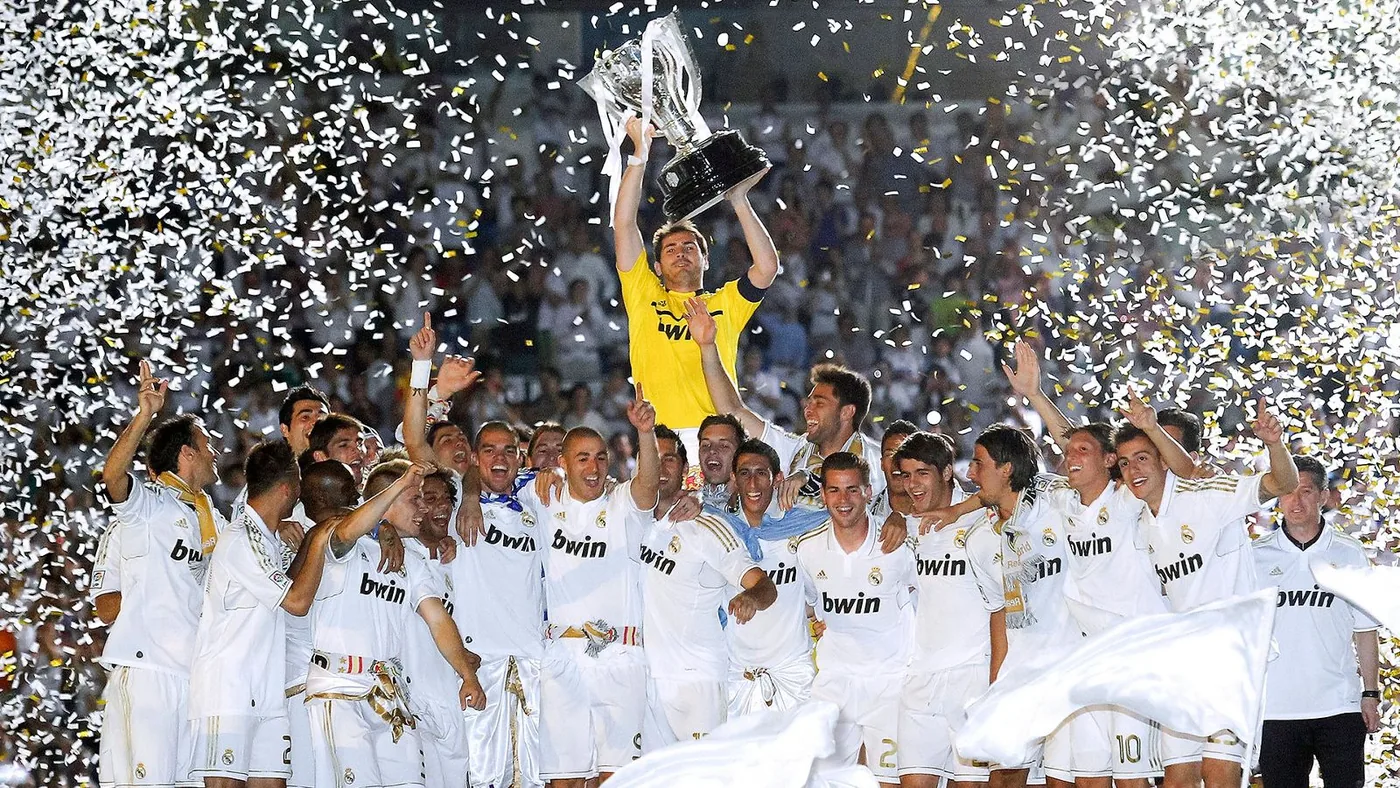
Real Madrid's official history describes José Mourinho's 2011/12 champions as the first side to reach 100 points and credits them with the current 121-goal record. Barcelona's own season review records how Tito Vilanova's 2012/13 champions then reached 100 points and equalled Madrid's competition mark. The points record is therefore shared, while the team-goals record remains Madrid's alone.
Barcelona's official Messi profile supplies the two individual scoring figures: 474 goals in 520 league appearances and 50 in 2011/12. The career average works out to about 0.91 goals per appearance, but that rate is our calculation from the published totals, not a separate official record. Readers who want the active race rather than the historical benchmark can use the current La Liga top scorers table.
Record check: August 27, 2026. Scope: men's Spanish top-flight league matches only; cups, European competition and lower divisions are excluded.
Most Points in a La Liga Season
Real Madrid and Barcelona share the La Liga single-season points record with 100. Madrid established it in 2011/12 under José Mourinho; Barcelona equalled it immediately in 2012/13 under Tito Vilanova. LALIGA's own historical points review lists both club-season combinations at the same total.
First to 100
Real Madrid, 2011/12
32 wins, four draws and two defeats produced 100 points. Madrid's annual report calls it the first 100-point season in competition history; the title was won by nine points.
Record equalled
Barcelona, 2012/13
The same 32-4-2 line produced the same 100 points. Barcelona finished 15 points clear, showing that an identical total can create a different title margin.
The calculation is straightforward: 32 wins at three points each yield 96, and four draws add four more. The two losses add nothing. That makes (32 × 3) + (4 × 1) = 100. A perfect 38-win campaign would be worth 114 points, so each record holder collected about 87.7 percent of the maximum available.
This also corrects two common misunderstandings. First, “100 points” does not mean a team was undefeated: both record seasons included two losses. Second, the points record is not the same as the largest championship-winning margin. Madrid finished nine clear in 2011/12, while Barcelona finished 15 clear the following year because the runner-up accumulated fewer points. Record performance and competitive gap answer different questions.
Points comparisons become useful when the season format is held constant. Both record campaigns involved 20 clubs, 38 matches and the modern three-point win, so the totals are directly comparable. A total from a shorter league or the old two-point-win era needs normalization before it can support a “best ever” claim. That issue is examined in the final section rather than hidden in the headline.
Most Team Goals in One La Liga Season
Real Madrid's 121 goals in 2011/12 remain the La Liga record for a team in one season. A May 2026 club retrospective still calls it the current record, and LALIGA's own record article identifies the same club, season and total.
121
goals in 38 league matches
3.18
goals per match, calculated
46
from Cristiano Ronaldo
The scale becomes clearer after dividing the total by the schedule: 121 ÷ 38 equals 3.184, or roughly 3.18 goals per game. That is a season-long rate, not a claim that Madrid scored three in every fixture. Their annual report instead highlights a series of large wins—including 7-1 against Osasuna, 6-2 away to Sevilla, 5-1 against Granada and 5-0 against Espanyol—and says the team recorded 20 big victories.
Madrid did not merely edge an outside record. The previous competition benchmark was also theirs: 107 goals in 1989/90. The 2011/12 side raised that mark by 14, an increase of about 13.1 percent. Ronaldo's 46 accounted for approximately 38 percent of the record total. The remaining 75 show why this is properly a team record, built from several attackers and attacking phases rather than a renamed version of the Pichichi race.
Barcelona came closest in the very next season. Its official review lists 115 goals in 38 matches in 2012/13, a club record at the time and exactly six below Madrid's 121. Barcelona scored in every league match that season, yet Madrid retained the higher aggregate. This is a useful reminder that consistency of scoring and quantity of scoring are related but separate achievements: one measures whether a team was shut out, the other sums every goal.
Do not add Copa del Rey, Champions League, Super Cup or friendly goals to this category. The record is based only on the league column across one La Liga campaign. Likewise, “goal difference” is not interchangeable with goals scored; it subtracts goals conceded. To inspect scorelines rather than a historical aggregate, use the La Liga results archive.
La Liga’s All-Time and Single-Season Scoring Records
Lionel Messi holds both major individual scoring records: 474 La Liga career goals and 50 in the 2011/12 season. Barcelona's official player profile gives the career total as 474 in 520 league appearances. That is about 0.912 goals per appearance across his complete Spanish league career.
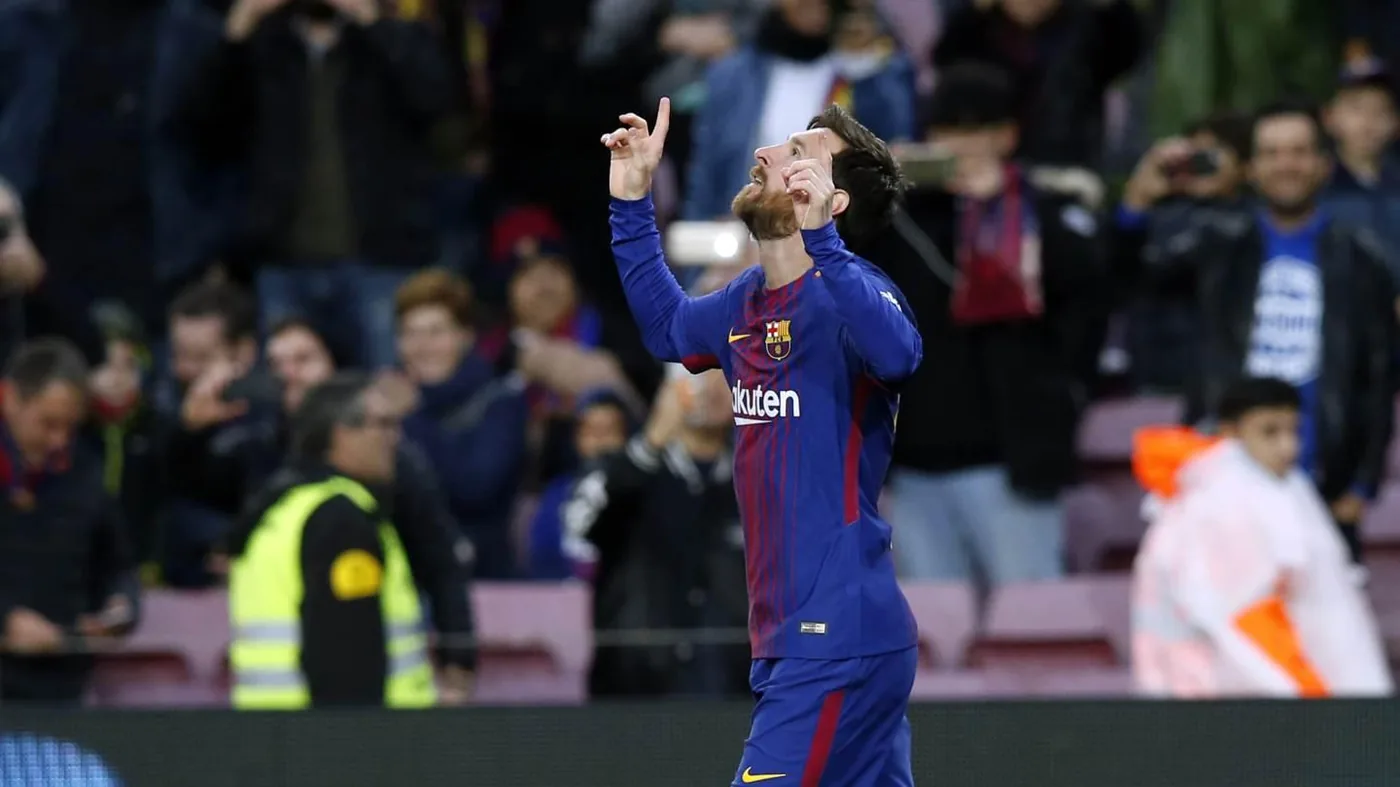
The career record is about sustained output over 17 league seasons, whereas the seasonal mark isolates one campaign. Messi's 50 arrived in 2011/12, an average of 1.316 goals for every one of Barcelona's 38 league fixtures. That is a team-schedule rate: he did not have to appear in all 38 for the record total to count. The correct comparison is 50 league goals against other players' league-season totals.
| Rank | Player | Season | Goals |
|---|---|---|---|
| 1 | Lionel Messi | 2011/12 | 50 |
| 2 | Cristiano Ronaldo | 2014/15 | 48 |
| =3 | Lionel Messi | 2012/13 | 46 |
| =3 | Cristiano Ronaldo | 2011/12 | 46 |
The two-goal gap between first and second is small compared with the scale of both seasons, but record language is exact: 48 does not tie 50. LALIGA's historical coverage also provides the handover point for the career crown. Messi reached 253 in November 2014 to move beyond Athletic Club great Telmo Zarra, whose 251 had stood since 1955. Messi then added another 221 league goals before leaving Barcelona.
A frequent counting error comes from Messi's 73 goals in all competitions in 2011/12. Fifty were in La Liga; the other 23 came in European, cup and super-cup or Club World Cup play. Only the 50 belongs in this league-season ranking. For the same reason, a player's full club total cannot be compared directly with 474 unless both figures are restricted to Spanish top-flight matches.
Why the All-Time Assists Record Needs a Source Label
Lionel Messi is the defensible answer to “who has the most assists in La Liga?”, but the exact career total must name its data source. Unlike goals, which are fixed in official scorelines, an assist is an interpreted event. Providers can differ over deflections, rebounds, won penalties and how older matches were coded. Historical coverage can also begin partway through a player's career.
| Published snapshot | Messi assist figure | What it proves |
|---|---|---|
| LALIGA, February 2015 | 107 | The league called him its maximum assist provider at that date. |
| FC Barcelona, January 2018 | 144 in 400 league matches | A club milestone snapshot, not his final career total. |
| Opta Analyst, accessed August 2026 | 167 in 520 league matches | Opta's displayed career-history total under its dataset. |
These numbers should not be blended into a homemade total. The first two were published while Messi was still adding assists. The Opta Analyst table is a finished Barcelona league row, but its season breakdown displays zero assists for the early campaigns through 2008/09. That visible limitation makes “167 according to Opta Analyst's current career table” accurate wording; simply declaring “the official all-time record is 167” would overstate what the page proves.
The identity of the leader is better supported than one universal number. LALIGA explicitly called Messi the competition's leading assist provider in 2015, and subsequent club material continued to show his total rising. Yet LALIGA's public leaderboard now presents the selected season's assist race rather than a complete, definition-stable archive back to 1929. A current seasonal leaderboard cannot independently certify an all-time figure.
How to cite an assists record responsibly
- 1. Name the provider: write “Opta records” or “Barcelona reported,” not an unexplained number.
- 2. State the competition: La Liga only, excluding cups, Europe and international games.
- 3. State the coverage: career, season, decade or games since a specified date.
- 4. Add an access or publication date: live statistical records can be corrected or reprocessed.
- 5. Do not merge datasets: one provider's early seasons and another provider's later seasons may use different definitions.
This caution does not make assist statistics useless. It makes them reproducible. For current matchdays, use a single provider consistently and check the live schedule before comparing players who may have played different numbers of fixtures. Our La Liga matches today page supplies that fixture context.
How to Compare La Liga Records Across Eras
Raw totals are most reliable when the seasons used the same points rule, number of matches and statistical definition. The two 100-point campaigns are clean comparisons because each covered 38 matches under three points for a victory. A champion from a different format cannot be ranked fairly by putting its raw total beside 100.
LALIGA dates Spain's introduction of three points for a win to 1995/96. Before then, a win was worth two. That changes the ceiling and the reward for aggressive play. Even the fixture count has varied: Real Madrid's official history describes 1986/87 as a special playoff season in which the champion played 44 matches and finished with 66 points. Its 84 goals came across six more games than a current 38-round campaign.
Points comparison
Use points won divided by the maximum available under that season's rules. Modern 2011/12 Madrid: 100 ÷ 114 = 87.7%. Do not retroactively award old draws or wins unless the exercise is clearly labeled.
Goals comparison
Use goals per match alongside the total. The 2011/12 record is 121 ÷ 38 = 3.18. The 1986/87 champion's 84 ÷ 44 = 1.91, but tactical context still matters.
Player comparison
Show goals per appearance and minutes when available, then keep career longevity separate from one-season peak. League expansion also changes the opponent mix and match opportunities.
Assist comparison
Hold the provider, definition and coverage constant. An event-coded stat from a modern data source should not be projected backward into seasons the dataset does not cover.
Normalization improves the question; it does not manufacture a single objective “greatest team.” Points share measures results, goals per game measures attacking volume, and title margin measures distance from the field. None captures defensive strength, opponent quality or tactical influence by itself. A reader should choose the metric that matches the claim.
It is also important to preserve official categories. Team goals are not goal difference. A player's league goals are not all-competitions goals. Appearances are not starts. A seasonal assist leader is not automatically an all-time leader. When a record post switches categories midway, a spectacular number can remain numerically true while answering the wrong question.
Five checks before sharing a La Liga record
- Competition: Is the number La Liga only?
- Time unit: Is it one match, one season, a decade or a career?
- Subject: Does it belong to a club or an individual?
- Format: How many matches were played, and how many points did a win earn?
- Source: Is the figure from the league, an official club archive or a named data provider?
Applied consistently, those checks leave a clear record book: Madrid and Barcelona share 100 points; Madrid owns 121 team goals; Messi owns 474 career goals and 50 in a season; and Messi leads the assists conversation with any exact total tied to its provider. Browse the La Liga research archive for season reviews and historical guides built with the same scope rules.
Comments
Sign in with Google to comment. Keep the conversation useful and football-focused. New comments are reviewed before they appear.
Loading comments…