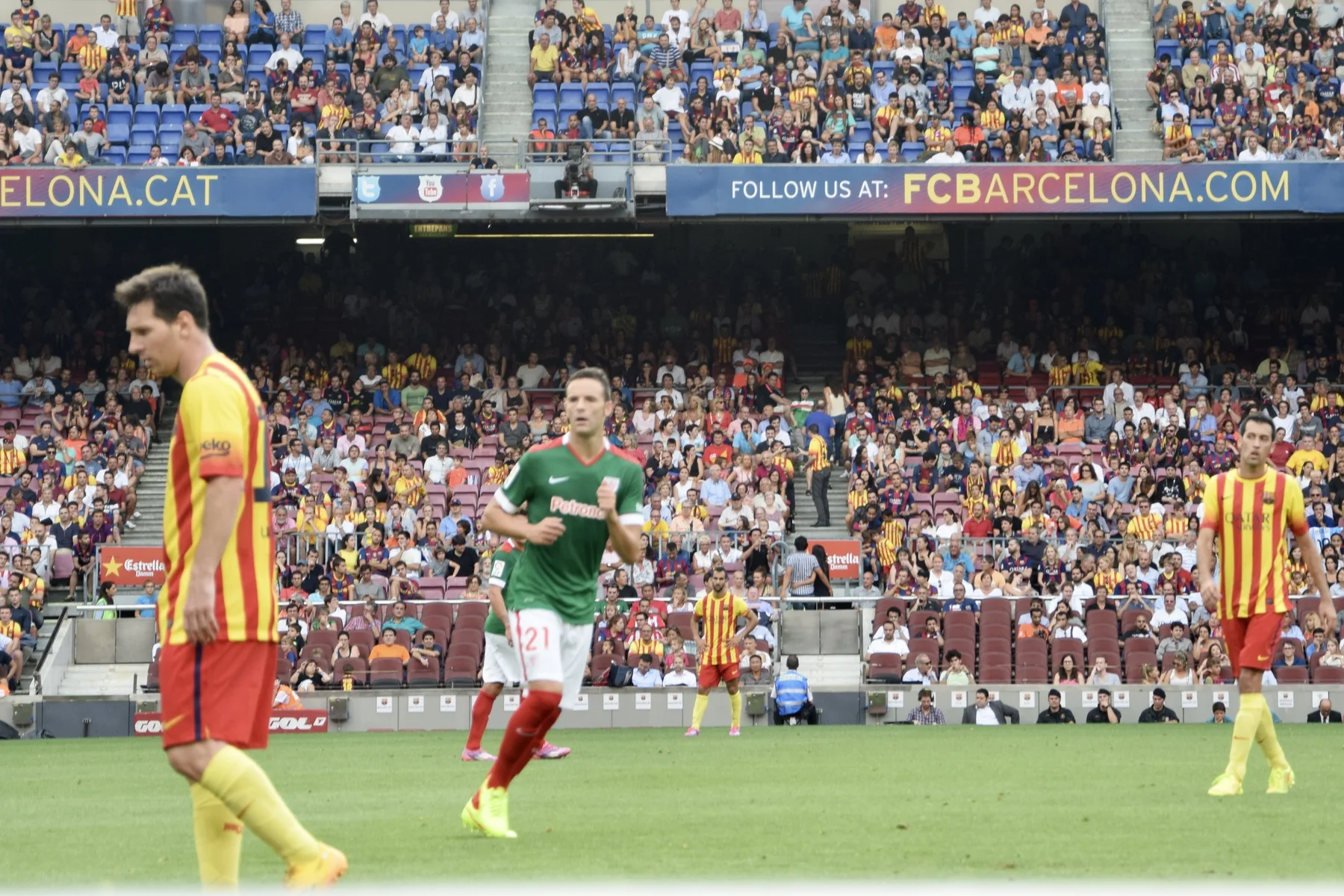
Lionel Messi is La Liga’s all-time top scorer with 474 goals, ahead of Cristiano Ronaldo on 311 and Telmo Zarra on 251. The headline answer is easy; understanding the record takes more. This fan-first guide adds appearances, scoring rates, era context and a dated look at the active chase, while explaining why reputable historical lists can differ by a goal.
The La Liga all-time top scorers table
Fans looking for the La Liga all-time top scorers usually want the number before the history lesson. Lionel Messi leads with 474 league goals for Barcelona. Cristiano Ronaldo is second on 311 for Real Madrid, and Athletic Club great Telmo Zarra is third on 251. Those three occupy distinct statistical worlds: Messi owns the largest total, Ronaldo produced the most extreme goals-per-game rate among the leading names, and Zarra set the benchmark that survived for roughly six decades.
The table below uses league goals only. Copa del Rey, European competition, Spanish Super Cup and international goals do not count. Appearances and calculated rates give the totals some scale, because 238 goals in 439 games tell a different story from 311 in 292.
| Rank | Player | La Liga club or clubs | Goals | Apps | Goals/game |
|---|---|---|---|---|---|
| 1 | Lionel Messi | Barcelona | 474 | 520 | 0.91 |
| 2 | Cristiano Ronaldo | Real Madrid | 311 | 292 | 1.07 |
| 3 | Telmo Zarra | Athletic Club | 251 | 278* | 0.90 |
| 4 | Karim Benzema | Real Madrid | 238 | 439 | 0.54 |
| 5 | Hugo Sánchez | Atlético, Real Madrid, Rayo | 234 | 347 | 0.67 |
| 6 | Raúl | Real Madrid | 228 | 550 | 0.41 |
| 7 | Alfredo Di Stéfano | Real Madrid, Espanyol | 227 | 329 | 0.69 |
| 8 | César Rodríguez | Granada, Barcelona, Cultural, Elche | 221 | 353* | 0.63 |
| 9 | Quini | Sporting Gijón, Barcelona | 219 | 448 | 0.49 |
| 10 | Pahiño | Celta, Real Madrid, Deportivo | 210 | 278 | 0.76 |
The ranking is a meeting point of very different kinds of forward. Messi was a creator and dribbler who also sustained elite scoring volume for well over a decade. Ronaldo compressed 311 goals into nine seasons. Zarra, César and Pahiño played in an era of shorter league calendars and much rougher travel and medical conditions. Benzema’s fourth place reflects longevity as well as a late-career scoring surge, while Hugo Sánchez’s total is spread across three Spanish clubs and includes one of the most acrobatic finishing repertoires the competition has seen.
Raúl and Di Stéfano also remind fans that raw goals do not capture a player’s entire influence. Both were central to eras in which Real Madrid’s identity was being renewed. Quini, meanwhile, built his number across Sporting Gijón and Barcelona and remains one of the strongest examples of a scorer whose reputation is larger than a single superclub context.
Treat the figures as a historical league record, not a list of every goal these players scored in Spain. A player’s club total across all competitions will always be higher. The current-season race is a separate question; fans can find that on our La Liga top scorers page. This article is about the career mountain, frozen only at the point a player leaves the division or retires. The asterisks also flag why older appearance totals sometimes vary between historical sources, an issue explained in the final section.
Why Lionel Messi’s 474-goal record is so difficult to reach
Messi’s 474 is difficult to attack because it is not merely a longevity record or merely a peak-performance record. It combines both. He scored at roughly 0.91 goals per league appearance across 520 matches, stayed in Barcelona’s first team from the 2004/05 season through 2020/21, and remained productive enough to win the Pichichi eight times. Most great careers contain one or two of those ingredients. Almost none contain all three in the same competition.
The arithmetic is brutal. A forward averaging 25 league goals every season would need 19 seasons to reach 475. At 30 per season, the chase still lasts almost 16 full campaigns. Even a striker producing 40 goals a year—an output that would normally define a historic season—would need nearly 12 seasons at that level. The modern transfer market makes the task harder because elite attackers often move between leagues. A goal scored in England, France, Germany, Italy, Saudi Arabia or the United States may enhance a career total, but it does nothing to the La Liga ledger.
At 25 per season
19 seasons
At 30 per season
Nearly 16
At 40 per season
Nearly 12
Messi also raised the ceiling while building the career total. UEFA identifies his 50 goals in 2011/12 as the single-season La Liga record. That campaign included 37 appearances and finished five goals ahead of Cristiano Ronaldo, who himself scored an extraordinary 46. Messi followed with 46 in 2012/13 despite playing fewer league games, and during that season scored in 21 consecutive league appearances. These were not short bursts added to a modest baseline. They were extreme peaks inside a run in which 25 to 40 league goals became almost routine.
His role makes the number even more unusual. Messi did not operate only as a penalty-box finisher. He dropped between lines, carried the ball through pressure, created chances and increasingly directed Barcelona’s attacks. That broader responsibility could have reduced his scoring volume; instead, it often improved the quality and frequency of the opportunities he reached. The team’s possession structure supplied territory, but his ability to start moves and still arrive for the finish made him far harder to scheme out of a match.
The landmark night came against Sevilla on 22 November 2014. Messi entered the match level with, or immediately beside depending on the historical count used at the time, Telmo Zarra’s long-standing record. A hat-trick took him clear, and LaLiga recognised him as the competition’s new leading scorer. Crucially, he then added more than 220 further league goals before leaving Barcelona. Breaking the old mark was not the endpoint; he moved it into a different statistical neighbourhood.
That is why a brilliant two-season run should not immediately produce “can he catch Messi?” headlines. A credible challenger must first remain in Spain, avoid major injury, hold a starting role through tactical and coaching changes, and sustain a generational rate well into his thirties. Messi’s total is best understood as seventeen seasons of solutions: different positions, different managers, different teammates and different defensive plans, yet the same name repeatedly appearing on the scoresheet. Fans exploring the club around that record can visit our Barcelona team page.
Cristiano Ronaldo: the most explosive scoring rate near the top
Cristiano Ronaldo is 163 goals behind Messi in the accepted all-time league table, yet his number may be the most startling once appearances are added. He scored 311 times in 292 La Liga games between 2009 and 2018. That works out at approximately 1.07 goals per appearance: more than a goal every time he took the field, sustained across nine full seasons at Real Madrid. No other member of the established top ten matches that rate.
The contrast with Messi is useful as long as it does not become a forced verdict on who was “better.” Messi’s record is the larger body of work: 520 matches and 474 goals. Ronaldo’s La Liga case is about compression. He arrived in Spain at 24, already an elite Manchester United player, and left at 33 while still near the front of world football. He therefore missed the early development seasons and late decline seasons that often pull down a career league average. What remains is a nine-year block almost entirely made of prime production.
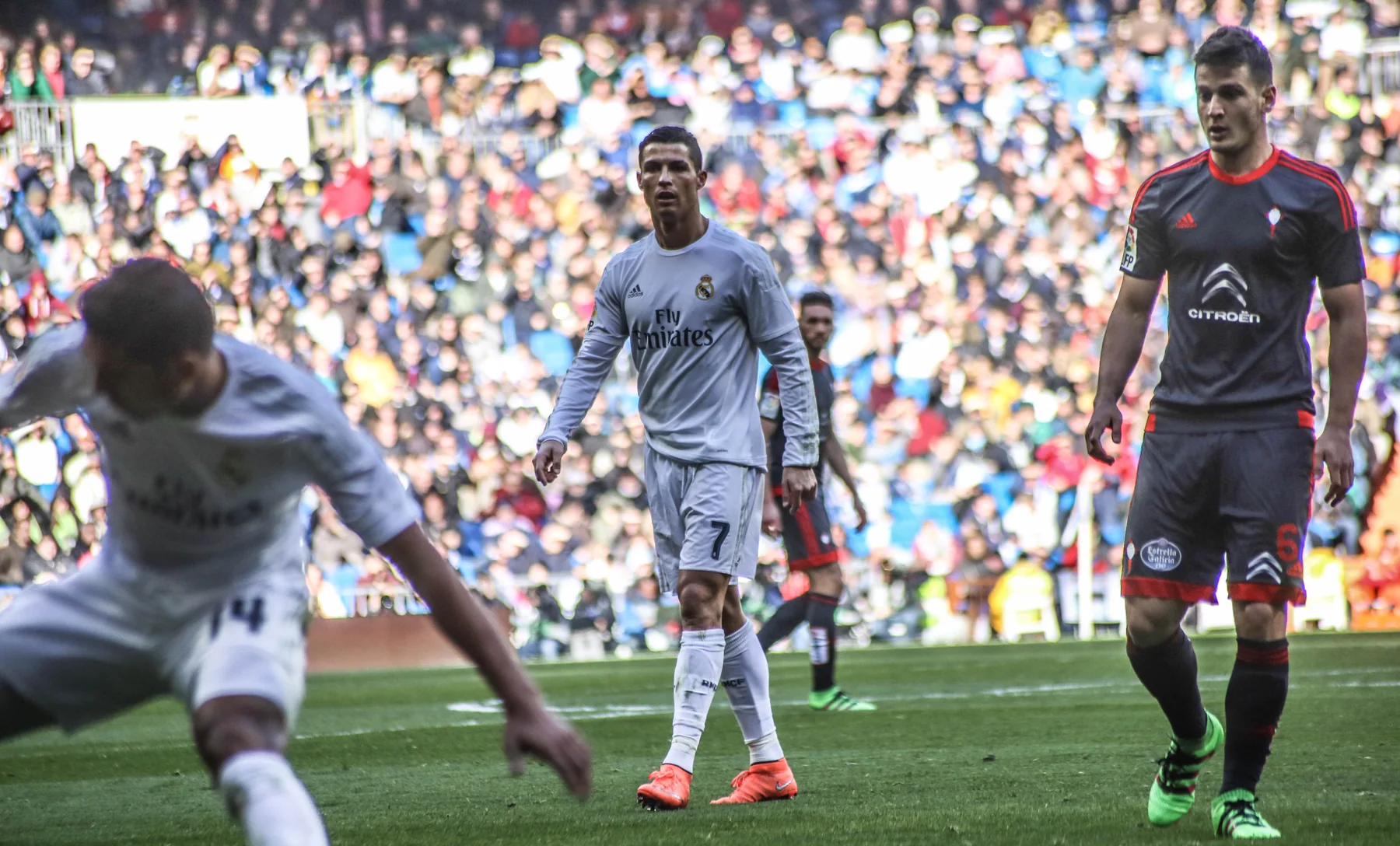
His scoring style also evolved within that block. The early Madrid version could start wide, beat a defender over distance and attack with the ball. As seasons passed, his movement became increasingly ruthless without it. He targeted the blind side of full-backs, attacked the space between centre-back and goalkeeper, timed back-post runs and turned rebounds into an expected part of Madrid’s pressure. Heading, penalties and powerful shots from either side gave him routes to goal against low blocks as well as teams that left space.
The seasonal peaks were absurd even by the Messi-Ronaldo era’s altered standards. Ronaldo scored 40 league goals in 2010/11, 46 in Madrid’s 100-point title season of 2011/12, and 48 in 2014/15. UEFA lists that 48-goal campaign as the league-leading total, while LaLiga’s Golden Shoe report records his 31 goals in 2013/14. A “down” year by his standard could still be a number that wins the scoring title in many other eras.
The team context mattered, of course. Madrid surrounded him with creators, transition runners and forwards willing to rotate or create space. Mesut Özil, Ángel Di María, Karim Benzema, Gareth Bale, Luka Modrić, Toni Kroos and Marcelo contributed different kinds of supply. But a high-volume attack does not automatically create a scorer above one goal per game. Ronaldo’s availability, appetite for repeat sprints and capacity to generate several high-quality attempts each week converted that platform into a historic personal rate.
Fans should therefore read the all-time table in two directions. Total goals reward production plus endurance in one league; goals per appearance reveal how densely that production was packed. Ronaldo does not lead the first measure, but he dominates the second among the ten leaders. His page in Real Madrid’s official legend archive also demonstrates why historical sources can occasionally disagree on one credited goal, a wrinkle covered later rather than hidden. For current club context, our Real Madrid team page connects the historic benchmark to the team chasing goals today.
Telmo Zarra and the pioneers who built the record book
Before Messi and Ronaldo turned weekly scoring into a global broadcast event, Telmo Zarra was the summit. The Athletic Club centre-forward scored 251 La Liga goals during a top-flight career from 1940 to 1955. UEFA says the mark stood for almost six decades, and LaLiga still identifies him as Athletic’s leading league scorer. Holding a major record that long means surviving several generations of tactical change, larger schedules and new challengers.
Zarra’s football belonged to a different visual language. Film is scarcer and less complete, so modern audiences often inherit the number without the player. He was renowned for his heading, anticipation and ability to finish attacks in crowded penalty areas. In 1950/51 he scored 38 league goals, a record Hugo Sánchez only matched four decades later. Cristiano Ronaldo eventually moved the single-season line to 40 in 2010/11, and Messi then took it to 50. That progression is a useful miniature of La Liga history: a benchmark survives, is equalled by a specialist finisher, then is broken during an unprecedented attacking rivalry.
Zarra’s six Pichichi-winning seasons show that 251 was not assembled through quiet accumulation. He repeatedly finished as Spain’s leading league scorer and helped Athletic win the 1942/43 league-and-cup double. His career was interrupted by military service, and the league calendars of his era were shorter than today’s 38-match programme. Those facts do not prove he would score a particular number in modern football; they simply warn against treating his lower total as evidence of a lower peak.
The names immediately below him broaden the story. Hugo Sánchez scored 234 La Liga goals across Atlético Madrid, Real Madrid and Rayo Vallecano. At Madrid, his one-touch finishing and acrobatic volleys became central to the Quinta del Buitre era. Real Madrid records four Pichichi awards during his years in white, and his 38-goal 1989/90 season matched Zarra’s old record. His career total belongs to the league rather than one club, which is why a team-by-team view matters.
Alfredo Di Stéfano’s 227 goals sit beside a much wider influence on Madrid’s play. He did not wait permanently between the posts; he moved toward midfield, accelerated attacks and then arrived to finish them. César Rodríguez, credited with 221 league goals in the standard table, was Barcelona’s league benchmark before Messi and a master of aerial finishing despite not fitting the physical stereotype of a towering centre-forward. Quini’s 219 came for Sporting Gijón and Barcelona, while Pahiño’s 210 were spread among Celta Vigo, Real Madrid and Deportivo La Coruña.
These careers also show why an all-time list should never be reduced to Madrid versus Barcelona. Athletic, Sporting, Celta, Deportivo, Atlético and other clubs helped build the competition’s scoring culture. Zarra remains the clearest symbol: a Bilbao forward whose record survived from 1955 until Messi’s hat-trick against Sevilla in November 2014. Fans can explore Athletic’s modern identity through our Athletic Club team page, but the historical table makes the deeper point. Long before global superstar marketing, La Liga already had scorers whose numbers forced later generations to redefine what was possible.
The active-player chase and the scale of the gap
The active chase looks much less dramatic once the numbers are placed beside Messi’s 474. At the end of the 2025/26 season, Iago Aspas was the leading scorer still set to play in La Liga, with 171 career league goals. Cadena SER reported that 169 of those had come for Celta Vigo, with the other two from his season at Sevilla. He entered 2026/27 for one final playing campaign, so his pursuit is about climbing several historical places rather than reaching the top three.
Aspas’s position is still a major achievement. He has produced elite attacking value for a club that has not generated Madrid- or Barcelona-level possession and chances every year. His 171 places him in the broader company of David Villa, Luis Suárez and other famous finishers, while his importance to Celta extends into creation, leadership and decisive goals in relegation battles. The all-time table rewards that kind of long relationship as surely as it rewards title-winning dominance.
Completed 2025/26 checkpoint
- Iago Aspas
- 171 career goals
- Mikel Oyarzabal
- 100 range
- Kylian Mbappé
- 56 after two seasons
- Gap from 56 to 475
- 419 goals
Mikel Oyarzabal reached the 100-goal neighbourhood by the completed 2025/26 season and scored 15 times in that campaign according to LaLiga’s scorer table. He has time to add substantially, but the distance to even Pahiño at the bottom of the historic top ten remains more than a century of goals. Robert Lewandowski’s Barcelona seasons delivered high totals after he arrived in his thirties, yet age and a later start in Spain make a chase of the career summit unrealistic.
Kylian Mbappé is the more interesting thought experiment. AS recorded 56 league goals across his first two Real Madrid campaigns—31 in 2024/25 and 25 in 2025/26—before the 2026/27 season began. He already had consecutive Pichichi awards and the scoring speed expected of a player who could move rapidly through the modern list. But even from 56, he needed another 419 goals to pass Messi. Thirty league goals every year would require almost 14 more seasons, all in Spain. A transfer, extended injury or gradual positional change would immediately alter the projection.
This distinction helps fans avoid two common mistakes. The active leader is the player with the most accumulated La Liga goals among the current squads. The best theoretical challenger is a younger elite scorer with the rate, role and contract horizon to keep adding. Those descriptions can belong to different people. Aspas carried the first label at the completed-season checkpoint; Mbappé offered the clearest high-rate projection. Neither fact means Messi is under immediate pressure.
Active totals also move every matchday. For that reason, this section uses a clearly dated base—completed 2025/26 numbers—rather than pretending an article is a live scoreboard. Readers can use our La Liga teams directory to reach current club pages and fixtures, then check the live season scorer table for week-to-week changes. The historical lesson will remain stable even as those totals tick upward: reaching 200 La Liga goals makes a forward exceptional, 250 enters the oldest record territory, 311 demands an era-defining rate, and 474 requires a career that almost never leaves the league or the scoresheet.
How to read all-time scorer lists accurately
All-time scorer tables look objective, but older football records are not always perfectly uniform. A ball may take a decisive deflection, match reports may disagree on the scorer, and archives compiled decades later may use different contemporary newspapers. The right response is not to abandon the list. It is to state the counting method, choose a consistent authority and flag meaningful disagreements.
Cristiano Ronaldo provides a clear modern example. The widely used La Liga career total is 311, and that is the figure in this article. Real Madrid’s own legend page credits him with 312 league goals. The difference traces to a September 2010 free kick at Real Sociedad: contemporary reporting notes that the official attribution went to Pepe after the shot deflected off his teammate. A club record can preserve Ronaldo’s claim; the competition record can follow the official scorer. Both numbers have a traceable reason.
Zarra’s total has produced an even longer debate. The Spanish federation’s account of Messi breaking the record identifies Zarra’s mark as 251, and that became LaLiga’s recognised benchmark in 2014. Other club pages, newspapers and historical reconstructions have at various times printed 252 or more. In matches played before comprehensive video archives and standardised digital feeds, disputed own goals and incomplete reports are not surprising. For a league-wide comparison, using 251 consistently is more useful than silently switching totals from player to player.
Five checks before trusting a scoring table
- Competition: confirm the list counts Primera División goals only, not Copa del Rey, Europe, super cups or friendlies.
- Level: do not mix top-flight and Segunda División goals. A player’s “Spanish league” career total may include both.
- Attribution: note whether the source follows the referee and competition record, a club archive or a newspaper.
- Cutoff date: active-player totals need a date or matchday because they can change within hours.
- Denominator: compare goals per appearance only when appearances use the same convention. A two-minute substitute outing still counts as an appearance.
Era comparisons need similar restraint. Older leagues had fewer teams and fewer fixtures, while modern players face denser calendars across several competitions. Earlier football offered different defensive structures but harsher pitches, heavier balls, limited substitutions and far less advanced injury care. Modern attackers benefit from sports science and detailed chance creation but are also analysed with video and tracking data every week. There is no honest multiplier that converts Zarra’s 1951 goals into a guaranteed 2026 total.
The most satisfying way to use the ranking is therefore layered. Start with career goals to answer the main question. Add appearances to reveal efficiency. Read the season peaks to understand dominance, then consider clubs, tactical roles and historical conditions. That approach leaves Messi first, Ronaldo astonishingly efficient and Zarra foundational without forcing unlike careers into one simplistic verdict.
Finally, keep historical records separate from the current table. A team’s position, goals for and goal difference change throughout the season and belong on our La Liga table page. The names here answer a slower, richer question: who accumulated the most goals across an entire life in Spain’s top division? With a clear scope and visible sources, small archival disagreements become part of the history rather than a reason for fans to lose trust in it.
Comments
Sign in with Google to comment. Keep the conversation useful and football-focused. New comments are reviewed before they appear.
Loading comments…