
La Liga 2026/27 Dates at a Glance
The 2026/27 La Liga season began on Saturday, August 15, 2026, and its final matchday is scheduled for Sunday, May 30, 2027. The full set of pairings was drawn in Madrid and released on June 30, so searches asking when the fixtures “will” come out are now out of date. The season is already underway.
Fixture release
June 30, 2026
First kickoff
August 15, 2026
Final matchday
May 30, 2027
Season volume
38 rounds, 380 games
The official announcement described the opening as the weekend of August 14, 15 and 16. That is the matchday window, not evidence that every club played on those three days. Deportivo Alavés against Getafe supplied the first actual kickoff on August 15, while several clubs affected by the World Cup schedule received later opening-round dates. This split is important when comparing tables early in the season: teams may have played different numbers of matches without any fixture being cancelled.
Twenty clubs play every opponent once at home and once away. That produces 38 league matches per club and 380 across the division. Unlike a knockout cup, La Liga does not finish with a separate final; Matchday 38 closes the league calendar. The champion may be confirmed earlier if the points gap becomes mathematically impossible to close.
Full 38-Matchday Calendar
These are the official nominal matchday dates for the 2026/27 season. A Sunday label identifies the round's calendar position; individual games may be assigned to Friday, Saturday, Sunday or Monday around it, and the two midweek rounds spread across weekdays. Opening-round exceptions are covered separately.
| Phase | Matchday dates |
|---|---|
| August | MD1 — Aug 16; MD2 — Aug 23; MD3 — Aug 30 |
| September | MD4 — Sep 6; MD5 — Sep 13; MD6 — Sep 16; MD7 — Sep 20 |
| October | MD8 — Oct 11; MD9 — Oct 18; MD10 — Oct 25 |
| November | MD11 — Nov 1; MD12 — Nov 8; MD13 — Nov 22; MD14 — Nov 29 |
| December | MD15 — Dec 6; MD16 — Dec 13; MD17 — Dec 20 |
| January | MD18 — Jan 3; MD19 — Jan 10; MD20 — Jan 17; MD21 — Jan 24; MD22 — Jan 31 |
| February | MD23 — Feb 7; MD24 — Feb 14; MD25 — Feb 21; MD26 — Feb 28 |
| March | MD27 — Mar 7; MD28 — Mar 14; MD29 — Mar 21 |
| April | MD30 — Apr 4; MD31 — Apr 11; MD32 — Apr 18; MD33 — Apr 21 |
| May | MD34 — May 2; MD35 — May 9; MD36 — May 16; MD37 — May 23; MD38 — May 30 |
The rhythm is not uniform. Matchday 6 arrives in midweek immediately after the September 13 round, creating the first three-game sequence for many clubs. Matchday 33 does the same in April, between rounds on April 18 and May 2. Those stretches are where European commitments, recovery time and squad depth can turn a straightforward-looking league fixture into a more difficult tactical assignment.
Three longer gaps align with senior international periods: after Matchday 7 before the October 11 return, after Matchday 12 before November 22, and after Matchday 29 before April 4. The winter pause follows the December 20 round, with league play resuming around January 3. Cup and European fixtures occupy parts of the same season, so an empty league weekend does not always mean players are resting.
For today's confirmed card rather than the season skeleton, open La Liga matches by date. It reflects the latest assignments, whereas this table is deliberately optimized for long-range planning.
Why Matchday 1 Was Split Across August
Matchday 1 was unusual: it lasted nearly two weeks. Most of the opening games were played from August 15 to 17, Atlético Madrid hosted Málaga on August 19, and the remaining fixtures extended through August 27. This was a planned split, not a sign that the league had lost or cancelled matches.
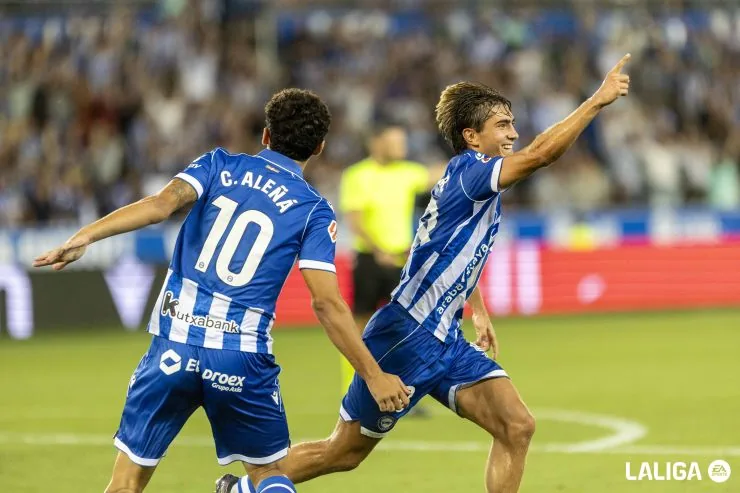
The cause was the 2026 World Cup. Clubs with players who had reached the tournament's final stages needed an adequate recovery and preseason period before domestic competition. LALIGA's approved split-round model created room for affected squads rather than delaying the entire division. The later group included Valencia against Real Betis, Real Madrid against Real Sociedad and Barcelona against Athletic Club; Atlético–Málaga was also moved beyond the core weekend.
| Opening phase | Fixtures |
|---|---|
| Aug 15–17 | Alavés–Getafe; Sevilla–Rayo; Racing–Villarreal; Espanyol–Levante; Celta–Osasuna; Deportivo–Elche |
| Aug 19 | Atlético Madrid–Málaga |
| Aug 25–27 | Valencia–Real Betis; Real Madrid–Real Sociedad; Barcelona–Athletic Club |
For supporters, the practical effect was an uneven early table. A club with one match played could sit above a team that had not yet opened its season, while another had already moved toward Matchday 2. Points-per-game comparisons were more informative than raw position until the delayed fixtures were completed. It was also possible for a club's second scheduled round to appear close to its first, changing recovery and lineup decisions.
The episode is the best warning against booking from the June draw alone. Pairings may be official while the exact day remains provisional, and exceptional events can move a game after the broad calendar is published. The official results area explicitly advises regular checks. Use the site's completed La Liga results to separate matches already played from those still awaiting kickoff.
El Clásico and Other Fixtures to Circle
The two league Clásicos are the obvious anchors. Barcelona is scheduled to host Real Madrid in Matchday 10, on the October 24–25 weekend, and Real Madrid hosts the return in Matchday 35, on May 8–9. The calendar uses October 25 and May 9 as the nominal round dates. Those are useful planning markers, but they should not be treated as confirmed kickoff appointments until LALIGA publishes the detailed schedule.
El Clásico
Barcelona vs Real Madrid
Matchday 10 · October 24–25, 2026
El Clásico
Real Madrid vs Barcelona
Matchday 35 · May 8–9, 2027
Madrid derby
Atlético Madrid vs Real Madrid
Matchday 7 · September 19–20, 2026
Madrid derby
Real Madrid vs Atlético Madrid
Matchday 30 · April 3–4, 2027
The placement matters as much as the names. The first Madrid derby arrives before the October international break, while the return begins the final nine-round run. The second Clásico sits in Matchday 35, with only three league games remaining afterward. If the championship is close, that late meeting can change both the points gap and the head-to-head picture. If it is not, demand will still make it one of the hardest tickets of the season.
A major regional rivalry also returns. Celta Vigo welcomes Deportivo La Coruña at Balaídos around January 3 in Matchday 18; Deportivo hosts the reverse at Riazor around April 18 in Matchday 32. The Galician derby is back in the top flight after eight seasons away, giving those dates significance beyond the table. Promoted Deportivo's presence also changes the travel map for supporters in north-west Spain.
La Liga uses an asymmetric calendar, so the second half does not simply replay the opening 19 rounds in order. That is why the Clásicos fall in rounds 10 and 35, while the Madrid derbies land in rounds 7 and 30. Fans following one club should check its complete sequence rather than assume the return fixture arrives exactly 19 rounds later. The La Liga teams directory is the quickest route to club context before comparing fixture runs.
Confirmed Kickoff Times Versus Placeholder Dates
A fixture can be official without its kickoff being final. The June draw confirms who plays whom, the home team and the matchday. A nominal date such as “Sunday, October 25” then identifies the round's position in the calendar. Only the detailed scheduling announcement places an individual game into a specific day and time.
| What you see | What it means | Safe action |
|---|---|---|
| Matchday and pairing | Opponents and venue are drawn, but the slot may be open. | Save the weekend; use flexible bookings. |
| Day and kickoff published | LALIGA has assigned the broadcast slot. | Set a reminder and verify the displayed timezone. |
| Club and ticket channel confirm | The same details appear in the sales or supporter notice. | Make firmer plans, while retaining change protection where possible. |
Why the delay? Ten games need to be distributed around television windows, stadium operations, policing and supporter logistics. Clubs involved in UEFA or domestic cup competition may have additional recovery constraints. Those variables are not all settled when the season framework is drawn. Staggered scheduling also lets viewers watch more matches without simultaneous kickoffs.
“Confirmed” does not mean legally immovable. LALIGA's own results pages warn that matches may be modified and advise regular checks through official league and ticket-sales channels. Exceptional weather, safety problems, force majeure or a clash created by another competition can still lead to a later change. The opening round already demonstrated how player-rest requirements can reshape a published window.
Timezone is a separate trap. A league page served for Spain may show Spanish local time, while an international or broadcaster page can present a converted time. Spain also changes between Central European Time and Central European Summer Time during the season. Before sharing a kickoff, record the date, time and timezone together; for example, “21:00 in Madrid” is much safer than “9 p.m.” by itself.
How to Follow, Print and Plan the Schedule
The most reliable approach is to use two versions of the schedule rather than force one document to do every job. Keep the RFEF or official full calendar as the season map: it is ideal for seeing all pairings, home and away order, international gaps and the 38-round structure. Then use a live fixture page for exact days, kickoffs, results and late changes.
- 1. Mark the broad windows. Add the 38 nominal dates and the major fixtures from this guide to a planning calendar.
- 2. Recheck before spending. When LALIGA assigns the individual kickoff, compare it with the host club's fixture or ticket page.
- 3. Confirm local viewing. Broadcaster rights differ by country, and channel assignments can vary by match.
- 4. Check again near matchday. Review the fixture shortly before departure or broadcast, especially when cups, UEFA games or severe weather are relevant.
A printable schedule or PDF is valuable because it gives a stable overview and works offline. Its weakness is equally clear: paper cannot update itself. Write “nominal date” beside unconfirmed rounds, leave room for the final kickoff, and record the date on which you last checked it. If a PDF and the live league listing disagree, the current league and club channels take priority.
Build a schedule that shows what changed
A useful personal spreadsheet needs more than two columns for teams. Record the matchday, home club, away club, nominal round date, confirmed kickoff, source timezone, your local conversion and the date checked. Add separate fields for ticket status, broadcaster and final score. This prevents a later time update from erasing the original round context and makes it obvious which cells still say “TBC.”
Update by round, not only by favorite club. Moving one game can affect travel choices for supporters trying to see two matches in the same city, and a television assignment may shift several fixtures across the same weekend. When a new schedule notice appears, compare all ten games against the previous version. Highlight the changed cells, keep the source URL, and remove reminders tied to the old kickoff before creating new ones.
Calendar apps introduce another subtle risk: a bare time can be interpreted in the device's current zone. Store “Europe/Madrid” as the event timezone, then let the app convert it for travel or viewing. If you are flying to Spain, the event should automatically display Spanish local time after arrival. Also retain the competition name—“La Liga,” not simply “football”—so league fixtures are not confused with Copa del Rey, the Spanish Super Cup or UEFA matches involving the same clubs.
Fans planning an in-person match should work backward from risk. At the draw stage, shortlist several games in the same region. At detailed-schedule stage, choose refundable travel. After the host club opens the appropriate ticket sale and repeats the fixture details, complete the purchase through an authorized channel. A reseller's date alone is not better evidence than the competition organizer or host club.
Viewers need one more layer: media rights. LALIGA maintains a country search for official broadcasters, while kickoff listings depend on territory and may display a local conversion. Our where-to-watch La Liga guide explains the legal viewing options; the daily La Liga schedule is the faster check when matchday arrives.
Has the 2026/27 La Liga schedule been released?
Yes. The complete pairing calendar was released on June 30, 2026. Later rounds still need individual kickoff assignments.
When does the 2026/27 season end?
Matchday 38 is scheduled for May 30, 2027. There is no separate La Liga final after it.
Can I rely on a La Liga schedule PDF for kickoff times?
Use it for pairings and round dates, then verify exact kickoffs live. A static file may not include later television selections or fixture changes.
Last reviewed: August 27, 2026. This guide will age more gracefully because it separates fixed season structure from details that remain changeable.
Comments
Sign in with Google to comment. Keep the conversation useful and football-focused. New comments are reviewed before they appear.
Loading comments…